Football shirt: the World Cup fetish and the reality show of the male body
From the terraces to fashion, the football shirt is the fetish of a libidinal economy worth 87.5 billion dollars, turning the World Cup into a reality show of the male body watched and consumed
A sweaty football shirt and a pair of Megan Fox’s worn heels are the same thing
Footballers exist for our voyeuristic pleasure, argues Simon Doonan, author of Soccer Style: The Magic and Madness; in their strange, meteoric footballing lives we are meant to see all our hopes and fantasies distilled and amplified, bursting and collapsing. The magical thinking around jerseys made of flammable polyester has reached as far as the menswear block of SoHo, New York. Here, at 323 Canal Street, sits Classic Football Shirts — a symbolic presence on the axis of New York luxury, proof that a pink 1991 vintage Palermo FC shirt can equal a Lady Dior. Long before the Maisons learned to sell five-hundred-euro sneakers and nine-hundred-euro grey sweatshirts, those jerseys in glossy plastic, cut to the silhouette of a square, held a value beyond the game itself. Part of the interior design of fans’ rooms and sports bars, they were worn to stand for a city or a country. Ideally, by the final whistle they were stained with the alcohol uncorked in victory. Even so, they belonged to another world: too sweaty, too working-class. A fetish of belonging rather than of taste. Until that changed.
In 2026 the original shirts, made mostly by Puma, Nike and Adidas, cost between eighty and two hundred euros. In 2024 the global football-shirt market was valued at 87.5 billion dollars; estimates suggest it could approach 140 billion by 2034. Sportswear became casualwear, until a specific term was coined for those who wear football jerseys as ready-to-wear: blokecore. In British slang the bloke is the lad, the everyday guy. The graphic designs now carry Stella McCartney, Balenciaga and Armani where accountancy firms and betting brands once sat as sponsors. A 1974 Lazio shirt can cost more than two hundred euros; one worn during a match, ideally stained with soil and sweat, more than a thousand. Why we speak of fetish is clear: for a football fetishist it is the equivalent of a pair of Megan Fox’s worn heels for someone else.
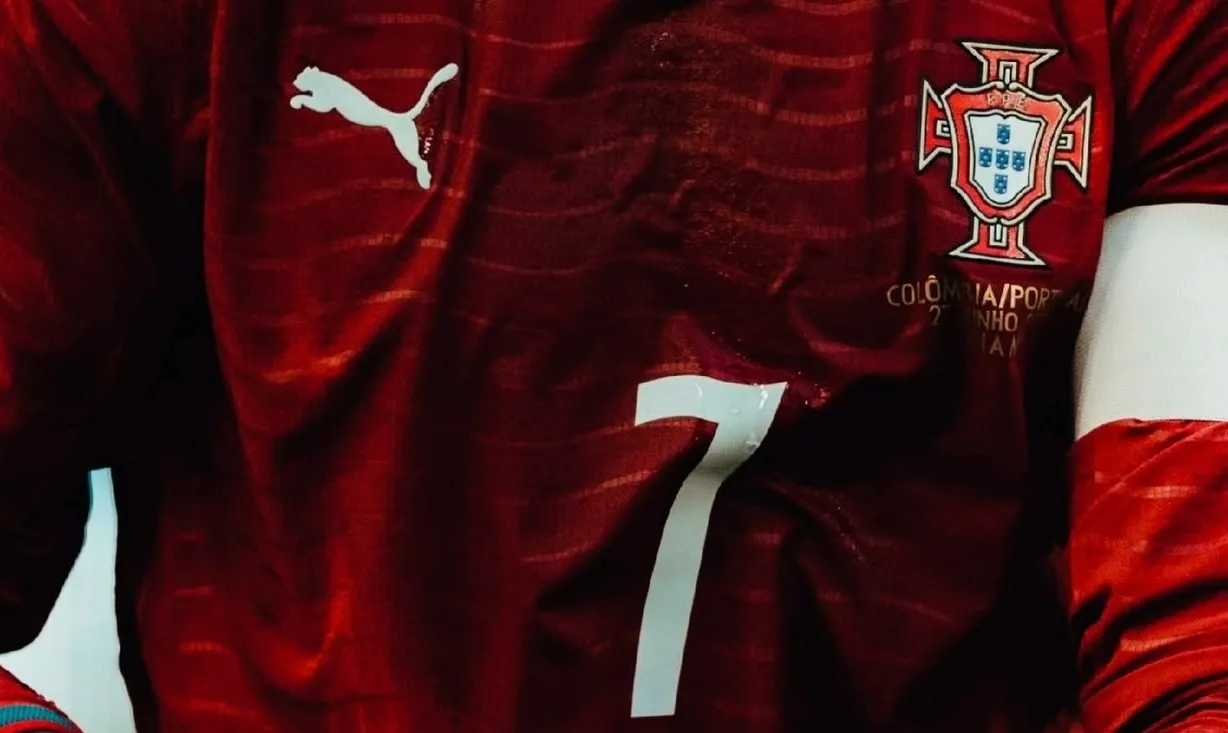
Football is an affective economy. Its fetishes are jerseys in flammable polyester and bodies in advertising
Football, and the World Cup in particular, is a form of collective voyeurism: an emotional narrative that feeds the audience’s identification, fed in turn by one of the rare occasions when men are allowed to weep, writhe on the ground, put on a scene and make one. As said, it is a reality show. The shirts carry identity, nostalgia and affection. Their mass diffusion follows the logic and materials of global merchandising: in polyester or cotton blend, they are highly flammable. Few works truly explore the theme of easy combustion. Many, instead, certify its geopolitical value: at the World Cup the shirt becomes an instrument of state legitimation that, in a hyperconnected world, feeds on clips, framings, zooms, behind-the-scenes footage, commentary and the spectacle of joys and sorrows. Those sorrows are usually burned on the pyre of football shirts, whose flammability comes in handy — as in 2021, when Milan fans publicly burned the jerseys of the traitor goalkeeper Donnarumma after his move to Paris Saint-Germain. A rite of social expulsion.
In an affective economy like football, the fetishes are the shirts and also the bodies that wear them. It is one of the cases where we speak of hunkvertising: advertising that exalts the physique of virile men as objects of desire. A gendered event, centred on the male body, and shaped by an extreme aesthetic culture. The sports-nutrition consultant Nessan Costello has spoken more than once of a culture of fear fed by weekly checks of body-fat percentages. In many cases the players take no part in the decisions about their own bodies: the club sets the numbers, and they must meet them through iron dietary control. A long-standing prejudice — that eating problems are a female preserve — has left studies of body-image disorders in football rare and often ignored.
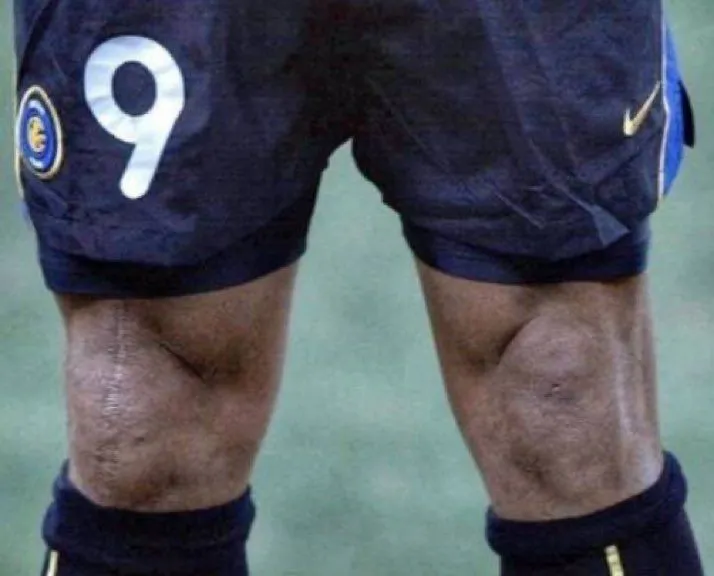
Football-entertainment: the origin of a global reality show of the branded male body, watched and consumed
When Robbie Williams — the golden boy of pop, the footie fanatic and redeemed rebel — performed at the opening of the 2018 World Cup in a glossy crimson, leopard-spotted Givenchy suit, an unbuttoned black shirt and a heavy silver chain, it felt fitting. That tiger-king, tacky-glam look, part psychedelic and part brazen, matched the quadrennial assembly of the ambassadors of flammable polyester. The World Cup is about sport, and about far more than sport. The clearest proof is the biography of David Beckham, the former England midfielder whose two episodes are always cited. The first is his sending-off at the 1998 World Cup in France, when Beckham caught the Argentine Diego Simeone on the calf. The second is when, a few weeks earlier, he turned up to an official dinner in a sarong. Today Djibril Cissé’s pleated leather skirt or Roberto Firmino’s gold-plated tie pass without a second glance: partly thanks to Beckham, the canary in the mine of football’s reality show, and partly to George Best.
The patron saint of football fashion, Best injected glamour into a system until then a stranger to the pleasures of style. Until 1961 English football wages were capped at twelve pounds a week. That year the Football League abolished the maximum wage, and salaries rose steeply. The new incomes were the primordial mud from which the stylish players would emerge: polished tracksuits, heavy jewellery, tigerish tattoos. Football thus became a sport for a global, strident audience, Sex and the City style. The sporting equivalent of what the journalist Diana Vreeland called the youthquake, George Best was to football what the Beatles were to music and Mary Quant to fashion: a rebel jolt, like micro skirts with severed hems. Best turned football into entertainment — a global reality show of the branded male body, watched and consumed.
Football clubs are brands with creative directors devoted to consumption
A man of the street, anti-establishment by definition, at twenty-three Best had an enviable sporting career, two nightclubs, three boutiques, a weekly column in a sports magazine and a string of modelling contracts. His teammate Jimmy Greaves held that if a player better than George Best ever existed, he never knew him. Best moved across the pitch as if the ball were tied to his feet. He was the beautiful-and-damned figure who anticipated the Nineties, when the rise of the supermodels and the Victoria’s Secret Angels — Tyra Banks, Gisele Bündchen and Heidi Klum — was matched by Arsenal’s Freddie Ljungberg in Calvin Klein underwear and David Beckham in Armani.
European football keeps restrictive rules on fashion: at every stage of the match only the club’s official kit may be worn. The arrival fits, though — the looks worn on arriving at training — hold more room to manoeuvre. Liverpool’s Marcus Thuram wears Balenciaga or Chrome Hearts. Jules Koundé mixes archive pieces with haute couture. Jude Bellingham wears only Louis Vuitton, of which he is Ambassador. In the summer of 2023 the British club Crystal Palace became the first Premier League side to hire a creative director. The role went to the sports-marketing professional Kenny Annan-Jonathan, tasked with overseeing the club-brand’s logo apparel collections along with outside partnerships. Annan-Jonathan — the first, he says, to pull on a pair of jeans in a neighbourhood of grey tracksuits — wants to move beyond acrylic T-shirt merchandising bearing the team and sponsor logos. He wants to make lookbooks.
Venezia FC has been called the most fashionable club in the world by GQ, regularly staging photo shoots better suited to glossy magazines than grass pitches. In October 2024 Como 1907 also hired a creative director — Rhuigi Villaseñor, founder of the brand Rhude — to make the team a global powerhouse beyond sport, one shaping fashion, hospitality and consumer goods. One more slogan untroubled by placing consumption at the heart of its ideology. Is it really needed?
Stella Manferdini