Teatro dei Sogni traces a line from Venice to Lake Como
A Venetian pattern dated 1780 becomes Teatro dei Sogni, the fine bone china service developed by Geminiano Cozzi for Passalacqua on Lake Como
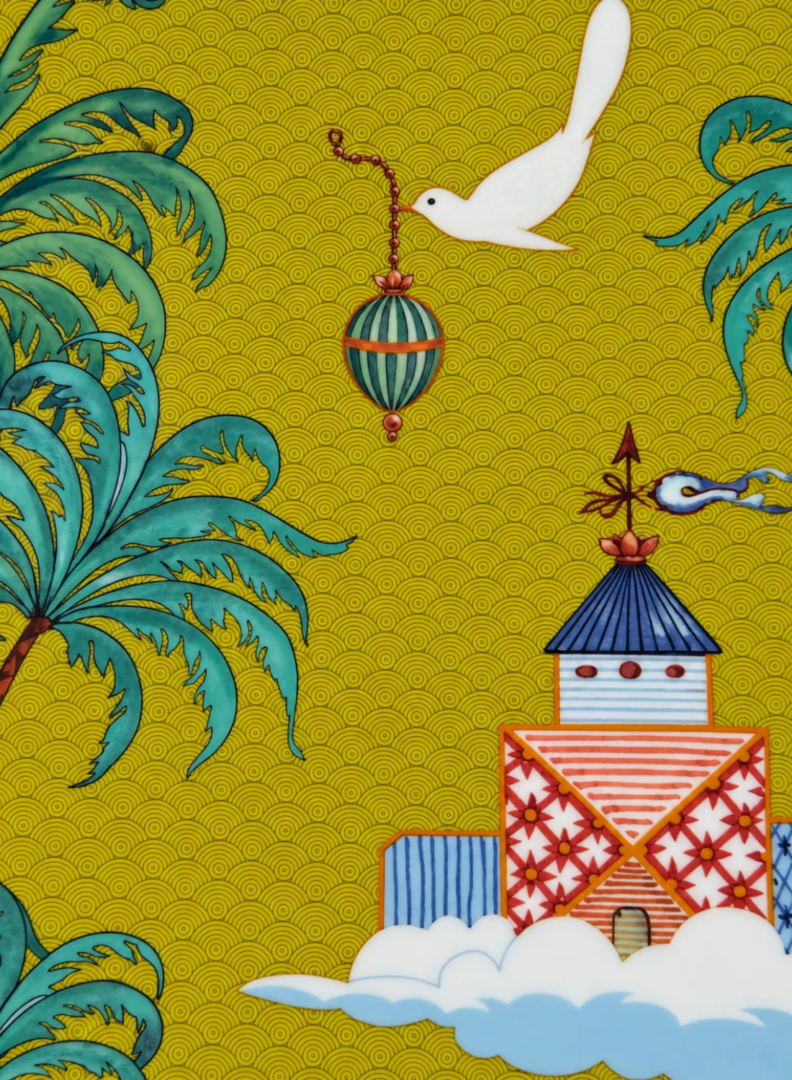
At Passalacqua, a table is laid with Teatro dei Sogni, a service by Geminiano Cozzi Venezia 1765. Palms, a building in the Chinese taste, a white bird holding in its beak a little chain with an egg tied to it. The drawing comes from an eighteenth-century Venetian porcelain; the material is fine bone china, developed in England at the end of the eighteenth century.
The service was developed for the house. Paolo and Antonella De Santis, collectors of contemporary art and owners of the property, who with their daughter Valentina De Santis brought Passalacqua back into hospitality, saw the drawings and the samples as the collection was taking shape, and had a hand in choosing the name.
Teatro dei Sogni: from a Ca’ Rezzonico vase to Aldo Rossi’s Teatro del Mondo
The pattern comes from an eighteenth-century Cozzi potiche held at Ca’ Rezzonico, the museum of eighteenth-century Venice, and from a drawing dated 1780: a small building in the Chinese taste ringed by palms. The motif became a line that brings colour into the range, recomposed for flat and soup plates, trays and serving pieces, each with its own relation to the rim and to the space the food leaves bare.
The name went through three stages. At first it was to be Le Palme, the palms. When Antonio Tognana, chief executive of Geminiano Cozzi Venezia 1765, showed the collection to the De Santises, Mr. De Santis proposed Ca’ dei Sogni — ca’ is the Venetian word for house, here the building in the design. The final title came when Mr. Tognana recognised in that architecture the proportions of the Teatro del Mondo, the floating theatre the architect Aldo Rossi built for the 1980 Venice Biennale.
The egg hanging from the bird’s beak carries the stripes of Striche Verdi, the green stripes the company treats as its historic signature and links to the painter Piero della Francesca.
Five Cozzi services at Passalacqua: Venezia 1600, Striche e Oro, Incanto di Primavera
Teatro dei Sogni is the most recent of five Cozzi lines in use in the house, each tied to a room and a time of day.
Incanto di Primavera, spring enchantment, carries breakfast, with leaves and flowers crossed by small birds and butterflies, on a white or pale blue ground. Cucina italiana, from the same Atelier line, is used for the cooking classes.
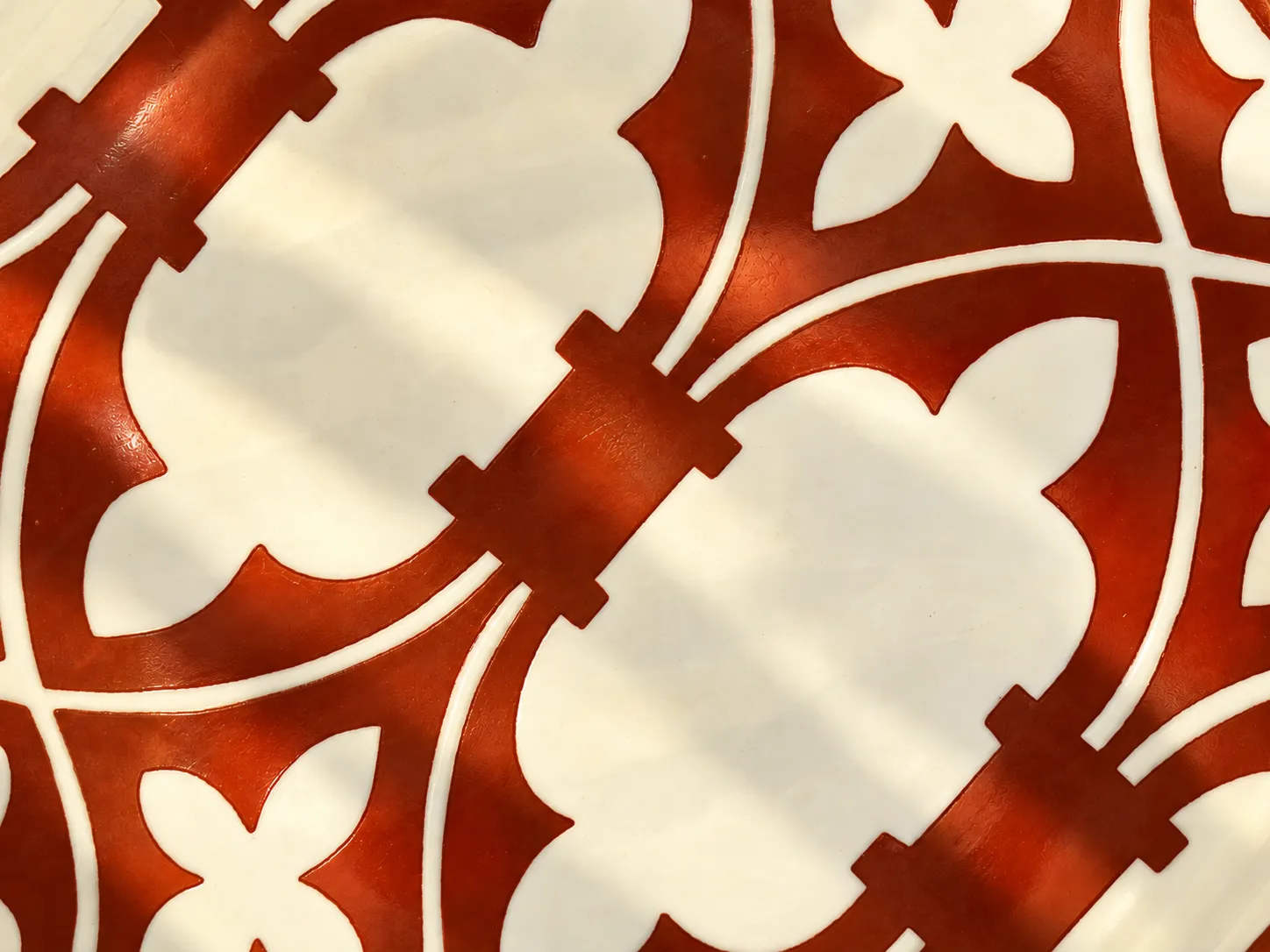
In the restaurant the table is laid with Venezia 1600, a collection made for the 1600th anniversary of the founding of Venice and drawn from two buildings, the Ca’ d’Oro and the Palazzo Ducale: architectural profiles, balconies and friezes redrawn in the iron red that runs through the historic Cozzi catalogue.
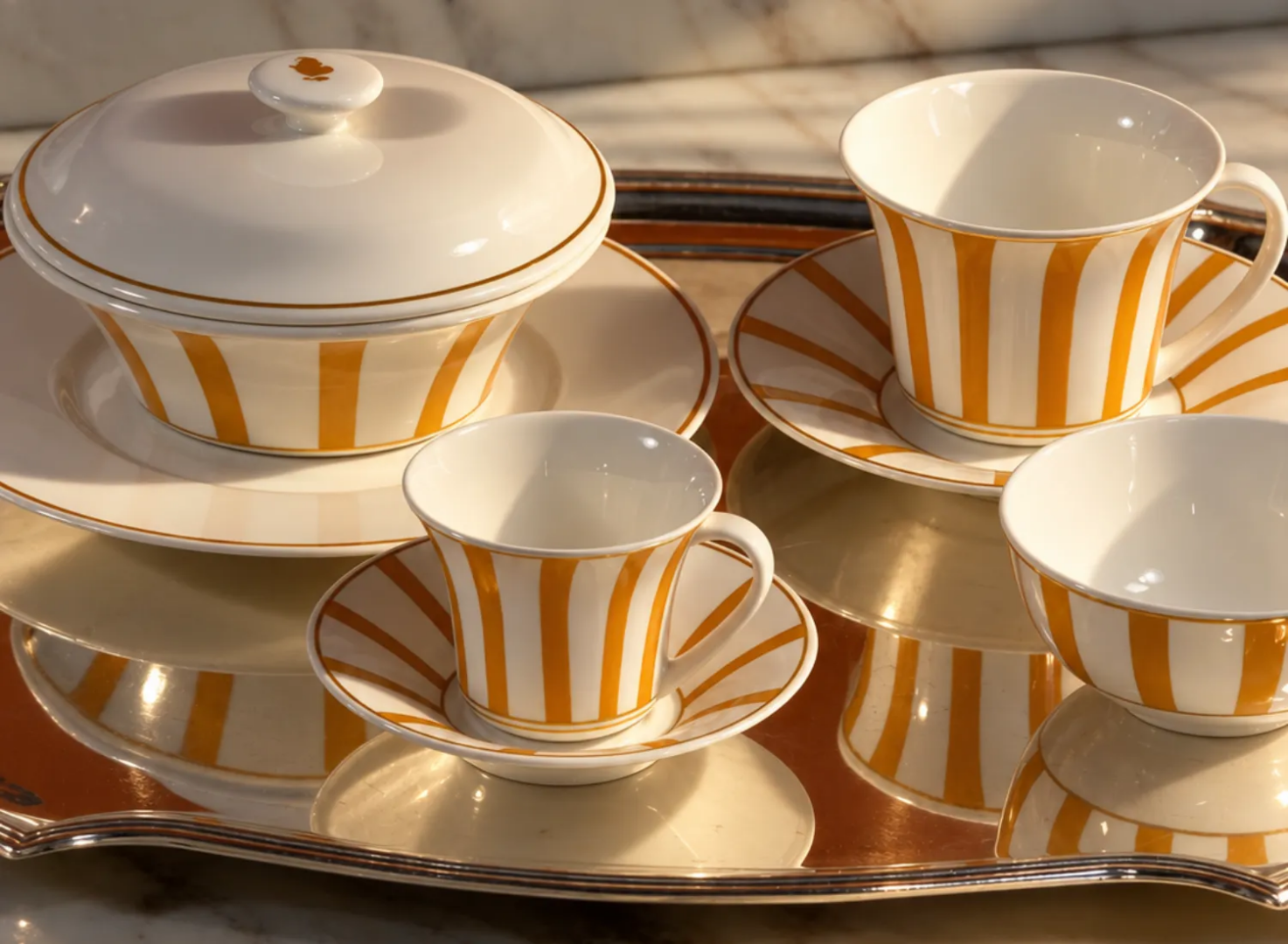
Striche e Oro, stripes and gold, the company’s emblem collection, appears in an ochre version made for Passalacqua, with gold lines in the smaller rooms.
“Tradition is alive when it can speak to the present. With Passalacqua we share an idea of beauty: history, craft and hospitality put together to make experiences that are Italian in a real sense,” says Mr. Tognana.
Chinesi Fiori Finiti and Striche Verdi: the historic patterns at Ca’ Riflesso
In September 2026, as part of Homo Faber in Città, the citywide programme around Venice’s Homo Faber craft event, the porcelain was shown at Ca’ Riflesso, a project in which the online marketplace Artemest gathered more than 50 Italian artisans inside Casa Sanlorenzo, in the Dorsoduro district, dressed as the home of an imaginary collector; it closed on 30 September. The 1940s building was restored by the studio of the architect Piero Lissoni.
Two other lines were on show. Chinesi Fiori Finiti, finished Chinese flowers in the language of the period catalogue, takes up floral compositions in red-orange, blue and gold with carp, a repertoire retailers tie to a factory inventory of 1785; studies by the ceramics historian Francesco Stazzi point to a Cozzi vase decorated in the Imari style as a possible source. Imari names the Japanese ceramic tradition of the Arita area, exported to Europe in the seventeenth and eighteenth centuries and absorbed by local manufactories.
Striche Verdi, which the company dates to 1765, reduces the design to radial stripes that follow the shape of the vessel, with gold rims and touches. A stripe running from the centre to the rim changes orientation on the curved surface, and the smallest misalignment stays visible.
The San Giobbe factory in Venice: privileges, kaolin from Tretto, 45 workers
Geminiano Francesco Antonio Cozzi, the manufactory’s founder, was born in Modena on 7 February 1728 and moved to Venice around 1754 with his siblings Domenica and Vincenzo; the company dates his arrival to 1751. He went into partnership with a Saxon couple, Nathaniel Friedrich and Maria Dorothea Hewelcke, who ran a porcelain works; the venture closed in August 1763, and Mr. Cozzi started production on his own at San Giobbe, in the Cannaregio district of Venice.
On 21 August 1765 the Venetian Senate granted the factory privileges and subsidies. The plant was already running before that date. One of the arguments with which he won the Republic’s backing was the use of local raw materials instead of imported ones: kaolin from Tretto, in the hills above Vicenza.
Porcelain was one business among several. Cozzi also grew coral, made crucibles for the Mint and supplied timber for the hulls of the Venetian navy; by the company’s account he was the first Italian entrepreneur to issue bonds to finance his own activity. Popular accounts cast him as a financier, and his entry in the Treccani, Italy’s standard biographical encyclopedia, notes that an earlier banking career has no documentary support; what the sources show is his ability to organise capital, supplies, production and distribution.
Venice already knew the trade. In the 1720s the merchant Francesco Vezzi had founded one of Europe’s first hard-paste porcelain works, active until 1727, and the Hewelckes’ venture predated Cozzi’s. The city counted three porcelain manufactories in the eighteenth century.
He also had to find the skills. Mr. Cozzi brought painters and decorators to Venice from the manufactory at Nove, near Bassano del Grappa; in 1765 Pasquale Antonibon, who ran that manufactory, took legal action against the former employees who had crossed to his competitor. By 1767 the factory had 4 kilns and employed 45 workers and 6 apprentices; a 1768 source counts 83 heads of household who had become masters. In 1767, about a third of the output went to Trieste and the Levant, another third to the Po Valley.
The catalogue widened to maiolica in 1769 and to English-style earthenware in 1781, with dinner services, pieces for coffee, tea and chocolate, vases, apothecary sets and small sculptures. The clientele went beyond the aristocracy: records document supplies to coffee houses, convents, government offices and the middle class. The decorative repertoire mixed Chinese-derived figures, flowers, butterflies, garlands, landscapes and heraldic emblems, in iron red, green, blue, purple and gold. The mark is an anchor, almost always painted in red.
In 1778 the business was reorganised with the entry of his brother Vincenzo and the financier Bonaventura Marinoni; in 1784 the partnership dissolved; in 1791 Geminiano handed the company to Vincenzo, and he died between August 1797 and May 1798. The last documented news of the manufactory is from 1799, while the company and one tradition place the closure in 1812. His widow, Antonia Caterina Sauli, carried the knowledge of porcelain making to Doccia, the Tuscan works near Florence later known as Richard Ginori.
Antonio Tognana and Tamara Mascarello: the brand revived from 2015
The new chapter began in 2015. Mr. Tognana had bought the brand decades earlier and kept it apart from Tognana tableware, aimed at different markets. He is the fifth generation of a family that began making bricks in Treviso in 1770; his father Aldo founded Tognana Porcellane in 1946. He runs the revival with his wife, the interior designer Tamara Mascarello, who works on the creative side and on the tailor-made projects for hotels, private clients and luxury brands. The range is organised in four families: Bianco Puro, the white ware; Classici, the reproductions of historic forms and patterns; Atelier, the contemporary decorations; and Art Collection, limited editions made with artists.
No unbroken production line runs from San Giobbe to today: there is a reclaimed name, historic documentation used as reference, forms and drawings revived, and a supply chain built now. The brand reaches the market through Pve, which also produces and distributes Manifattura di Venezia; by Mr. Tognana’s account, the group closed 2025 at around 4 million euros in revenue, with exports near 25 percent.
Much of the distribution runs through hospitality. A restaurant plate is stacked, moved and washed again and again, seen from different distances and under different light, and for much of the time it stays covered by food.
Lake Como came first. Between 2016 and 2017 the Tognanas met the De Santis family, and the porcelain entered the Grand Hotel Tremezzo: the Striche were dyed orange, the hotel’s colour, against its upholstery. Carte da Zogo, playing cards in Venetian, followed in another of the group’s outlets, then Feston e Cadena, festoon and chain, and the Chinesi Fiori Finiti chosen for Villa Sola Cabiati. Passalacqua came after that. The hotel placed fifth in The World’s 50 Best Hotels 2026 and took the titles of Best Hotel in Europe and Best Boutique Hotel.
Hard-paste porcelain and bone china: what changes in the body
Cozzi’s eighteenth-century porcelain was hard-paste: kaolin, feldspar and quartz, fired at high temperature, forming a glassy phase and mullite crystals. The proportions of the San Giobbe recipe cannot be read off a reference formula; that would take analysis of old pieces or factory documents.
Fine bone china belongs to the phosphatic porcelains. Calcined bone ash adds calcium and phosphorus, and firing normally yields anorthite, tricalcium phosphate and a glassy phase. A traditional recipe runs to about 50 percent bone ash, 25 percent kaolin clay and 25 percent feldspathic flux; at Passalacqua, Mr. Tognana says the brand’s body contains 48 percent calcined cattle bone. Calcination removes the organic part: what goes into the plate is a mineral powder rich in calcium phosphates.
The company states that its bone china is 25 to 30 percent lighter than traditional porcelain and at least 30 percent more resistant to chipping at the rim, and attributes that resistance to the elasticity the bone ash gives the body. In a vitrified ceramic, resistance to chipping comes from the microstructure, the thickness and the geometry of the piece. The bone ash is also material recovered from another supply chain, which the company presents as the environmental argument for the material.
The property that makes this body the choice for high-end services is translucency, distinct from whiteness: held to the light, light passes through the thin walls, while an object can be white and stay opaque. It depends on residual porosity, the glassy phase and the distribution of the crystals.
The English name points to a British technology. The Victoria and Albert Museum in London records bone-ash experiments at the Bow manufactory in the 1740s, and the Spode Museum Trust dates to 1796 the porcelain the potter Josiah Spode introduced as Stoke China, later known as bone china. The same green, the same blue rim, the same gilding behave differently on a body that transmits light differently.
On the production side, the trade names say little. In underglaze the colour goes beneath the clear coating, in overglaze above it, with a second firing; a transfer carries a design prepared elsewhere, sometimes laid by hand, while hand-painting builds the mark on the surface. Gilding varies by composition, metal content and fixing temperature. Calcination, powder preparation, forming, drying and firing all consume energy.
Casabianca: the De Santis contemporary art collection on Lake Como
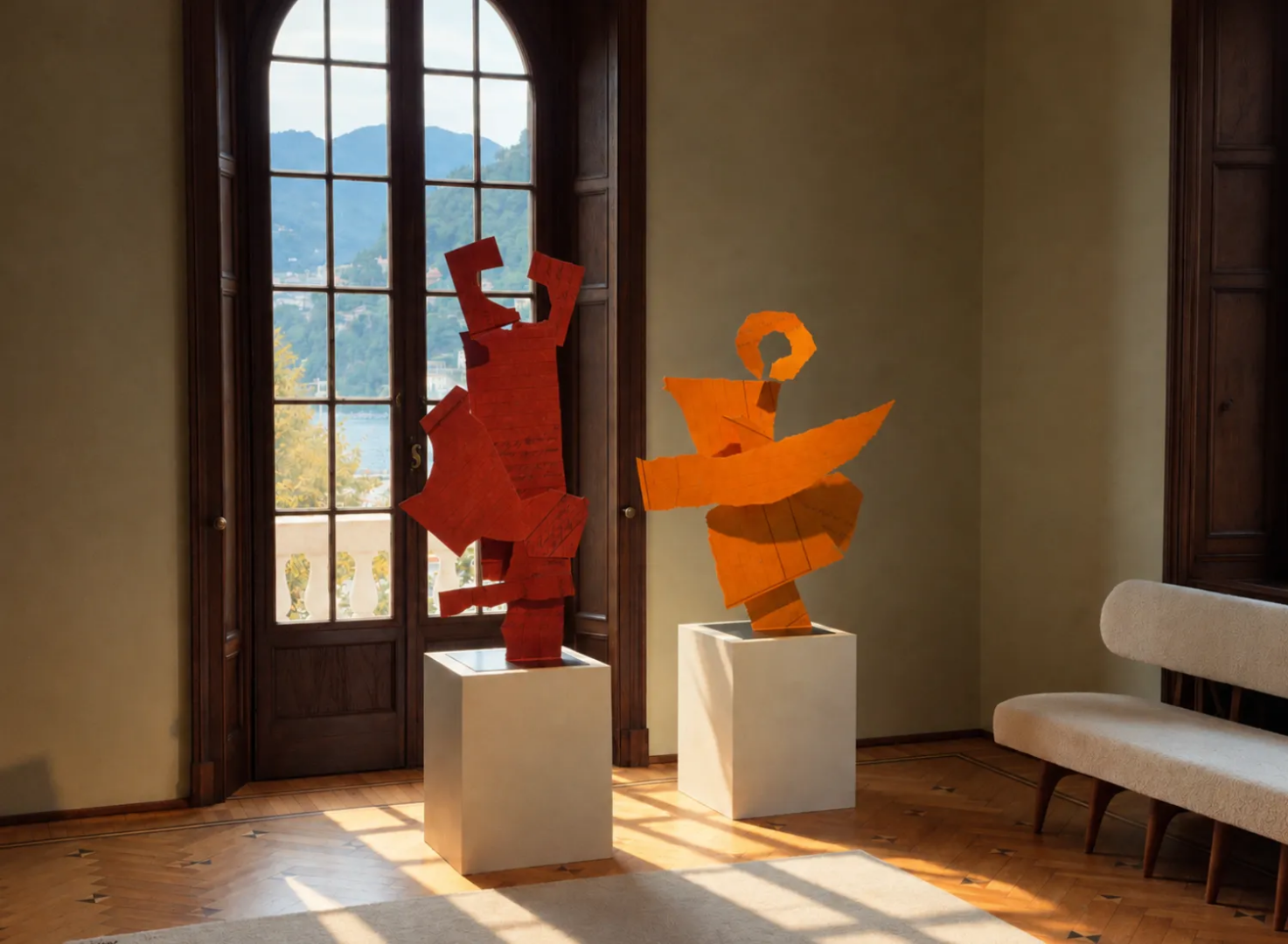
The second stop is Casabianca. The De Santises bought the villa in 2024 for part of the contemporary art collection they began in the early 1980s and had kept until then in their home, Villa Mondolfo. The building dates to 1930, designed by the architect Piero Ponci for the Rosasco family, Como textile industrialists; after the war it housed their company’s offices, then passed to the silk manufacturer Antonio Ratti and later to a bank.
The collection started with a ceramic sculpture, bought in the 1980s at La Ruota, the Como atelier of the designers Ico and Luisa Parisi.
Before the entrance stands Dove le stelle si avvicinano di una spanna in più by the artist Giovanni Anselmo, 2001–2016: 6 slabs of Belgian black granite that turn a measure of the body into a conceptual operation. Inside, Habitat, made by the artist Giulio Paolini in 2025 for the atrium, sets 4 busts — two replicas each of the Venus of Arles and the Capitoline Antinous — beside 29 frames holding 17 photographs tied to Villa Mondolfo.
On the ground floor the Cova Casabianca café holds a tapestry by Alighiero Boetti, Segno e disegno, from 1990, and two works by Mario Merz. In a side room, Crystal Murano, made in 2025 by the artist Flavio Favelli, assembles the glass arms of a discarded Passalacqua chandelier with a neon tube; in the pastry room, the artist Francesco Simeti covers walls and windows with Leg(g)enda lacustre. In the gallery, facing Twenty Locations of Meaning by Joseph Kosuth, the artist Haim Steinbach shows a 2024 work holding objects the collectors chose: among them a ceramic figurine by Ico Parisi, set on two books from their library, the Iliad and Ernst Gombrich’s The Story of Art.
The rooms that follow gather Pier Paolo Calzolari, Alberto Garutti, Giuseppe Penone, Carla Accardi, Gilberto Zorio, Jannis Kounellis and Vanessa Beecroft; upstairs, Emilio Vedova, Francesco Vezzoli and Anselm Kiefer. The bathroom keeps its purple Carrara marble from 1930 and holds a work by Luigi Ontani. The Agorà space hosts temporary projects: from 16 September 2026, with the gallery MASSIMODECARLO, I Know You Want It by the artist Paola Pivi, a polar bear covered in fuchsia feathers, announced through January 2027.