How Carthusia rewrites itself through Intenso di Mirto
Juniper and ginger over patchouli and cedarwood — moving Carthusia away from the flowers of Capri
Intenso di Mirto: the launch marks a new chapter for Carthusia
Intenso di Mirto, Carthusia’s newest fragrance, in 2025 arrived as an unexpected move by a house that built its identity on continuity and permanence. Capri, local monastery legends and manual production, flowers and citrus, Mediterranean light — the brand rarely moved because it never needed to. Repetition over reinvention became the source of its authority. In a climate of constant launches, celebrity collaborations, and storytelling, Carthusia chose to remain structurally conservative. It continued to sell Capri in a bottle, through recognizable visual codes and familiarity in olfactory language.
Yet the release didn’t read as an ordinary perfume launch; it was a controlled internal shift for the house. Intenso di Mirto sits outside Carthusia’s vocabulary, but it doesn’t reject the brand’s past. Even the wording alters the rhythm; «Intenso» enters the house’s vocabulary, as a challenge to the traditional lightness communicated through flowers, sea, citrus, gardens. Intenso di Mirto enters the Mediterranean transparency with a different weight, darker and sharper construction. The atmosphere is denser.
The materials that shape Carthusia’s Intenso di Mirto
Intenso di Mirto is not traditionally Mediterranean in its composition. The scent opens with the sharpness of juniper berries, cut through by the warmth of davana and the dry spiciness of ginger. The introduction is aromatic, unlike the floral-citrus vocabulary associated with Capri and Carthusia.
At the center sits myrtle; it’s green, resinous, bitter. This is what gives the fragrance its structure and atmosphere, introducing something darker and more grounded. Rose softens this rigidity without romanticizing it. It shows up less floral and more textural, adding warmth and depth instead of sweetness. Osmanthus pushes the composition further away from classic Mediterranean references. With its fruity facets and leathery undertones, it introduces a dryness and complexity that prevents the fragrance from becoming green or aromatic.
The base settles into patchouli, cedarwood, and musk, which anchor the fragrance in something more structured and persistent. Patchouli deepens the darker side of the composition, while cedarwood introduces dryness and clean woody tension. Musk smooths the edges without softening them, allowing the fragrance to retain its sharpness and density long after the opening fades. Together, the materials create a composition that is layered and controlled rather than expansive.
How Intenso di Mirto reshapes Carthusia
Heritage houses exist under pressure to preserve recognizability while remaining contemporary. Too much heritage can turn a brand into a museum; too much modernization can dissolve the identity. Intenso di Mirto arrives within this tension. It doesn’t abandon Capri, but rewrites the island’s representation. The island moves from postcard scenery into something more mineral, nocturnal, and architecturally severe.
The visual language transitions as well. The Carthusia aesthetic becomes darker and more compressed. The Mediterranean presented is no longer all brightness and leisure; there’s depth and density to it on the island, but outside where tourism is concentrated. Capri remains the foundation, but how it shows up has changed. This is where Intenso di Mirto moves Carthusia away from its nostalgic heritage, giving it a more contemporary appeal.
Intenso di Mirto shows a different side of Capri — more atmospheric and material
A fragrance built around myrtle, though unexpected in its dense formulation, still aligns with Capri’s scenery, but in a more discreet way. Myrtle is native to the island; it grows lower to the ground, inside dense coastal vegetation spread across southern Italy and the wider Mediterranean basin. In May and June, the plant bursts into white flowers, and the aroma becomes stronger. That’s because it has little in common with the polished imagery of the island’s commercial identity; nor is it decorative or idealized. It belongs more to scrubland, dry heat, stone, resin, and wind than to postcard aesthetics.
This is reflected in the atmosphere of the fragrance itself. The material carries aromatic sharpness, bitterness, and medicinal greenness. Historically, myrtle exists in agriculture, medicine, ritual, appearing in Mediterranean ceremonies and herbal practices, and in Sardinian liqueur culture. While signature fragrances like Fiori di Capri translate the island through flowers, Intenso di Mirto translates it through vegetation and shadow. Capri becomes atmospheric and material — dry stone walls retaining post-sunset heat, aromatic plants burned by salt air, dark vegetation compressed against the cliffs.
Antoine Lie and Luca Maffei: two perfumers, two directions
Behind Intenso di Mirto are two perfumers from different traditions: Antoine Lie and Luca Maffei. Lie has long been associated with a structured and technical approach to perfumery. Based in Paris, he built his portfolio through compositions that emphasize contrast, depth, texture, woods, smokes, and spices. His work reflects the contemporary French fragrance culture shaped by laboratory precision and material experimentation. This influence is visible in Intenso di Mirto; it avoids over-romanticism and nostalgia, keeping the structure controlled and deliberate.
Founder of Atelier Fragranze Milano, Maffei comes from a younger generation of Italian perfumers who work with local atmosphere and global niche perfumery. His works carry a connection to texture, landscape, and materials, but with more movement, openness, and balance between density and air. For Intenso di Mirto, Maffei’s collaboration with Lie becomes an adjustment of two visions. Lie brings structure and tension; Maffei maintains warmth.
Beyond introducing a new scent, their involvement brings a redirection in the cultural positioning of the brand. Still a Caprese house, still keeping the island central, it starts operating more openly within global perfumery discourse through external creative visions. Not an abandonment or rupture, this is a controlled evolution for Carthusia.
Carthusia introduces a new aesthetic structure for Intenso di Mirto
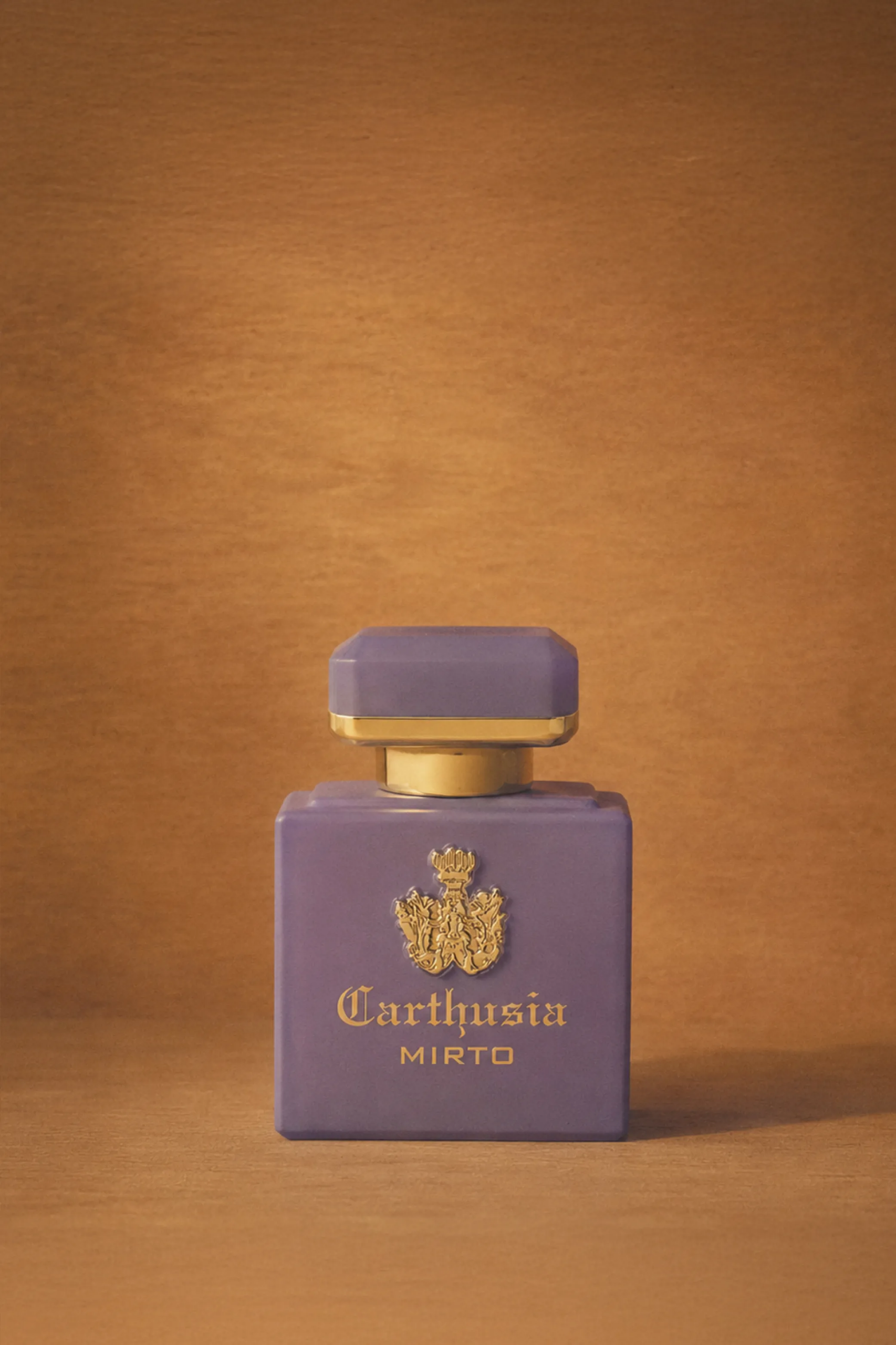
The design of the bottle is updated, bringing a new visual identity that aligns with the more intense direction. Carthusia, known for its historic apothecary-style bottles and transparent glass, enters a different aesthetic territory with the perfume. The Mirto bottle still carries the recognizable shape, but the transparency is replaced by color and sharper graphics. Ornamentation is reduced; it’s closer to contemporary niche perfumery without dissolving into its minimalism. The warmth is still in the bottle, as is the connection to Mediterranean craft, but it’s now filtered through shadow and density.
The redesign of the bottle carries the image of the fragrance before the scent. Before any physical encounter, perfume bottles now circulate through screens, and Carthusia appears to be aware of this. The house has created Intenso di Mirto both to exist on Capri and to move internationally inside a visual ecosystem.