Pietro Porcinai, 1,300 landscape projects: a reportage from Oasi Zegna
In Oasi Zegna, between the 1950s and 1970s, architect and agronomist Pietro Porcinai developed a territorial system for the Zegna family, integrating gardens, industry, forests, and monuments
Pietro Porcinai archive: 1,300 landscape projects and the structure of a design practice
The archive preserved by his heirs at Villa Rondinelli contains more than 1,300 projects across Europe and beyond: the United States, Canada, Costa Rica, Peru, Brazil, Egypt, Ivory Coast, South Africa, Saudi Arabia, Lebanon, and Japan. These works span fifty years and reflect a profession Porcinai largely shaped on his own terms. His Fiesole studio operated as what one collaborator described as a “thinking and creative company,” structured around specialized roles and clearly defined responsibilities.
Milena Matteini, who worked with him in his later years, recalled the studio’s rhythm: “when Porcinai was present, the atmosphere was intense. Phone calls overlapped with rapid instructions on multiple projects, which he would review at his next visit. When he left—often boarding a train at dawn, sometimes dictating letters en route—the office returned to calm, carrying forward a new set of directives and ideas. Porcinai organized his practice like precision engineering. Each collaborator and each phase functioned as a calibrated component within a complex design apparatus refined over years of sustained activity. He monitored the entire process with exacting attention. Directed, tested, and evaluated decisions made by his team. He maintained constant dialogue with clients to refine solutions and secure mutual agreement. Selected trusted contractors and cultivated long-term relationships with the gardeners responsible for maintaining his landscapes after construction was complete.”
Porcinai established a near-symbiotic relationship with every site he worked on, approaching each commission with the intellectual intensity of an artist. His working method becomes clear when examining the documentation preserved in his archive at Villa Rondinelli. Photographs from initial site visits reveal his reading of place: he analyzed the broader landscape context, existing architecture, individual trees, and soil conditions. He took notes, questioned clients, observed in silence, and began forming mental projections of possible interventions.
Porcinai method: site analysis, surveys, and the design process from sketch to execution
He then commissioned detailed topographic and botanical surveys. Back in the studio, he sketched preliminary ideas in pencil over these measured drawings. These early sketches are key to understanding the genesis of his work. At this stage, form and space remain intuitive and unresolved—an initial, sensory hypothesis that will later be structured, drawn with rigor, geometrically defined, and translated into detailed plans.
He typically developed at least two alternative proposals. Plans and watercolor perspectives were prepared to communicate clearly with clients, allowing them to grasp both the spatial logic and experiential qualities of each option. Once a direction was agreed upon, he moved to the executive phase: construction details, custom-designed furnishings, complex paving layouts specifying the placement of each element, plant palettes, lighting and irrigation systems. Every component was defined so contractors could execute the design without ambiguity.
Construction was overseen in collaboration with a trusted surveyor. Porcinai required biweekly progress reports to remain informed, since his international commitments often prevented continuous on-site presence. He visited during critical phases to resolve technical issues and make decisions directly with clients.
Completion did not mark the end of his involvement. Porcinai remained deeply concerned with the long-term care of his gardens. He continued corresponding with clients, offering cultivation advice and recommending skilled gardeners. Like an artist attentive to a living medium, he treated his landscapes as evolving works—organisms to be guided, supported, and matured over time.
Text: Marco Ferrari

Pietro Porcinai and the Zegna family: landscape design between industry and nature in Oasi Zegna
For the way he handled clients—for the complexity and range of projects that moved from territorial planning down to architectural detail—Pietro Porcinai became a long term partner for the Zegna family. What began as a professional relationship gradually evolved into mutual respect and, over time, friendship.
In the years when Porcinai was working to foster a landscape ethic within Italy’s industrial world—engaging figures such as the Piacenza family, Adriano Olivetti, and the Zegna family—the Biella region proved receptive. Here, sites of production and places of living were not treated as separate spheres.
Between “industry and nature”—as Porcinai wrote to Aldo Zegna on April 13, 1970—the collaboration extended across scales. It began at the territorial level, along the Panoramica road and within the reforestation efforts launched in the 1930s by Ermenegildo Zegna, later consolidated into what is now known as Oasi Zegna. It continued through the industrial and social sphere centered on the Trivero wool mill and reached into the architectural and private dimension of the family residences, with gardens and winter gardens.
Residential gardens in Biella: Ca’ Gianin and Al Roc, landscape architecture and territorial vision
From the 1950s through the 1970s, Porcinai navigated this layered commission through a sequence of projects and proposals—some built, others not. Across all of them, he demonstrated a sensibility and a command of modern garden language. Along the Panoramica, where he introduced calibrated plantings of trees and shrubs, Porcinai designed two key residential gardens: Ca’ Gianin for Angelo Zegna and Al Roc for Aldo Zegna. Both were conceived through observation of the surrounding terrain, structured around visual connections and experiments with plant material that echoed the textures and colors of both native and exotic species cultivated within Oasi Zegna.
The garden at Ca’ Gianin (1958–1973) is organized around a stone-paved path that passes through the villa’s portico and extends outward toward a woodland of beech and birch. Along the way, rhododendron collections and broad lawns link the different living areas, the tennis court, the gatehouse, and the ancillary spaces of the residence. A short distance away, the garden at Al Roc (1967–1970) operates as a threshold between house and landscape. Through subtle manipulation of topography and a sequence of lawns, shrub masses, and tree groupings, the design frames 360-degree views of its setting: the Biella mountains, including Monte Rubello and the forest planted by Ermenegildo Zegna, as well as the town of Trivero, marked by the silhouette of the parish church and the Zegna wool mill.
Greenhouses were conceived as functional shelters for plant collections—the “orchid greenhouse” designed for Ermenegildo Zegna in 1960—while others took the form of winter gardens, envisioned as natural rooms where landscapes could be gathered and staged.
Winter gardens and greenhouses: integration of architecture, plant systems, and controlled environments
The greenhouse-living room at Al Roc and the winter garden at the Zegna wool mill (1962–1964) stand out as emblematic examples. In both cases, spatial composition is structured around a calibrated balance between plant material and mineral surfaces. Within iron-and-glass structures—carefully engineered from a technical and systems standpoint—curated botanical collections were installed and updated. These were not decorative additions, but environments where vegetation and architecture operated as a single system.
In relation to the industrial plant, Porcinai introduced measures aimed at reducing its visual and environmental impact on the town of Trivero and the surrounding landscape. His 1961 redesign of the parking area incorporated tree plantings and an advanced vegetated structure conceived as both visual and acoustic buffer between the wool mill and the road.
His proposals also extended into the architectural scale. Between 1963 and 1965, he developed plans for a residential village for employees in Roveglio, located just a short distance from the factory—an attempt to integrate housing, labor, and landscape within a coherent framework.
Industrial landscape mitigation: Trivero wool mill, environmental design and visual impact strategies
Other projects, though unrealized, addressed broader civic and social dimensions. These included studies for the expansion of the Church of Saints Quirico and Giulitta in Trivero (1962–1967); sports facilities for a minigolf course in Bielmonte (1963); and hospitality-related interventions such as the interior and outdoor design for the San Bernardo hotel (1962), near the rhododendron basin of Oasi Zegna.
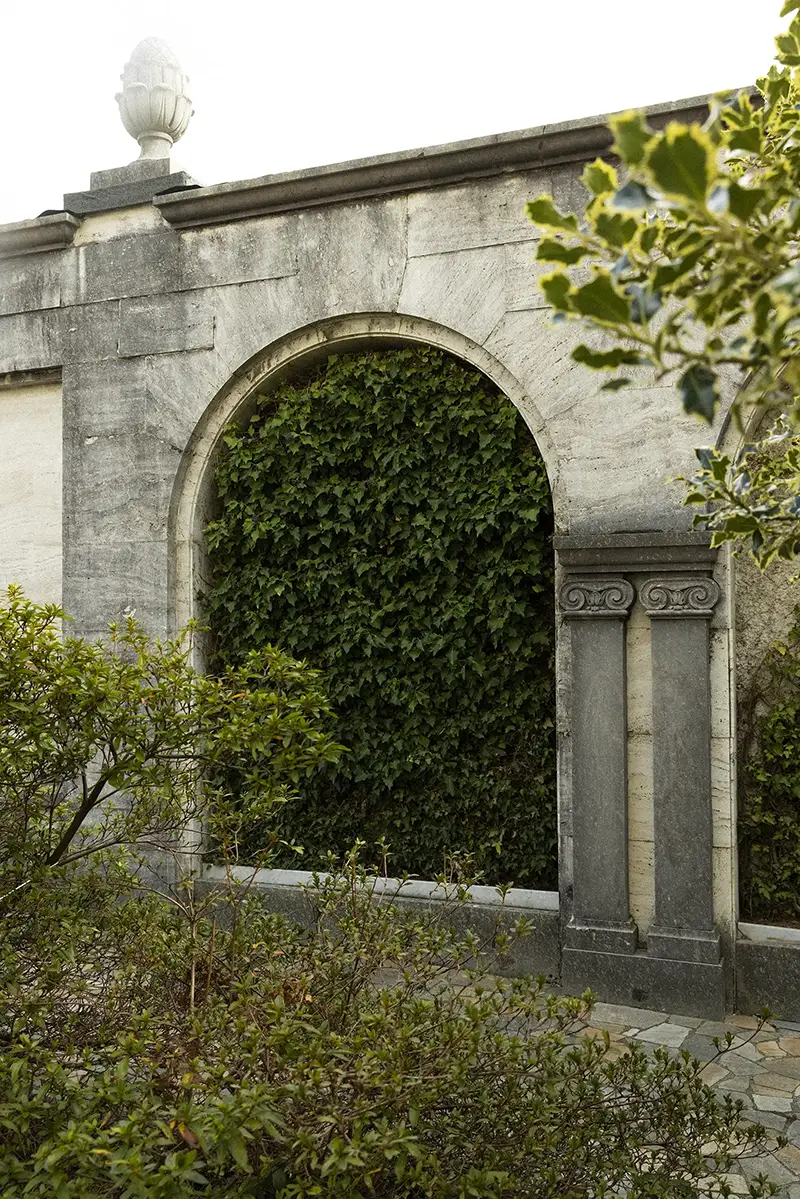
Porcinai also worked on the family chapels at the Craviolo cemetery (1962–1967) and developed a proposal for a commemorative monument dedicated to Ermenegildo Zegna (1967–1968). The monument was conceived for the Craviolo hill along the Panoramica, where landscape itself becomes a repository of memory and a tangible record of Zegna’s work.
Including temporary installations created for celebrations and events, Porcinai’s body of work for Zegna spans a wide and varied range of programs. Each was approached with the meticulous project management that defined his practice. The alignment of vision between designer and client positioned Porcinai as director of a territorial system in which the mountain operates as connective tissue.
Text: Ester Germani

Pietro Porcinai profile: landscape architect, agronomist, and multidisciplinary designer
Pietro Porcinai was an agronomist, architect, designer, urban theorist, draftsman, writer, professor. He worked across scales, from the smallest construction detail to large territorial systems. His projects included private and public gardens, archaeological sites, environmental restoration plans, infrastructure, industrial campuses, temporary exhibition designs, furniture, and patented elements. He moved fluidly between disciplines without completing a formal academic path in any single one.
The term “landscape architect” is recent. It appears comprehensive, yet in practice it often narrows the field—particularly in Italy. In Porcinai’s case, “landscape artist” is accurate. He mastered both technical and artistic tools; operated across scales, from regional planning strategies to precise construction drawings. He embodied what a contemporary landscape practitioner is expected to know and control: ecology, engineering, composition, horticulture, and spatial design as a single system rather than separate domains.
Yet the title most often associated with him—professor—may be the most fitting. He taught for years at the Agricultural Institute of Cascine. He continues to teach through his archive and built work. His drawings, letters, and gardens function as manuals. They reveal method, discipline, and judgment. Each project is a structured lesson in how to read a site, how to intervene without excess, and how to construct space as a rational device rather than a decorative gesture.
Porcinai’s work is defined by process, not by style. His landscapes operate like mechanisms: calibrated, measured. Every line serves a purpose. Every plant choice responds to climate, soil, and long-term maintenance. The result is coherence, not spectacle.
Born just outside Florence, in the hillside village of Settignano, in 1910, Pietro Porcinai grew up inside a garden. His father, Martino, was head gardener at Villa Gamberaia, working for the cultured Princess Ghyka. That landscape was his first training ground.
Teaching and legacy: Pietro Porcinai archive as a manual for landscape architecture
He earned a degree as an agricultural technician in 1928, then continued his formation in Germany and Belgium, focusing on cultivation practices while building a broad, self-directed cultural education. Between 1931 and 1938, after returning to Italy, he worked at Martino Bianchi’s nursery in Pistoia before opening his own studio on Via dei Sassetti, later relocating to Lungarno Torrigiani. During those same years, he attended the Florence Art High School, graduating in 1935, and enrolled at the Royal Institute of Architecture, a program he did not complete.
In 1938 he opened a new office on Lungarno Corsini with architects Nello Baroni and Maurizio Tempestini. He left the partnership in 1956 and moved to Villa Rondinelli, on the hills of Fiesole, where he worked until his death in 1986. Over the decades he developed close ties with central figures in twentieth-century architecture—BBPR, Franco Albini, Luigi Cosenza, Marco Zanuso, Carlo Scarpa, and Oscar Niemeyer—as well as leading landscape designers including Geoffrey Jellicoe, Sylvia Crowe, René Pechère, and Carl Theodor Sørensen.
Text: Marco Ferrari