Renée Levi covers the Hayward Gallery façade with seven fluorescent colors
Audemars Piguet Contemporary commissions the Swiss artist to create a large-scale painting on perforated industrial mesh for London’s brutalist landmark on the Southbank
From September 23 to November 15, 2026, the façade of the Hayward Gallery in London will be transformed by a large-format painting installation conceived by Renée Levi — the first painting commission in the history of Audemars Piguet Contemporary, the international public art initiative of the celebrated haute horlogerie brand. Co-produced with the Hayward Gallery within the Southbank Centre cultural complex on the south bank of the Thames, the work also marks the largest-scale intervention Levi has undertaken in the United Kingdom.
The Hayward Gallery — opened in 1968, host to major temporary exhibitions, and visited by 11 million people each year — is one of London’s defining buildings and a canonical example of brutalist architecture. The rhythmic alternation of projections and openings that animates the façade, the chiaroscuro produced by the sculptural concrete morphology: these were Levi’s point of departure.
Who is Renée Levi: painting, body, space, and site-specific installation
Born in Istanbul in 1960, Renée Levi moved to Switzerland at the age of four. Raised in the canton of Aargau, among fertile valleys and forests of precise geometric density, she now lives and works in Basel. Her artistic practice began in 1998, following studies in architecture completed with a postgraduate course at the Zurich School of Art and Design and professional experience at the Herzog & de Meuron studio.
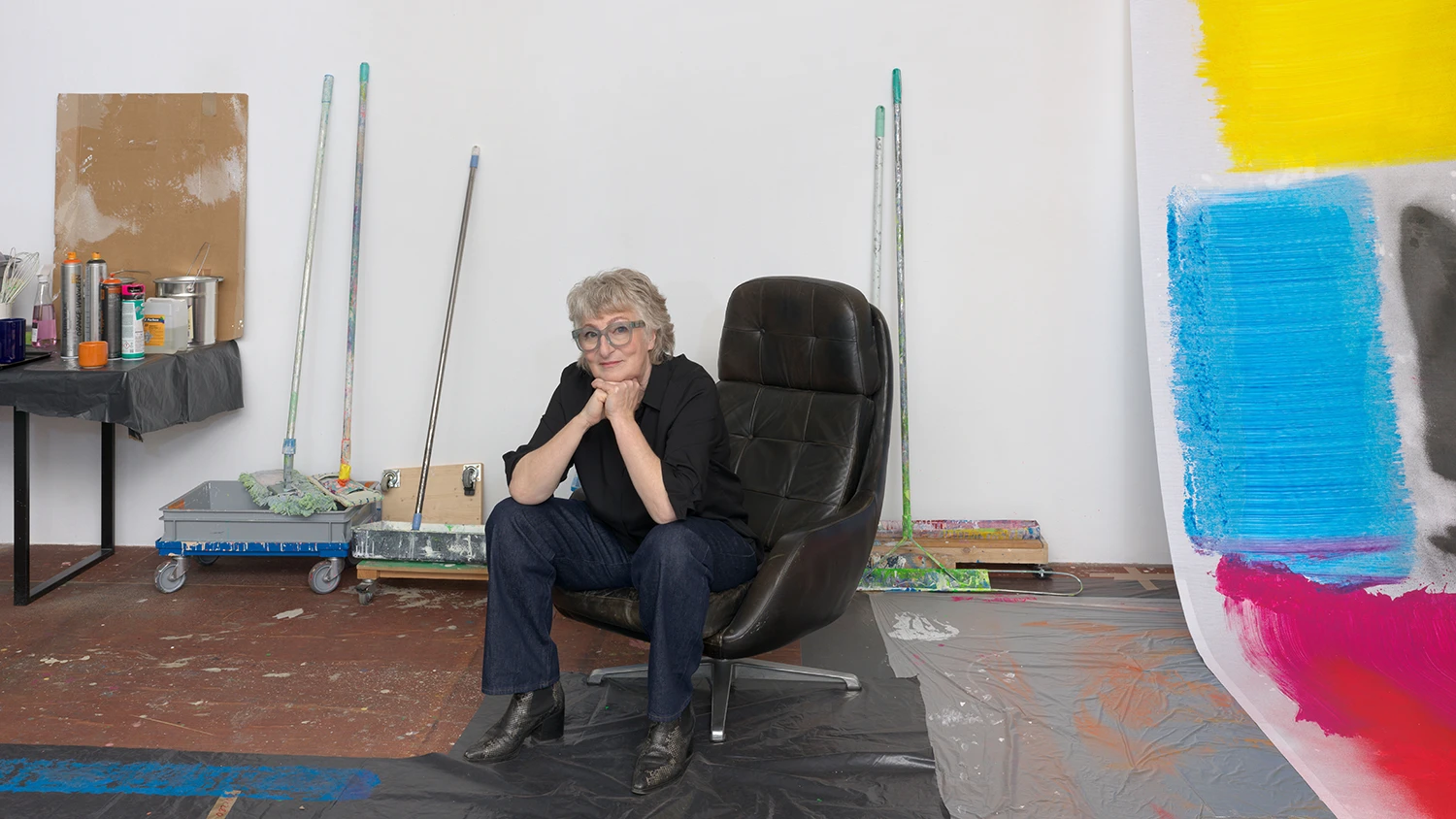
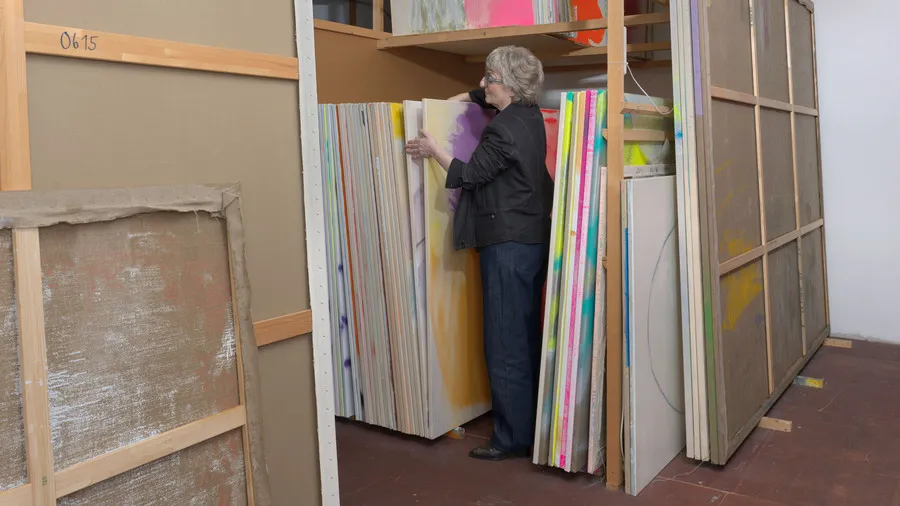
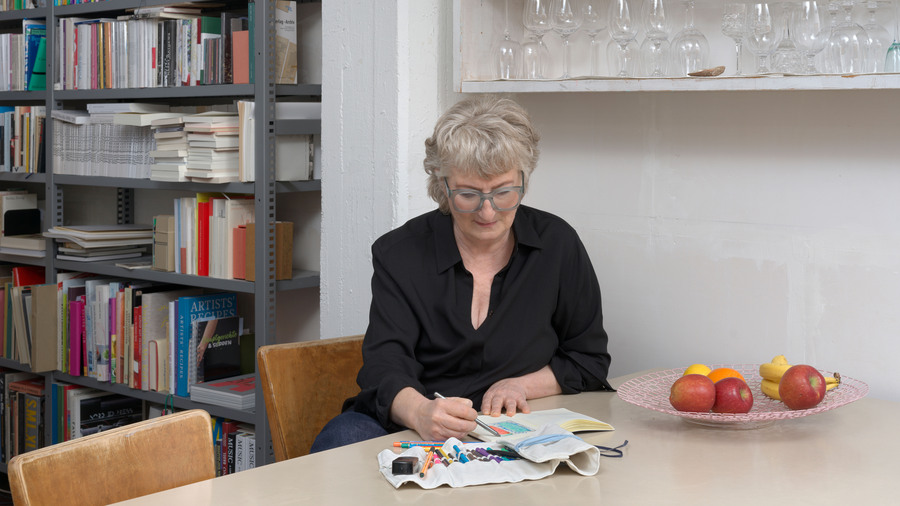
For over thirty years, Levi has interrogated the medium of painting, engaging with color, the application of material, her own body, and space. She defines her canvases as objects and frequently treats the place in which they are installed as an additional pictorial surface to be claimed in continuity — expanding the flow and breath of the mark with full conceptual independence. Her practice sits at the intersection of painting, drawing, and writing, grounded in a personal trajectory where multiple languages and different cultural matrices converge and condense.
From the very beginning of her career, Levi conceived projects for public spaces in collaboration with her partner Marcel Schmid. Large scale has always been congenial to her work. Recent evidence includes the intervention at the Swiss Innovation Park in Basel-Allschwil, the piece on the pediment of the Federal Palace in Bern — secured through a public competition held to mark the 175th anniversary of the Swiss Constitution — and the sweeping 2025 installation Elle at the Palais de Tokyo in Paris, which combined mural painting and drawings that appropriated the building’s windows as surfaces.
How Renée Levi works: rules, gesture, and spontaneity in the painting process
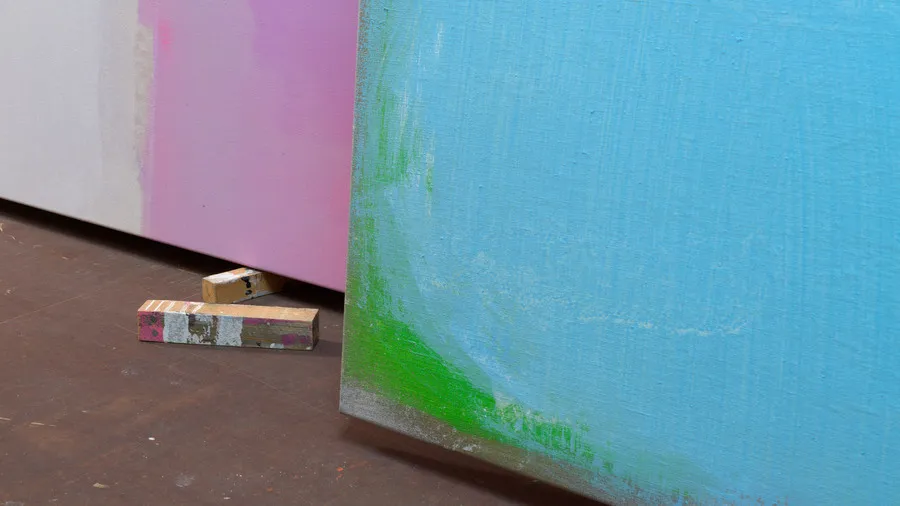
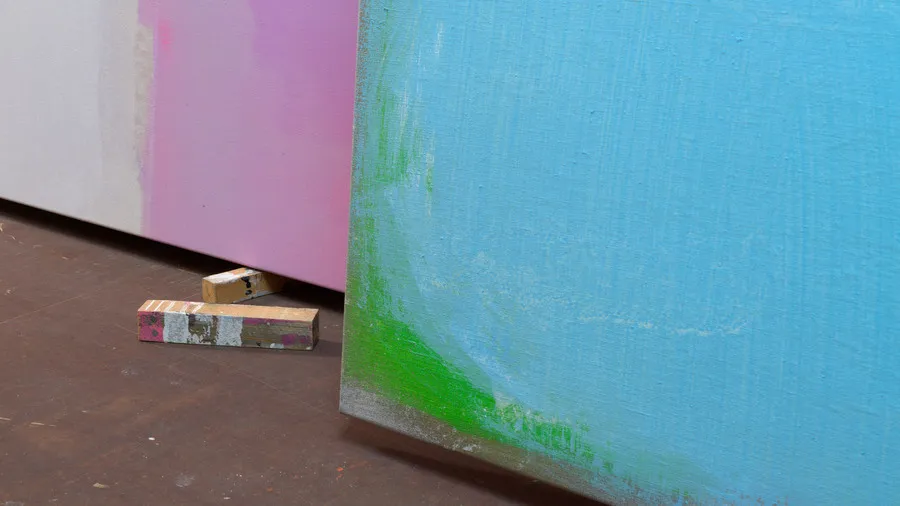
The chromatic data is powerful, the gesture imposing: Levi works with aerosol and cleaning cloths that reveal and redraw the surfaces they touch. The overall image is never predetermined but opens progressively through exploration. Behind every work lies a long preparatory process: as she often states, she sets the rules of the game in advance. Every element must be studied, almost dissected, understood in depth — so that genuine spontaneity can follow, releasing the full expressive force of the gesture.
“Drawing is an immediate bodily act in situ — Levi declares — one that unfolds inside a place that determines material, scale, and action. Scale is based on the body: it is reach, the movement of the arms, extension in space. The rules arise within the act itself and exclude any possibility of correction, repainting, or composition. There is no going back. The work is executed in a single continuous passage. Drawing is action, and action produces the image. What becomes visible is time.”
Perforated industrial mesh and seven fluorescent colors: the technique behind the Hayward façade
“Renée Levi — observes Audrey Teichmann, art curator at Audemars Piguet Contemporary — studies the space she must engage with in meticulous detail, not only in terms of its architectural and volumetric logic, with which she establishes a close dialogue, but also its history, function, meaning, and aesthetic character. Once she has identified what needs to be brought forward, she focuses on the technical approach.”
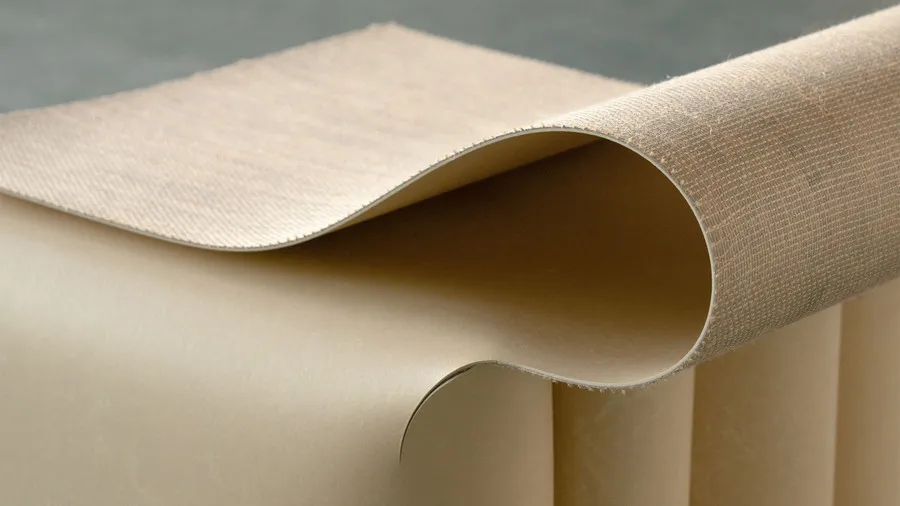
The work will be executed on a support of perforated industrial mesh — flexible, suited to outdoor conditions, and resilient against weather. Its partial transparency places it in direct, specular dialogue with the texture of the architecture beneath. Controlling the intensity of color and calibrating the alternation between opacity and luminosity proved a significant technical challenge, as did sourcing the right paint and the appropriate preparation for a material that reacts poorly to certain agents at a chemical level. A single manufacturer was found capable of producing the ideal pigment for the base coat. Over this ground, Levi mixed seven different fluorescents.
“A theme running through her entire career is the relationship with the urban context, with graffiti, the invitation to interact, to respond with an impulse — Teichmann continues. It is not by chance that she uses a spray can. The crucial question concerns mediation and our role as spectators when we encounter something: whether we approach it passively or actively. Much will depend on each person’s orientation in front of the painting, on the magic of alternation and exchange with the concrete — a powerful material that shapes the context. Especially in a city that can move through four seasons in a single day, where everything shifts in an instant, or in the darkness of a night crossed by light and reflections. To embody the state of weather, of sky. It is an exhortation to return to an artist’s work, to seek out a relationship, to weave something intimate and domestic. Renée has the rare faculty of generating a sense of intimacy, of identifying a suspended and softened core even within a monumental setting. The entire technique is directed in service of the intention, aimed at capturing a gesture that translates time — recounting itself and those few minutes or seconds spent creating the drawing. Elements distant and discrepant that fuse together in a kind of dialectical osmosis: difficult to explain, but inevitable, and invariably exciting. It is an expression that is essential, even rough and incised, yet one that places us in an unfamiliar position in our confrontation with architecture.”
Brutalist architecture as pictorial surface: Levi’s dialogue with the Hayward Gallery façade
Levi approaches the Hayward Gallery not as a backdrop but as a surface to be involved — an organism to engage with, responding to the material and morphology used to build it. She has worked with its dynamics, its projections, its light effects, its chiaroscuro, and the expanded scale of a brutalist envelope that became a symbolic landmark of modern architectural language in the British capital from the moment it was completed.
When Levi first encountered the Hayward, her attention settled on the building’s so-called “eye” — an aperture that allows the interior to be read from outside and vice versa, creating a crucial threshold between inside and out. Seen from the exterior, her work responds to this architectural filter without masking its essence, instead drawing out specific qualities and placing them in relief.
The modularity of the façade is mirrored in the work itself, which is equally modular and tightly bound to the idea of structure. The play between painting and building is simultaneously declared and ambiguous: it destabilizes established proportions, dissolves architectural certainties, and at the same time amplifies the telluric plastic energy that rises from the unmistakable façade — the vibrant, sculptural grain on which the work is installed.
Cesare Cunaccia