A UFO Lands in Brooklyn – only the dent survives
Tom Friedman turns disposable cookware into permanent steel figures, while a companion show on the Lower East Side treats thirty-six years of studio debris as the work
Tom Friedman, roasting pans and stainless steel at Entrance Sculpture Garden, Red Hook
Tom Friedman builds figures out of aluminum roasting pans and has them cast in stainless steel. The pans do not enter the metal. Their edges and the dents of his fingers do. At the Entrance Sculpture Garden in Red Hook, if I ran the circus takes that process outdoors. The show runs until November 29, 2026. The garden covers ten thousand square feet of a lot that used to serve industry. A second show, there’s no such thing as art, ran at the Entrance gallery on the Lower East Side. There, the studio waste is art.
Looking Up: grocery-store pans, Styrofoam and lost-wax casting
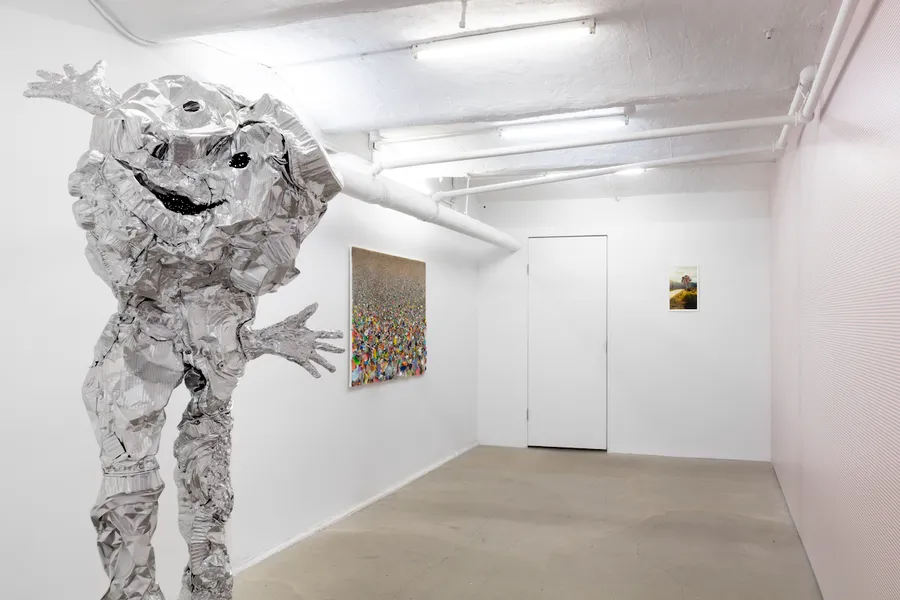
Looking Up shows the route step by step. Mr. Friedman collected aluminum pans from grocery stores, choosing them for their patterns. He built an armature, bulked it out with Styrofoam and spray insulation, and set the pose. With a hot-glue gun, he covered the body with pans and cut pieces. Aluminum tape closed the gaps. At its foundry in Rock Tavern, New York, UAP cast the figure in stainless steel and finished it. The method was molding and lost-wax casting, followed by a polish. The version shown at Rockefeller Center stands as high as a basketball hoop and weighs seven hundred pounds. Its walls measure a quarter inch. On the left foot, the handling instructions printed on a pan read in reverse, in steel. Untitled (Looking Up), 2012, measured over thirty-three inches. The edition at The Contemporary Austin reaches thirty-three feet.
Lost-wax casting: how a crease survives the foundry
In lost-wax casting, the foundry takes a mold of the model. A wax copy forms inside the mold. A ceramic shell goes over the wax and into the kiln, where the wax melts and drains out. The foundry pours metal into the space the wax left. The shell is broken away, and the surface is chased and finished. A crease in a pan passes from model to mold, from mold to wax, from wax to metal. Hazmat Love, 2017–2026, begins the same way: maquettes of roasting pans, scaled up for the outdoors. This version comes in stainless steel, finished in orange auto paint. Two figures lock in an embrace, part wrestling match, part dance. Crumple of an aluminum-foil maquette into stainless steel, with running water.
Waste or production: what casting a roasting pan consumes
The roasting pan does not end up in the sculpture. No aluminum from it reaches the steel. The process is not recycling. It is production. A mold, a wax copy, a ceramic shell, heat for the kiln, metal for the pour, labor for the polish. For Looking Up, the pans came from the grocery shelf, not from the trash. At the height of a basketball hoop, the figure holds seven hundred pounds of stainless steel. The Contemporary Austin presents the work as baking tins joined to the scale and permanence of steel. Mr. Friedman’s practice runs both ways. Some works are made by hand to look like factory products. Others are cast in a foundry to keep the handmade.
Assembly without a cast: cookware, road signs and welded steel
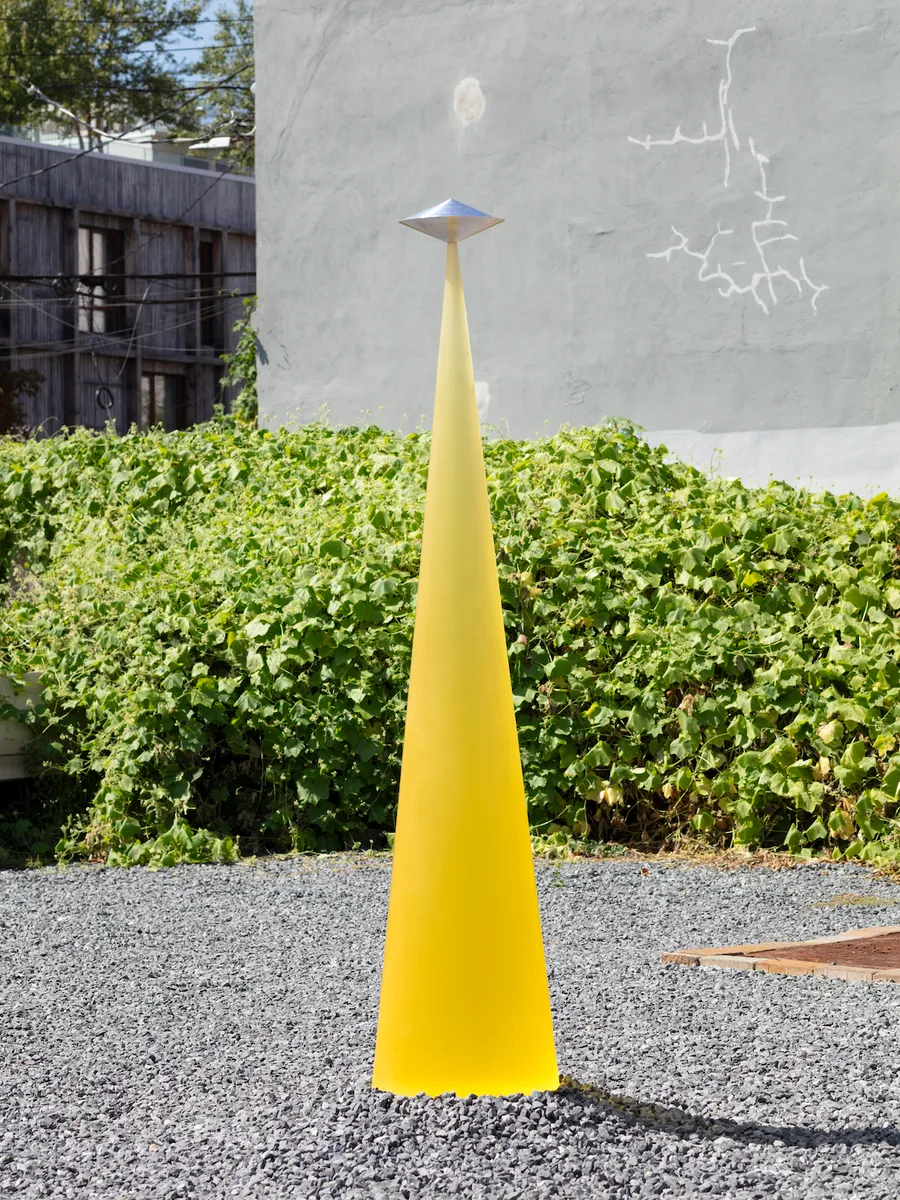
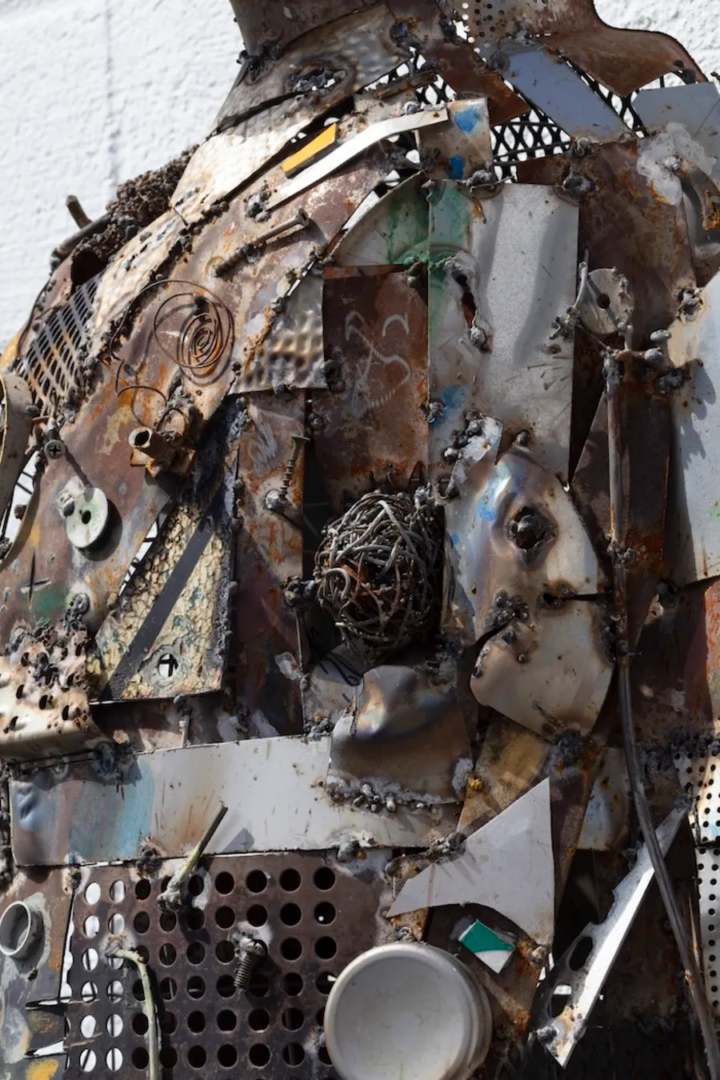
Some works in Red Hook skip the foundry. come and get it, 2026, assembles stainless-steel cooking paraphernalia into a figure. Stainless steel is the metal of restaurant kitchens; in Red Hook, it makes a body. sign for road to utopia, 2026, puts used road signs and a signpost to work. It stands ninety-seven inches. Thing one and Thing two, 2015–2026, is welded steel. Hobo Enso, 2022–2026, is welded metal. In these works, the objects keep their substance.
Studio detritus as material
The companion exhibition, there’s no such thing as art, ran at 48 Ludlow Street. It opened on September 10 and closed on October 10, 2026. It went the other way. The chair, the pile and the canvas went through no foundry. i do not exist, 2026, is a chair Mr. Friedman sat in for decades, cut in half. mandala, 1990–2026, is a pile of his detritus, collected over thirty-six years. kit and kaboodle, 2026, fixes paint and studio debris to a canvas of thirty-six by forty-eight inches. the edge of infinity, 2026, paints the back of a canvas in trompe l’oeil. The show set out to close the distance between the place of making and the work. Detritus ran at Lehmann Maupin in 2025. There, Mr. Friedman worked with scraps from the ground, fragments of his sculptures and packaging from his life. In Red Hook, the pan is the model. On Ludlow Street, the waste was the material.
Exposure and maintenance: salt, rain and sun on New York Harbor
Red Hook sits on New York Harbor. On stainless steel, salt from the air can cause tea staining: brown blotches that rain reactivates. Washing and a coating hold it back. Bronze corrodes with exposure. Its surface turns green with copper sulfates and carbonates, and acid rain speeds the process. For bronze outdoors, the National Park Service recommends a wash every year and rewaxing every one to three years. Epoxy pool paint is made for tanks and pools, under water and chlorine. Exposure to UV light, over time, can make it chalk. Resin makers advise against exposure to the sun, which yellows resin. The fountain needs water, a pump and someone to run them.
Louis Shannon and the Entrance Sculpture Garden
Louis Shannon, founder of Entrance, grew up in Lower Manhattan with an artist father. Before he turned ten, he saw Mr. Friedman’s shows at Feature Inc., at the end of the nineteen-nineties. Years later, the two met through Mr. Friedman’s daughter. Mr. Friedman proposed an exhibition across both Entrance spaces. Entrance opened at 48 Ludlow Street and added the Red Hook garden in 2024. The garden shows artists who build with materials outside the catalog, and addresses children as an audience.
Tom Friedman
Tom Friedman (St. Louis, 1965) is an artist. He lives and works in Leverett, Massachusetts. He works across sculpture, painting, drawing, video and installation. He holds a BFA from Washington University in St. Louis and an MFA in sculpture from the University of Illinois at Chicago. The Museum of Modern Art, the Whitney Museum of American Art and the Solomon R. Guggenheim Museum hold his work.
Editorial Team