Why is that man still burning? some lines about Burning Man
Demna, Veronica Leoni, and Louise Trotter and the rave aesthetic: it has nothing to do with the networking o that scrolls across screens every day. It is an aesthetic escape from Starbucks and Disney
There is no gospel in the rave: Oliver Laxe’s Sirāt and an escape that does not free
On the edges of cities, or under concrete overpasses, ravers wear nylon and elastane, necklaces assembled out of what look like paper clips, plasticized eyewear. Whatever emptiness or apathy runs through them, they hope to get past it for a few hours in communion with other disillusioned people. Sirāt, the film by the French-Spanish director Oliver Laxe, imagines paradise this way: an illegal rave watched over by towers of speakers in the middle of the Sahara. Laxe’s ravers are chasing a high. Breathing the same humid air thick with sweat, pressed against one another, is a form of connection. It has nothing to do with the networking of a smooth, frictionless reality that scrolls across screens every day. What the two share, the networking and the rave, is failure. As the characters in Sirāt learn, looking for release in escape leads nowhere. There is no gospel in the rave. Only a temporary truce. Not even the help of stimulants and hallucinogens will carry you to paradise in the middle of a party. When the lights go out, the synthesizers stop and Saturday ends, you are adrift again. Alone, locked into an ordinary life, looking for a way out.
Burning Man 2000: Rick Marin on Anal Avenue, between Sex Drive and Knee Lane
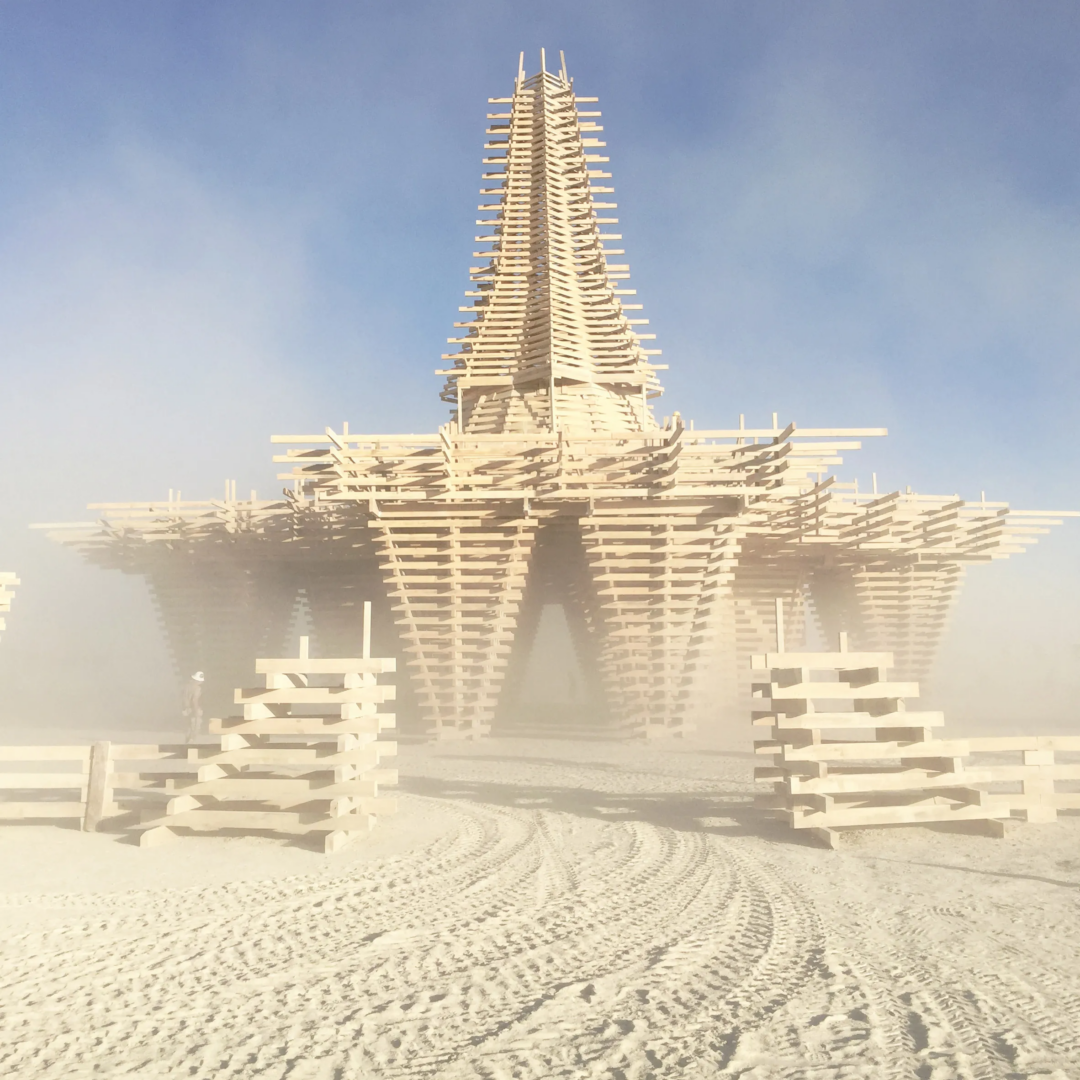
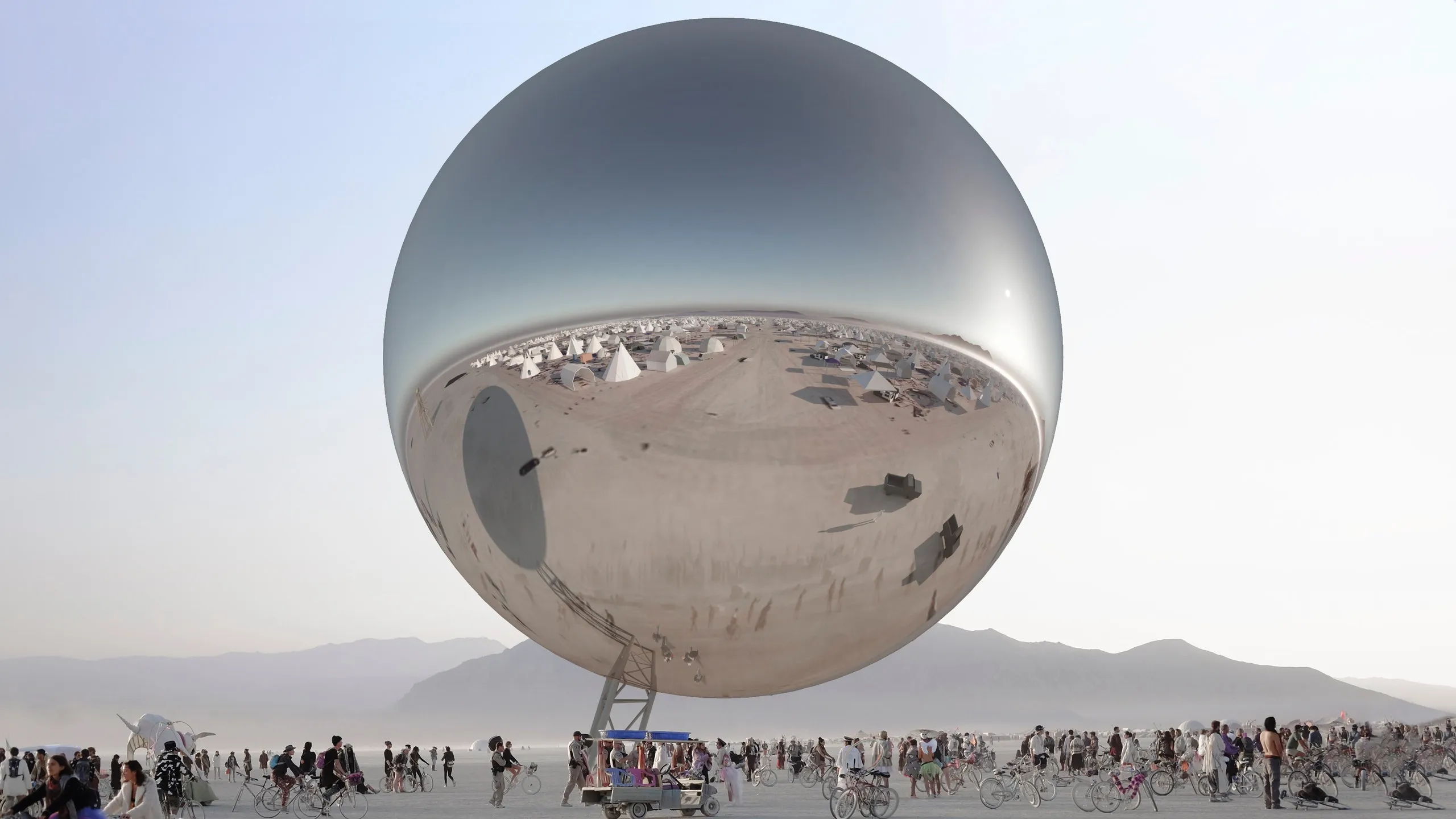
When the columnist Rick Marin first took part, in 2000, in the «seven-day cyber-hippie carnival in the Nevada desert» that goes by the name of Burning Man, the no-logo policy surprised him. The brand-free zone is given over to radical self-expression. The story is known: in 1986 its founder, Larry Harvey, had just been left by his girlfriend when he decided to burn a stick figure on a beach on San Francisco Bay. The pyrotechnic act turned into an annual collective ritual, until the authorities told Harvey and his circle to find another place to gather. When friends convinced Marin to attend the 2000 edition, around twenty-five thousand people were making the pilgrimage to the Black Rock desert. Today there are around eighty thousand. Neopagans, performers, artists, professionals of the new economy, ravers, nudists, and ordinary partygoers. The figure is a twelve-meter wooden skeleton lit with neon and filled with fireworks, and its combustion is the ritual climax of the event. Marin describes the week as «a county fair on hallucinogens that mixes Woodstock, Mardi Gras, Alice in Wonderland, and Cirque du Soleil». Years of professional cynicism had shut down every synapse required to join a drum ritual with enthusiasm. He hated camping, and hated hugging strangers. He went anyway: out of range of any cell tower, he pitched his Moroccan tent on Anal Avenue, between Sex Drive and Knee Lane.

The most common garment at Burning Man is nudity: each person in a body already different from every other.
Marin took part as a spectator, a category no one wants. An ordinary man in jeans, a velvet jacket, and a cap, he did not join the collective madness. Among his observations: every participant had a device for standing out. A performance, a priest’s costume, a car covered in fur. At night they covered themselves in glow sticks, neon headdresses, LED displays, and light installations shaped like arteries, with the aim of being noticed. Drug consumption was discreet rather than theatrical. Sheltering from a downpour, Marin ended up at a western-themed rave full of people dressed as cowboy cosplayers, and understood the appeal for the first time. In dusty jeans with a fluorescent poncho over them, he felt he had found a tribe. Its only principle was, and is, «Do whatever you want, as long as you do not ruin anyone else’s fun». So reads the paper handed out at Burning Man. What drives the festival is individualism. If in the Seventies the sartorial mantra of the hippie subculture was bell-bottoms, here the point is to dress like no one else. To be different like all the other different people. The most common garment at Burning Man is nudity: each person in a body already different from every other.
It is an aesthetic escape from Starbucks and Disney. As Marin noted, by 2000 the proliferation of brands was turning cities into billboards. Outside the United States, friendly countries were becoming fast-food courts. In The Lexus and the Olive Tree, Thomas L. Friedman argued that two countries with a McDonald’s have never gone to war with each other. A McDonald’s is the price of that peace.
How the Industry commodified the rave aesthetic: from free entry to five hundred dollars
Since its founding in the Eighties, several things have changed. Entry, once free, now starts at five hundred dollars. Sandstorms, torrential rain, commonly known as climate change, and Elon Musk’s capital have all reached this promised land of individualist nonconformism. It remains a city that rises each year out of nothing, built by its own participants, disconnected from the world, which is to say from the network, and without money, after spending it to get there. It has betrayed a good part of its ideals. In 2026, when every online retailer has a section of its site dedicated to festival fashion, this is hard to remember. There was a time when fashion and festival were opposing terms, and what you wore at the second was a protest against the first.
Woodstock and the genetic code of raver fashion: crochet, tie-dye, and the hippie trail
Woodstock is where that aesthetic took shape. In origin it was the anti-Peter-Pan-collar, the anti-polo, the anti-turtleneck. The unwritten dress code celebrated the rough, the raw, the handmade, including the badly handmade. Potholders and doilies as tops, crocheted vests, torn denim, tapestries as sarongs, fabrics bought along the hippie trail between Rajasthan and Kerala. The textiles told stories of illumination reached through distant cultures. Cultural appropriation was not yet a term. A political ideal set against a patriarchy bogged down in jacket and tie, this cornucopia of fringe, tie-dye, and crochet ended as a stereotyped celebration of individual expression. There is an irony in it. That the pioneers of festival fashion never considered that one day this would produce an age of mass-produced pseudo-individuality, available for purchase as a deluxe boho dress, says something about the naivety it was born with. That degree of genuineness is now out of reach.
Demna, Veronica Leoni, and Louise Trotter are raising the bastard child of rave culture: the rave aesthetic
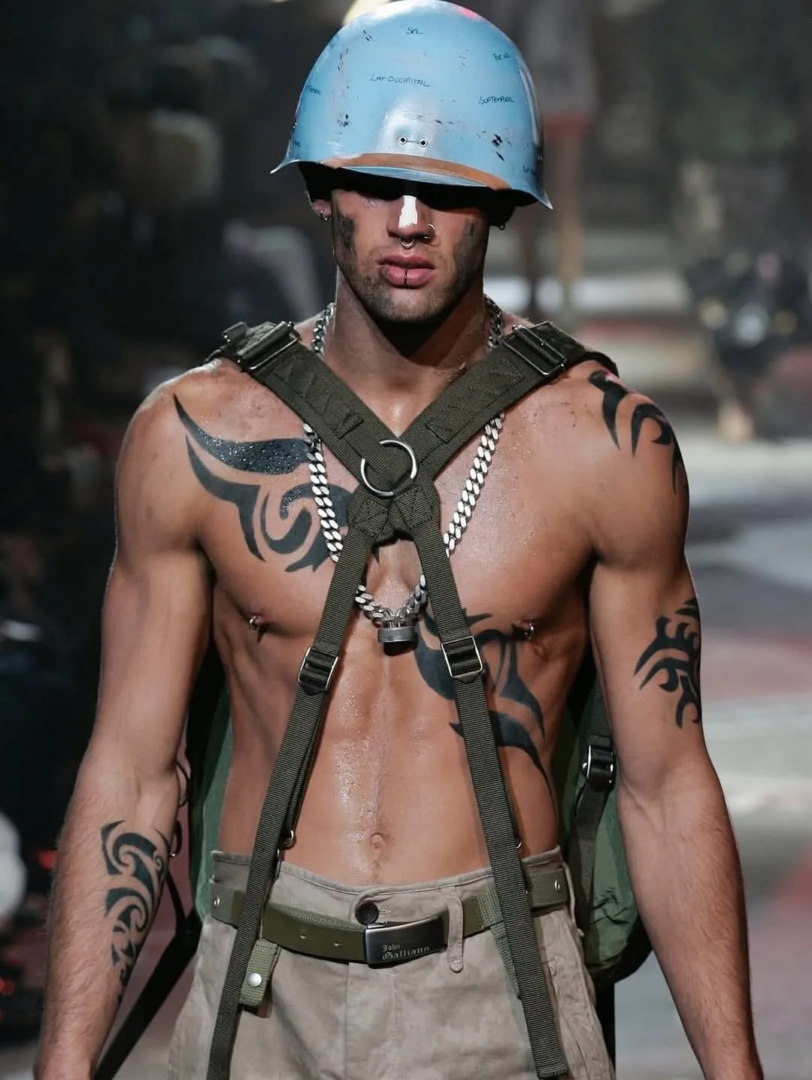
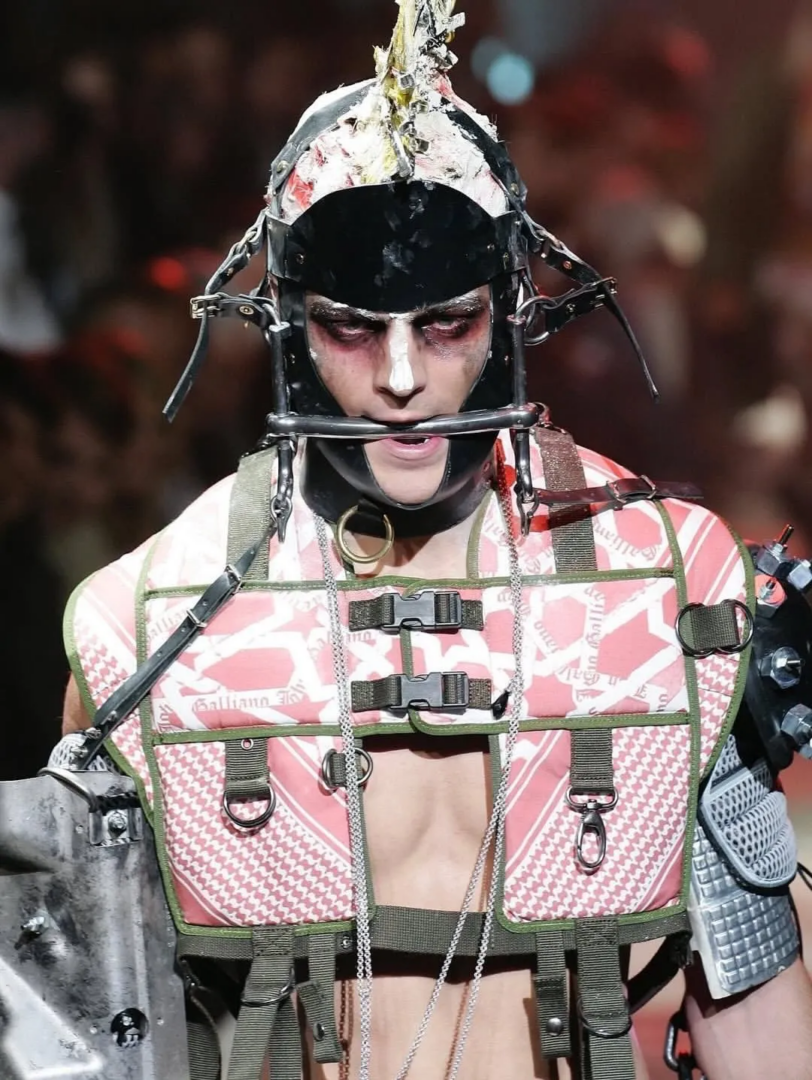
Rave culture is dead. Its bastard, capitalist child survived: the rave aesthetic. The fault lies with the Industry, which does to every counterculture what it does best, turning it into surface. The near-naked body. Nylon. Elastic surfaces. Improvised craft. Sexuality as a language. At Gucci, Demna does not recover the rave as a social phenomenon: he recovers what the rave left on the skin. In his debut the body is the center of the story again. Garments become elasticated tubes, jeans behave like leggings, briefs resurface above the waistband, nets of crystals catch the light. The same light that, forty years ago, passed through thousands of anonymous bodies pressed in front of a wall of speakers.
Veronica Leoni reaches the same conclusion from the opposite direction. Her word is sexitude. Not an image, an attitude. «When only the clothes are left, the king is naked», she says. The sentence overturns the whole construction. Calvin Klein had understood that desire lives in the space between dressing and undressing; Leoni takes that intuition to its conclusion, removing every artifice. What remains is the sound of fabric, skin, a thin erotic tension. It is the reduction to essentials that characterized rave culture before it became a purchasable category.
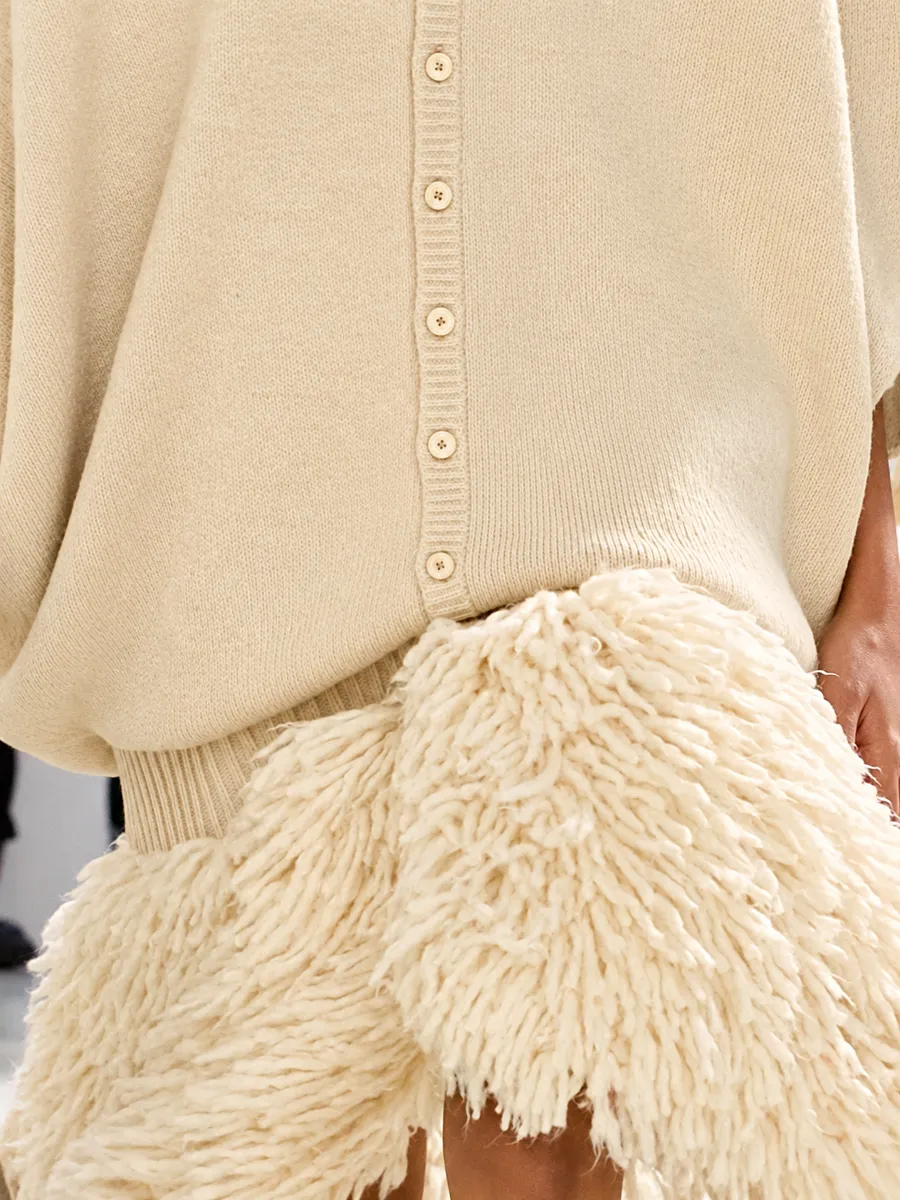
Louise Trotter keeps the most valuable fragment of that inheritance. She has said she learned how to be with other people in the British raves of the Nineties. It is not a biographical detail. It is a method. At Bottega Veneta the experience returns in an obsession with the manual gesture: weaves, fishing nets, braided chiffon, recycled fibers, materials transformed by hand. Before it was an aesthetic, the rave was a practice. Building it yourself. Making precious what was not. As happens to all half-successful revolutions, raving has ended up a dead language.
Stella Manferdini