Pillings, friction, wool: when the flaw becomes the design
Anatomy of pilling – from fibres, friction and washing to Ryota Murakami, who has made it the language of a brand
The wrinkles of fabric reveal a resistance to ageing
Technically speaking, pilling is a textile phenomenon in which surface fibres tangle together to form small balls on the fabric. Mechanically, it is caused by friction during use, and washing plays its part. Short, fuzzy fibres work their way out of the yarn, twist together and form pills that stay anchored to the base fabric. The type of fibre is a factor: hard synthetic fibres and short natural fibres encourage pilling, while linen and silk limit it. From an aesthetic and cultural point of view, the flaw belongs to the wabi-sabi and slow-fashion strand of thought, which values a garment’s natural ageing. Much like wrinkles, pills also reveal a resistance to deterioration. So the raw edge fraying at a cuff does not mean the jacket is falling apart. Rather, it is the effect of continuing to wear a sweater instead of throwing it away at the first aesthetic hiccup. So too the honeycomb patterns of Aran knits blossom into spiralling rosettes, and the drying of boiled wool leaves unstable, irregular fractures and a lumpy surface on the garment.
Pillings: in fashion, ridicule can be a weapon
Ryota Murakami, a 2025 LVMH Prize semifinalist, describes how the ridicule of small-minded people inspires his work. The “popular kids” who decide the winner of the coveted prize did not consider his brand, Pillings, enough to reach the final. Murakami argues that if work is not judged by the mainstream, it loses its sense and meaning. Anna Wintour has said his clothes are too heavy; she cannot wear them. Born and trained in Japan, Murakami graduated from Ueda Yasuko Fashion College and worked as an assistant at Writtenafterwards while attending Coconogacco. His graduation project, made in collaboration with his mother, was shortlisted for ITS, the most important fashion competition in Europe. As a child he wore clothes his mother made for him, girlish sweaters with ribbons. When he moved to a new school in the third grade, people started asking, “What is Murakami-kun wearing?” He did not go to school for six months. Today, that kind of awkwardness is bought by the Dover Street stores. Ridicule turns into a weapon.
Ryota Murakami: a brand built around pilling
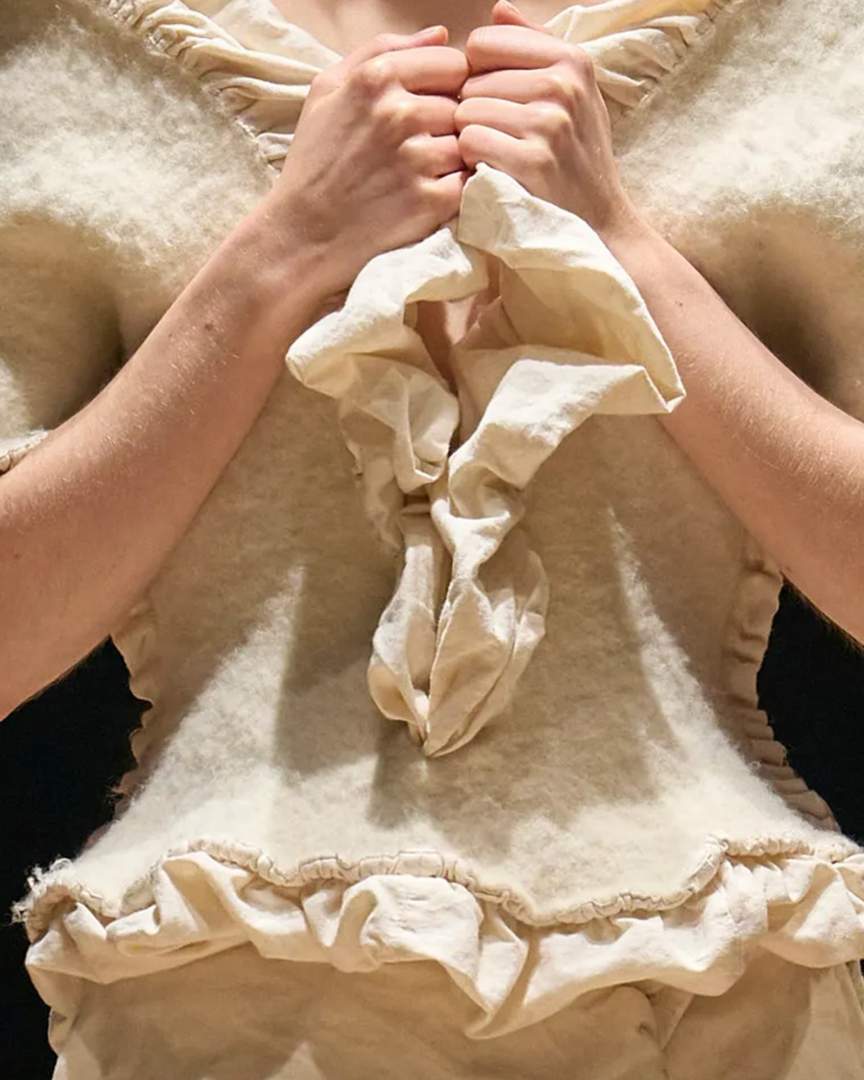
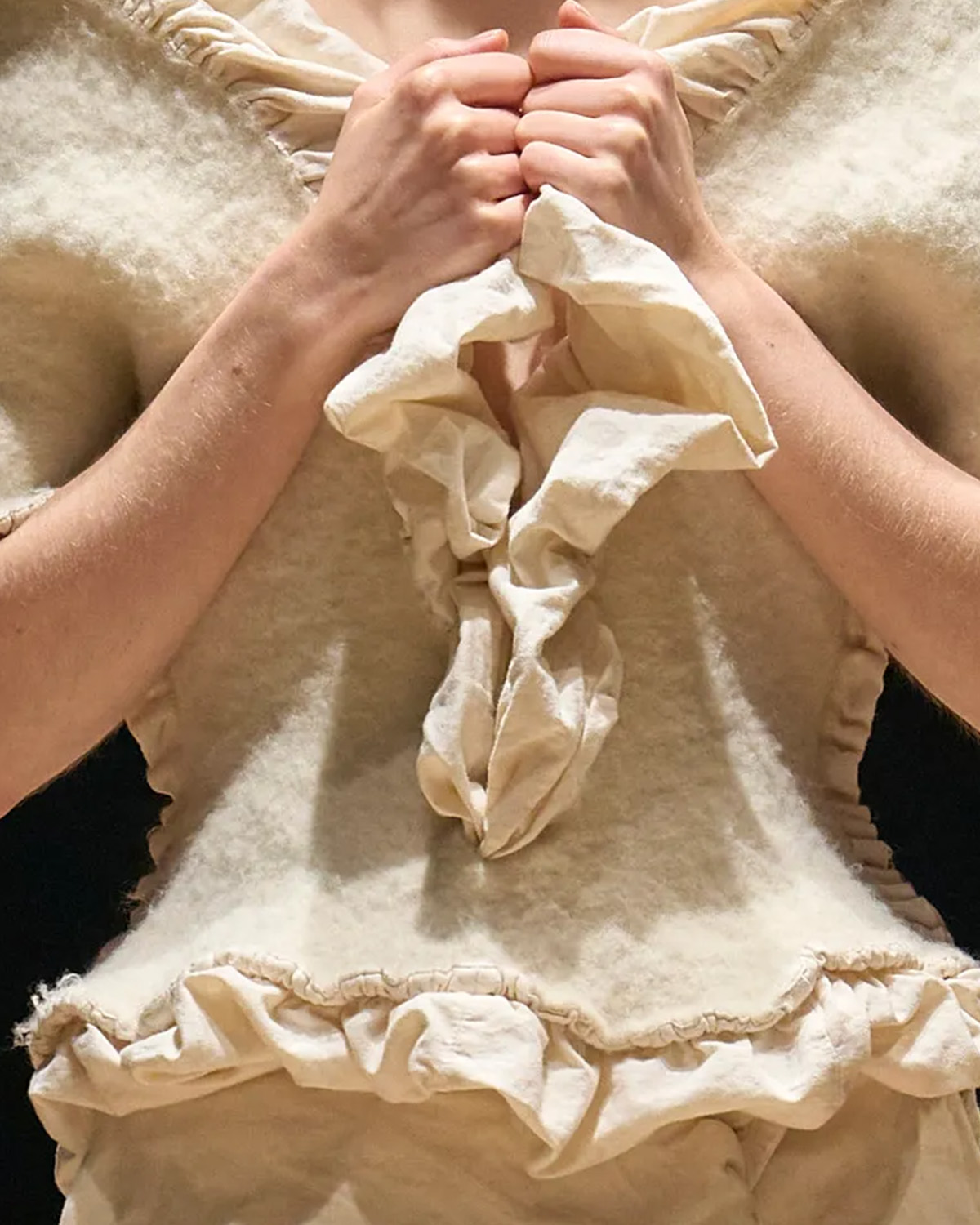
Ryota Murakami washes his sweaters in large machines with a special liquid that shrinks them, not unlike dish soap. The process for producing the pills goes like this: he first washes the sweaters in water at 80°C and adds the detergent. He spins them, then tumble-dries them at 80°C. It is exactly the opposite of what you are told to do with wool. The wool shrinks while the lining stays the same size, and the garment takes on a different density. Murakami designs around the body, crumpling the fabrics so they look fleshy. One cardigan, for instance, became a capelet. Murakami then brought the shoulders forward for a kind of emotional embrace. Models usually walk elegantly, but the Japanese designer wanted to show awkwardness, so for his latest show he hired a choreographer. The charm of knitwear is that a single thread is enough to create unique pieces. The garment changes over time, so each one can be said to be one of a kind. Asked what animal the pills represent, he answers: “Ants.”

Fashion is a slow drip of mistakes
Prada designs ugliness. Creases, stains, ombré effects and rumpled slips express the traces of living, the wrinkles that filters, and the fashion industry along with them, would rather erase. “There is a false idea of perfection,” Miuccia Prada says: “ Perfectionism is not necessarily unhealthy. Yet there is a difference between holding yourself to a high standard and holding yourself to an impossible one. The latter is what is known as “dysfunctional perfectionism.” The parallel Maya Singer drew in 2023, in an editorial titled Unfinished Business, on how fashion embraced the perfectly imperfect. She pointed to Pedro Almodóvar’s film Parallel Mothers, a plot that unfolds as a slow drip of mistakes.
The deliberate imperfection of Prada’s clothes resonates with the wardrobe that dresses it, with all its ebbs and flows. The idea surfaces in the patient, conscious work of art restorers, a frequent source of inspiration for Erdem Moralioglu. It can be found, too, in Dries Van Noten’s black ensembles inspired by Kazimir Malevich’s paintings of the void. After years immersed in a hustle culture that wants us to be tireless optimisers of ourselves, we have reached a saturation point. Out with life hacks, fillers, and the follower counts that quantify the performance of the brand called “me.” The cultural wind is blowing the other way, toward a more honest and messier portrait of being human.
When we measure ourselves against perfection, we are bound to fail
Telfar Clemens have long played with the idea of accessible perfection: liberal-democratic clothes in the absence of the American Dream. On the downtown New York scene you see mismatched buttons and hand-stitched details that differ from one garment to the next, a variability that becomes a selling point rather than a problem to be smoothed away. Ageing and ugliness do not really exist online; at most one speaks of jolie laide, the “ugly-pretty” label given to unexpected, asymmetrical, captivating faces. Even so, we end up discovering that when we measure ourselves against perfection, we are bound to fail.
Pilling, or disruptive, ecological knitwear
Fashion is in search of the new, which is to say, whatever differs from what is about to go out of fashion. Think of the threadbare clothes of glam, Saint Laurent’s retro interpretations, or what Vivienne Westwood called “the age of nostalgia for our little lives.” Westwood never cast herself as a vestal of the past. On the contrary, she took up a burning torch and destroyed it. She founded a visual language of wear and decay: raw edges, broken seams, elements turned inside out or cut away, plays on proportion that distort perception. A London cooperative of disillusioned young people gathered in her London shop. It was not born with the intention of being anti-fashion. It was an alternative to the homogeneity and hegemony of contemporary fashion. And so one of the most subversive designers of the Seventies and Eighties, whose slogans included “Buy less, choose well, make it last” and “Anarchy & Punk,” showed decades ago the pleasures of being rough and discordant. In 2026, knitwear covered in pills (little bobbles, in non-technical parlance) can play the same role as Vivienne Westwood’s corsets: disruptive and ecological.
Stella Manferdini