Hugh Herr builds the cyborg: prostheses the brain feels and controls as its own
After losing both legs at seventeen, Hugh Herr turned limitation into design, engineering prostheses that seamlessly connect flesh, skin, nerves and circuits through bidirectional neural interfaces
Hugh Herr – turning cyborgs into reality. It all started with amputated legs
«I would rather be a cyborg than a goddess». American philosopher Donna Haraway wrote that in 1985, in her Cyborg Manifesto. It was not about robotics. It was about identity, about dissolving boundaries — human and machine, organic and synthetic, self and system. Forty years later, this cyborg as an only entity between flesh and construction is no longer a metaphor. We’re not talking about steel monsters, but humans with body parts that can overcome existing physical impairments. If there is a laboratory where the cyborg discussion has shifted from philosophy to engineering, it is at the MIT Media Lab, where American scientist and bioengineer Hugh Herr directs the Biomechatronics group and co-directs K. Lisa Yang Center for Bionics. It’s a world where technology mixes seamlessly with human physiology and electromechanics.
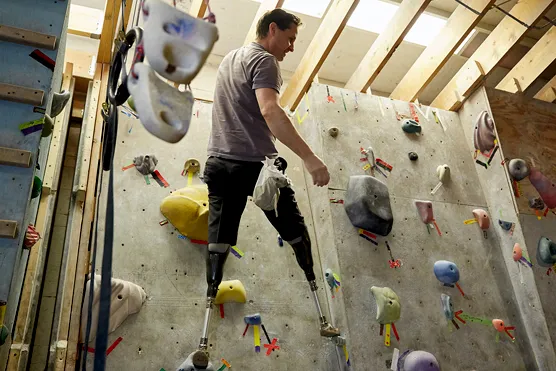
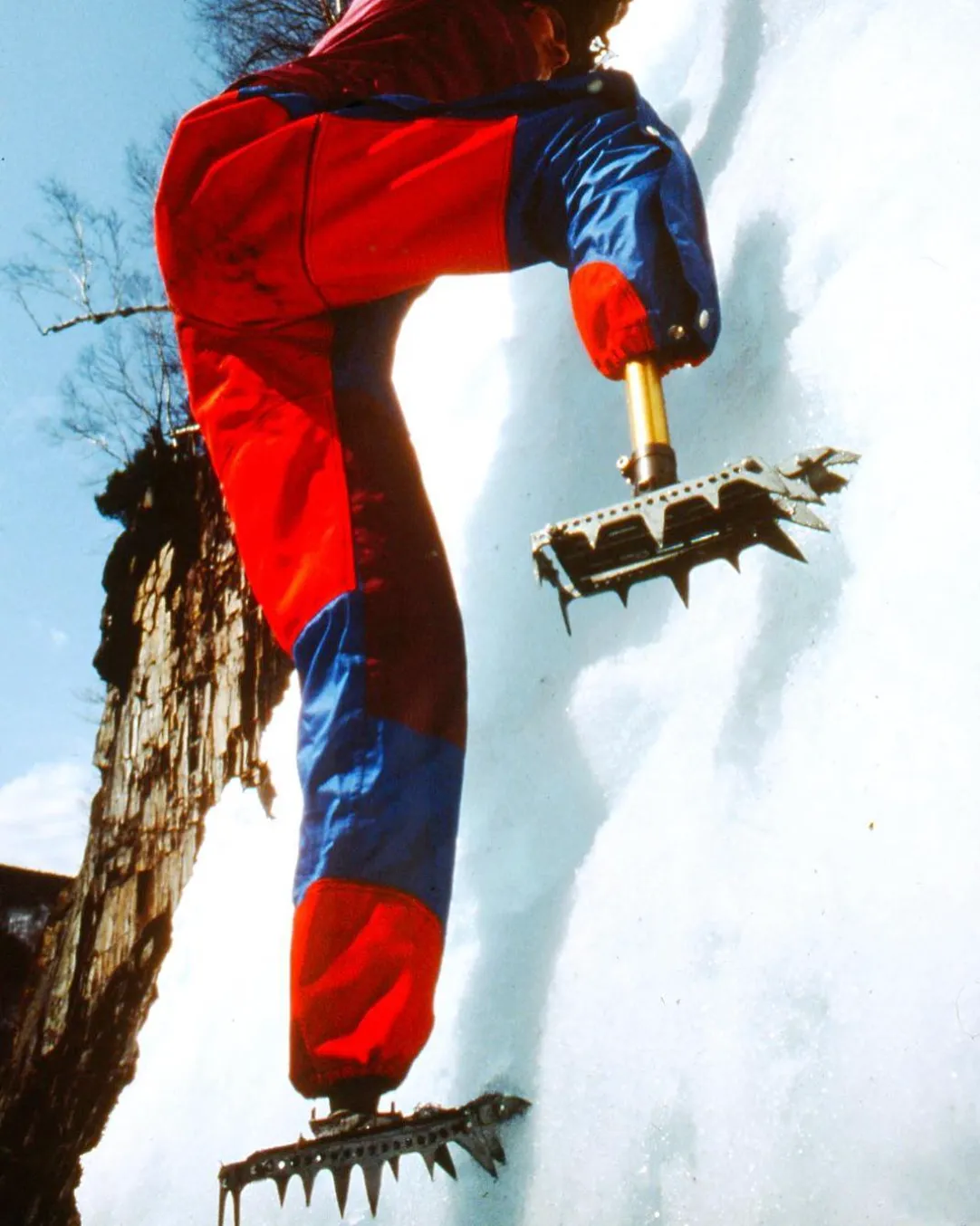
Herr is not only a scientist of the body. He is, himself, its own reconstruction. As a teenager, he was already a prodigy climber. In 1982, when he was 17 years old, while ice climbing on Mount Washington, a blizzard trapped him for days. Severe frostbite led to the amputation of both legs below the knee. The medical prognosis was limitation. Herr responded with design. He was never a good student before, but urgency turned him into one. He was given «passive» prostheses, made with wood, foam and metals. His body was amputated with the same technique that was used during the American Civil War.
In a slightly twisted way, the incident was fortunate. Herr began modifying his own prostheses to return to a full life — not just to walk again, but to climb at elite levels, even better than before. Today, he holds multiple patents in bionics. His work has redefined what a prosthesis can be and what it can allow a human with disability to do. Skip, jump, dance, run, climb. He made it a mission: Time Magazine referenced him as the leader of the bionic age.
Beyond assistance: the connection between synthetic parts and neural networks
For other people, he’s gone even further than what he did for himself. One of the lab’s central goals is to develop a bidirectional connection between mechatronic systems and the human body — linking machines to the skeleton and the peripheral nervous system: nerves, muscles, skin. The achievement doesn’t have to be simple movements, but sensation. Herr explains, «A person with an amputation should not only think and move a mechatronic limb, but actually should feel its movements — the pressure, the dynamics — as natural percepts. Just as we feel our hands. When we close our eyes, we know where our elbow is. If I’m handed a dumbbell, I feel the change in pressure. We want to provide ownership to the human over designed media».
In 2014, Herr made what he calls a critical decision. «I chose to pursue brain interfaces rather than going down the robotics and AI pathway. Robotics and AI can emulate natural dynamics and mechanics — but the human wouldn’t be intimately connected to the robot. They wouldn’t be embodied. I want to embed humanity beautifully into designed constructs so seamlessly that you don’t know where the human ends and where the design begins. I want them to be one and the same. There is no more edge». The nervous system must be linked bidirectionally — machine to brain, brain to machine. That’s the core point of what a cyborg is: an entity formed through «bidirectional communication» between synthetic parts and biological neural networks.
Rewiring the phantom with new surgical approaches
Recent breakthroughs achieved by Herr’s team, detailed in a recent Nature Medicine paper, describe a new surgical approach, mechanically reconnecting agonist and antagonist muscles — like biceps and triceps — during amputation. Muscles and tendons contain sensors that communicate position and velocity to the brain. This internal awareness is proprioception: the sense of where we are in space without looking.
Examples make it easier to understand. Let’s think of an arm. «If we amputate above the elbow», Herr explains, «we surgically link the biceps and triceps together. When a person thinks about moving a phantom elbow, those muscles physically move back and forth. The phantom limb moves — even though the elbow isn’t there. The brain receives the same sensory information as if it was». Applied to below-knee amputations, the technique restored natural movement — controlled continuously by the brain.
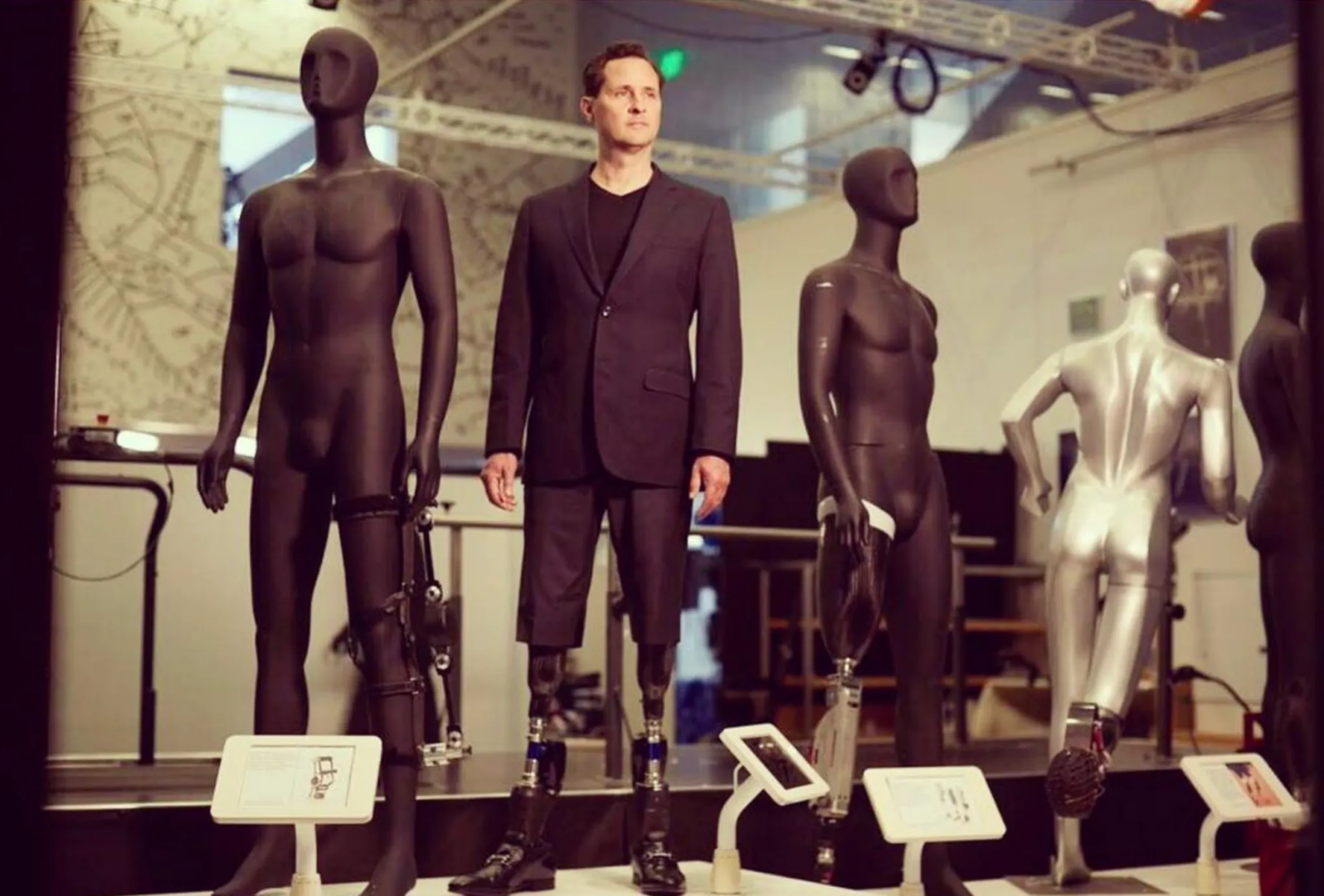
«The ankles I’m wearing now contain robotic algorithms. They’re not linked to my brain — so I’m kind of being walked», says Herr. «In our Nature Medicine paper, we showed the first prosthesis to restore natural movement controlled by the brain. The robot doesn’t know if the ground is icy or if you’re stepping on a banana peel. It doesn’t know anything. It’s the human brain, assisted by circuits going down the spinal cords, that controls the device». This was discovered in a study with fourteen participants. Seven with linked muscles. Seven without. The difference was decisive: «When you give the brain rich information, it knows exactly what to do. It doesn’t matter what the limb is made of».
Cutaneous Mechanoneural Interface – to feel, not just to move
One thing is movement; another thing is to recreate sensation. Herr’s team is connecting prostheses to the skeleton, offering more than proprioception. «Imagine someone with a cancer in the wrist. An amputation is needed. What we want to do is to feel the fingertips of the robotic hand that will replace the human one». Through what the lab calls the Cutaneous Mechanoneural Interface (CMI), surgeons wrap a small patch of skin, taken from each fingertip, around the end of the nerve that actually innervates the skin, «kind of like a taco». Over three months or so, the nerve regenerates and reconnects to the skin cells. Muscle tissue is wrapped around that construct. When the robotic fingertip is touched, the muscle activates, pressing on the skin cells and sending signals through the nerve. «The person can feel they’re holding a warm cup of coffee. Each fingertip has its own construct». Biological tissue and titanium components communicating — coexisting as a single.
From the dark age to a «dimly lit» era of prostheses
This leads to another question. Can the brain embody something that has never been human? Wings, perhaps? Potentially, says Herr. «What we’ve already described is a cyborg. Someone who projects their body schema, their sense of self, onto a designed construct made of titanium and silicon rather than flesh and bone. A body part doesn’t have to be flesh and bone to be alive. It has to be intimately connected to the brain». Until recently, he believed we were living in the dark ages of prosthetics, but «now it’s dimly lit». He sees a pivotal shift coming up: from humans as tool-users to humans embodied within designed constructs. «Mechatronics are not tools. They’re not like a hammer». Embodiment, he insists, exists on a spectrum. In the coming decade, rehabilitation and assistive technology will transform. Surgeons, engineers, clinicians and manufacturers will collaborate together not to sell devices, but to reconstruct bodies. «It’s like carving marble».
The economic impact of cyborgs
All of this, at first glance, seems pretty expensive. Herr argues that surgical procedures linking muscles do not significantly increase operative time. On top of that, in the States these operations are typically covered by insurance. The implants — small magnetic beads inserted into muscle tissue to measure movement — take seconds to place and cost only a few dollars at scale. «I believe we can dramatically improve prosthetic systems without increasing costs. Over a patient’s lifetime, brain interfaces may actually reduce costs — fewer injuries, fewer secondary conditions».
A new world where concepts ‘normality’ doesn’t exist
So, will these technologies remain restorative or become augmentative? «Both. The boundary between restoration and augmentation will blur. We currently separate clearly what’s ‘normal’ and ‘not normal.’ It will not exist in the future. Imagine a world where you can experience different forms of cognition and sensation in different bodies. The definition of normal would evaporate. Humanity will expand its diversity. Today’s narrow view of society of what beauty is, what a body is, will be outdated». Through his company Dephy, Herr already extended research into consumer applications. It has partnered with Nike to develop exoskeletal footwear — consumer-facing augmentation systems designed to increase walking and running efficiency.
The interface question: we need to get to the brain to erase disabilities
What about brain–computer interfaces such as those pursued by Elon Musk’s Neuralink? «If we aim to eliminate disability in the 21st century, we need interfaces at every level of the nervous system — peripheral nerves, spinal cord, muscles, central brain. Today’s approaches are too invasive. I don’t believe current methods will exist in twenty years. Elegant solutions are coming». He talks about the work of some of his colleagues: nanoscale devices delivered through the bloodstream — no drilling, no open surgery — externally powered, internally precise. The cyborg, then, is no longer speculative fiction. It is a matter of architectural of interface. Of where the body ends and whether that boundary still matters.