How Amouage builds a fragrance around perfumery’s most elusive flower
With Love Hibiscus, Amouage adds a fifth chapter to its Secret Garden collection — pairing one of perfumery’s most structurally elusive flowers with a caramelized pastry accord
Love Hibiscus is an eau de parfum within Amouage’s Secret Garden collection, composed by Jérôme Epinette. The fragrance pairs a hibiscus accord — tart, herbal, faintly earthy — with a salted caramel gourmand base anchored by passion fruit, frankincense, sandalwood, cypriol, and vanilla.
The creative brief originated with Renaud Salmon, Chief Creative Officer of Amouage, who drew on two sources: the hibiscus flowers common throughout Oman’s landscape, and a childhood memory of his mother making palmiers — the laminated pastry whose caramelized surface became the gourmand counterpoint to the flower. That palmiers shares a Latin root with palme, and that palms are ubiquitous in Oman, gave the conceptual frame its internal logic. It is a small etymological coincidence, but in perfumery, the best briefs are often built on this kind of private coherence.
What hibiscus smells like and why hibiscus is one of perfumery’s most difficult floral accords
The problem with hibiscus is structural. Most varieties of Hibiscus rosa-sinensis, the ornamental species found across Oman and throughout the tropics, are nearly scentless, producing no commercially viable essential oil or absolute. What most people associate with hibiscus as a smell comes from dried Hibiscus sabdariffa calyces — the same plant used to make hibiscus tea — which carry a tart, cranberry-like, slightly astringent character.
Steeped in hot water, the profile becomes more legible: herbal, lightly woody, faintly bitter, with red-fruit undertones that remain consistently soft and diffuse.
Every hibiscus note in perfumery is therefore a constructed accord, assembled from red fruit components — raspberry, cranberry, currant — with tart modifiers and soft tropical florals. The concentration is typically low, rarely exceeding two percent of a composition: at higher levels the note turns vegetal and acidic, destabilizing surrounding accords.
It functions best as a heart note, lending a fruity brightness that is softer than peach or apricot and more transparent than jasmine or tuberose.
The challenge of hibiscus in haute parfumerie is precisely this modesty of character. Rose and vetiver assert themselves; hibiscus recedes. Building a fragrance around it requires either amplifying its earthiness and bitterness or placing it against something with enough structural contrast to reveal what it is by opposition. The second approach is what Epinette chose.
The history of gourmand perfumes from Thierry Mugler Angel to contemporary niche perfumery
That counterpoint is caramel — and caramel in perfumery carries its own history.
The gourmand category was codified in 1992 with Olivier Cresp and Yves de Chirin’s creation of Angel. Before Angel, edible notes such as caramel, praline, chocolate and vanilla had no significant presence in fine fragrance. The perfume introduced them as a primary accord while removing traditional floral structures, producing a composition that smelled simultaneously of dessert and patchouli.
The gourmand category has since expanded considerably, absorbing floral, fruity and woody elements. The neo-gourmand movement that emerged during the 2010s introduced greater contrast — salt against sugar, smoke against cream, woods against confectionery accords — to move beyond simple sweetness.
The challenge today is saturation. Gourmand fragrances have become one of the dominant styles in mainstream perfumery. Any niche interpretation now requires a distinct compositional identity.
Amouage’s approach within Secret Garden has been to pair each floral accord with a gourmand counterpart that serves a structural function rather than a decorative one.
Amouage Secret Garden collection: floral and gourmand pairings from Lilac Love to Love Hibiscus
Secret Garden launched in 2016 with Lilac Love, pairing lilac with tonka bean and cocoa.
It was followed by Blossom Love in 2017, combining cherry blossom and amaretto; Love Tuberose in 2018, built around tuberose and Chantilly cream; and Love Delight in 2024, which explored heliotrope and Middle Eastern honey sweets while introducing a redesigned bottle with a matte ceramic finish.
Love Hibiscus becomes the fifth chapter in the collection and follows the same compositional logic: one flower, one gourmand accord, one point of tension.
Each fragrance confronts a different technical challenge. Lilac must be reconstructed entirely. Cocoa can become muddy. Tuberose is naturally dense and indolic. Hibiscus is diffuse and elusive. The collection’s identity lies in balancing these materials without allowing either side of the pairing to dominate.
Jérôme Epinette at Robertet: the perfumer behind Love Hibiscus and the Secret Garden brief
The brief was entrusted to Jérôme Epinette, Vice President of Perfumery at Robertet. Born in Burgundy, Epinette studied biochemistry at the University of Dijon before training at the Grasse Institute of Perfumery. He joined Robertet’s Paris office in 2003 and later helped establish the company’s New York Creative Center.
His style often relies on concise formulas, high-quality naturals and carefully calibrated contrasts. Patchouli and sandalwood frequently appear as structural anchors. His ability to maintain tension between opposing accords without neutralizing either is particularly suited to the Secret Garden concept.
Inside Love Hibiscus by Amouage: notes, accords and how the fragrance develops on skin
Epinette builds the hibiscus accord around its less obvious facets: tartness, herbal freshness and subtle earthiness rather than tropical sweetness.
Passion fruit acts as a bridge between the fragrance’s two poles. Its acidity reinforces the hibiscus accord while its ripe fruit character prepares the transition toward the gourmand heart.
Frankincense introduces a resinous brightness that connects the composition to Oman’s olfactory heritage. As one of the historic centres of the frankincense trade, Oman remains central to Amouage’s identity, and the material appears here not as a dominant note but as a luminous structural element.
The base combines sandalwood, cypriol and vanilla, creating warmth without excessive density.
The salted caramel accord functions as the fragrance’s counterweight. Against hibiscus, the salt acquires a mineral quality while the caramel reads as toasted pastry rather than confectionery sugar. The result is a contrast between acidity and warmth, brightness and softness, floral transparency and gourmand texture.
Whether hibiscus remains identifiable through the entire drydown is the central compositional question posed by the fragrance.
Amouage Love Hibiscus bottle design, price and availability in Italy
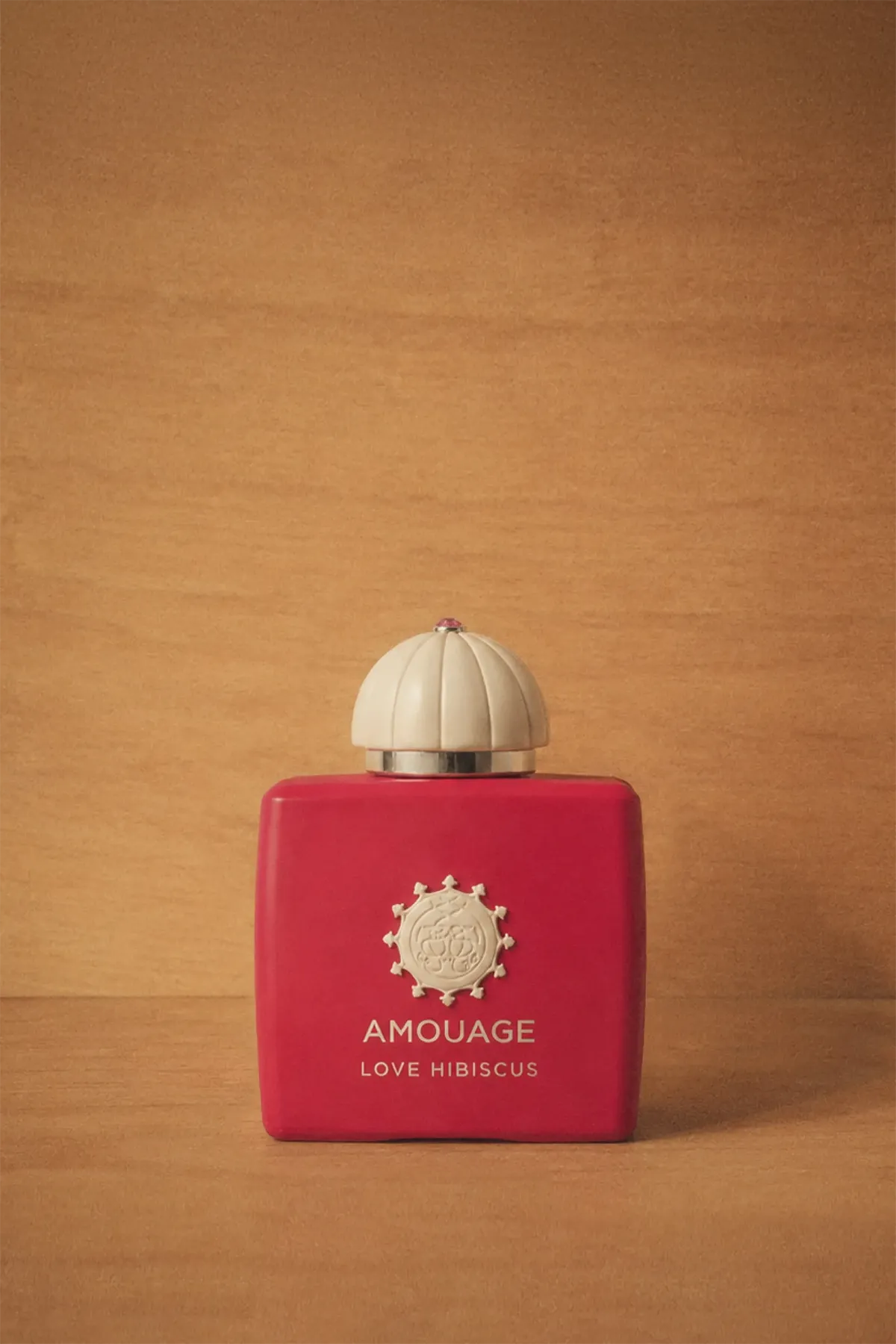
Love Hibiscus is presented in the ceramic-finished bottle introduced across the Secret Garden collection. The surface has a soft-touch texture reminiscent of peach skin and is rendered in a hibiscus-red shade.
In Italy, the fragrance is available exclusively through Olfattorio Bar à Parfums and its online store.
Founded in Turin in 1981, Olfattorio Bar à Parfums was among the first retailers to introduce international niche perfumery to the Italian market. Its retail concept combines guided olfactory consultations with a proprietary sampling system based on scented cones.
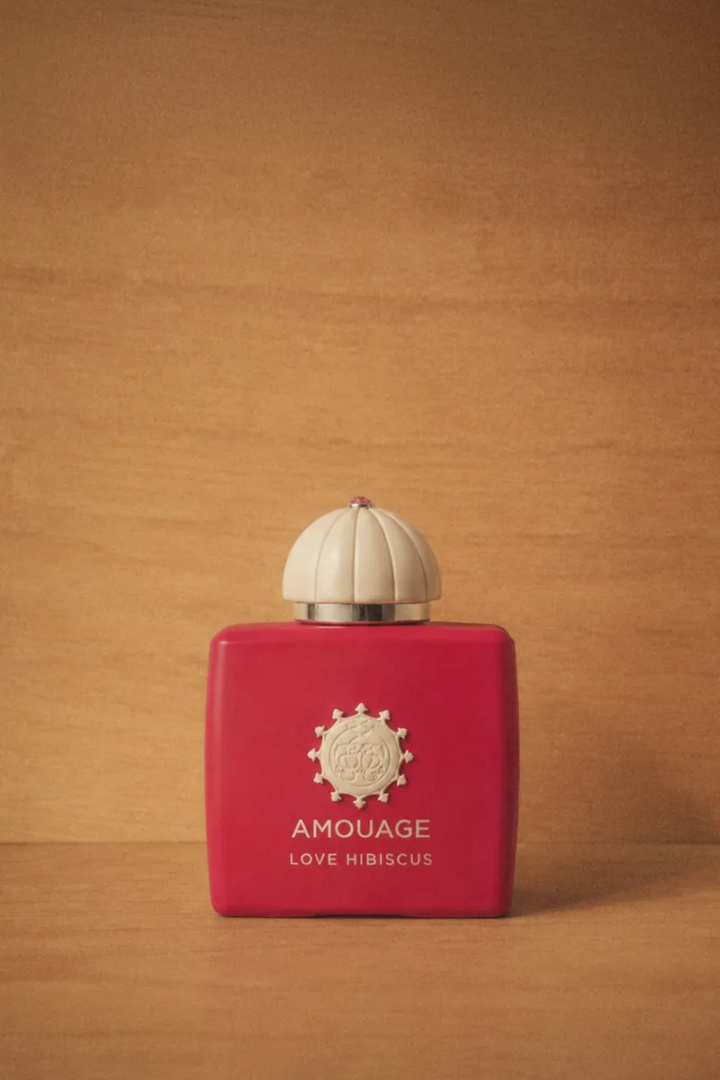
Perfumer: Jérôme Epinette
Collection: Secret Garden
Classification: Floral gourmand
Top notes: Hibiscus, Passion Fruit, Bergamot
Heart notes: Salted Caramel, Frankincense, Orris
Base notes: Sandalwood, Cypriol, Vanilla
Format: Eau de parfum, 100 ml