How the stereo speaker became one of design’s quietest icons
From hi-fi engineering to fashion boutiques, the stereo speaker has evolved beyond consumer electronics into a design object shaping interiors, listening culture and contemporary aesthetics
Jazz Kissa: The Soul of Japanese Listening Culture, gathers more than fifteen years of work by photographer and cultural historian Katsumasa Kusunose inside Japan’s jazz cafés — rooms where the audio system is the reason to walk in. The foreword is by Devon Turnbull, founder of OJAS, whose handmade speakers have travelled from underground listening rooms to fashion boutiques and museum floors.
That a design publisher would commit a large-format art book to cafés organised around vintage speaker cabinets is a symptom of something wider. The stereo speaker was built to disappear — so why is everyone looking at it?
Sound systems enter collectible design: Cosmic Sound at Nômade Temple Ibiza
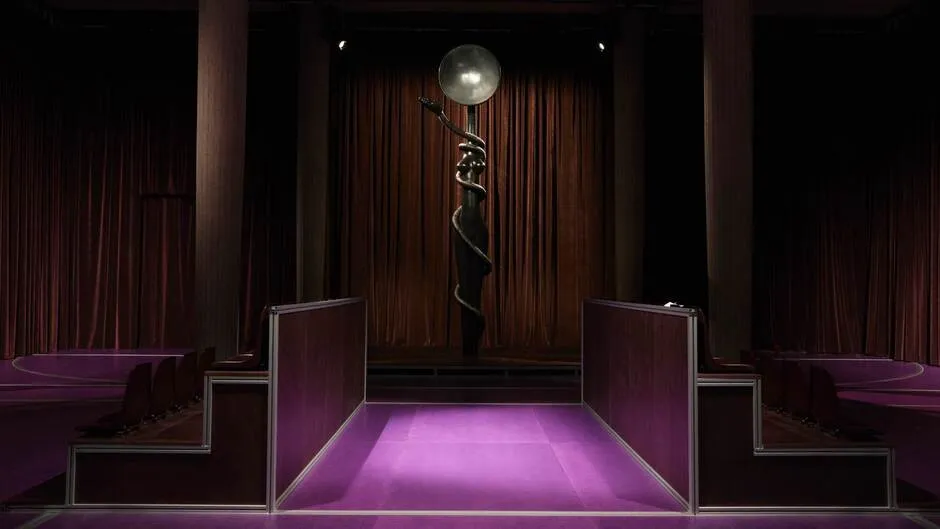
Sound is invisible. The objects that produce it are not. At Nômade Temple Ibiza, that distinction becomes the subject of Cosmic Sound, the inaugural exhibition by International Design, opening on September 30.
Curated by Valentina Guidi Ottobri with Manfredi Moretti and Gabriela Soleille, the exhibition brings together objects associated with music culture, from DJ turntable consoles and sound systems to vinyl-first furnishings and sculptural speakers.
Running through October 10, Cosmic Sound treats these objects not as equipment but as works shaped by architecture, craftsmanship and the people moving through the space. Moretti and Jules Guérard, both DJs and co-founders of International Design, approach sound through the objects that produce, carry and frame it. The speaker, once designed to disappear behind the music, becomes difficult to overlook.
Listening bars and the revival of sound as a social experience
For most of the twentieth century, listening was a physical act. Later, it became portable and unlimited; the physical experience disappeared. The listening bar emerged from Japan’s jazz kissa culture of the Fifties and Sixties. In these cafés, music was not background entertainment but was played for careful listening. Selected records were played through high-quality audio systems placed at the center of the room rather than being hidden. Listening bars were spots for the experience of sound.
Contemporary listening bars follow the same principle. From Tokyo to New York, London, Milan and Berlin, these bars are designed around the idea that music can be experienced physically and collectively. Interiors often feature dim lighting, vinyl collections, arranged seating and audio systems. What makes them different from a club is the objective: music does not overpower the room but connects the listener to the sound. The sound comes from the stereo speaker, placed at the center of the room.
The paradox of the stereo speaker: The object that exists between worlds
There are few objects as familiar yet overlooked as the stereo speaker. It has existed as a contradiction: physical, but designed to produce something intangible. The stereo speaker takes up space, demands precision, requires materials and engineering, yet its purpose is to disappear. The ideal stereo speaker has been the one that dissolves into the environment while creating the illusion of a space beyond the object. It removes itself from the experience of listening, allowing music to appear detached from its source.
Audio engineering has chased this idea for a long time. Every surface, every material, every cavity and every millimeter exists to solve a challenge: transforming electrical information into something the human body can experience. Sound may be intangible, but it is not entirely immaterial: it requires movement and air. It requires an object that can translate mathematics into vibration. In a stereo system, this process goes further. Two separate channels work together to create the perception of depth, direction and space, allowing sound to exist not only in time but also within an environment.
This makes the stereo speaker an object of cultural curiosity. It is a machine, but not entirely. It is close to furniture, yet it resists the category. It has existed between engineering and architecture, between industrial production and craftsmanship, between utility and sculpture. The paradox of the stereo speaker is that it is designed to serve the ear, yet it cannot help speaking to the eye.
Inside the stereo speaker: How signals become sound
The stereo speaker’s purpose is to move air. Everything else exists to control how that air reaches the listener. With every song, an electrical signal is transmitted from a source that is either an amplifier, a turntable or a streaming device. The signal passes through a voice coil suspended within a magnetic field. The current fluctuates, and the coil moves back and forth, driving a diaphragm that pushes the surrounding air. Those vibrations become sound.
Most stereo speakers divide this between multiple drivers. Woofers reproduce lower frequencies. Tweeters handle higher notes. A crossover distributes the signal between the two, allowing each to work within its range. The cabinet is engineered to minimize unwanted vibrations and resonance, ensuring accuracy of the sound. It is part of the acoustic system, not a container.
What sets the stereo apart from a conventional loudspeaker is the soundstage. The stereo system relies on two speakers with left and right channels. Together, they create the illusion of voices and instruments having distinct positions within a three-dimensional space rather than coming from a single source. The stereo does not only reproduce sound; it reconstructs an acoustic environment and turns electrical information into a spatial listening experience.
Stereo speakers began as a concept before becoming a system
The history of the stereo begins with a problem that predates it: how to capture and reproduce sound beyond the moment in which it was made. Before electronic audio production, sound existed as a live event. A voice, an instrument, an orchestra would perform at a certain time and place. Sound was experienced, but then it disappeared and could not be recovered.
The first forms of modern speaker technology emerged in the late nineteenth and early twentieth centuries with the development of electrical sound production. The late nineteenth century saw the rise of mechanical systems. Thomas Edison’s phonograph dominated recorded music. Emile Berliner then replaced Edison’s cylinder with the flat disc through the invention of the gramophone. Both, however, remained entirely mechanical up until 1925, when engineers Chester W. Rice and Edward W. Kellogg developed the modern dynamic loudspeaker. Their “hornless loudspeaker” replaced acoustic horns with a direct-radiating cone driven by a moving coil. This improved clarity, frequency response and efficiency. The invention became the foundation of radio receivers and domestic audio.
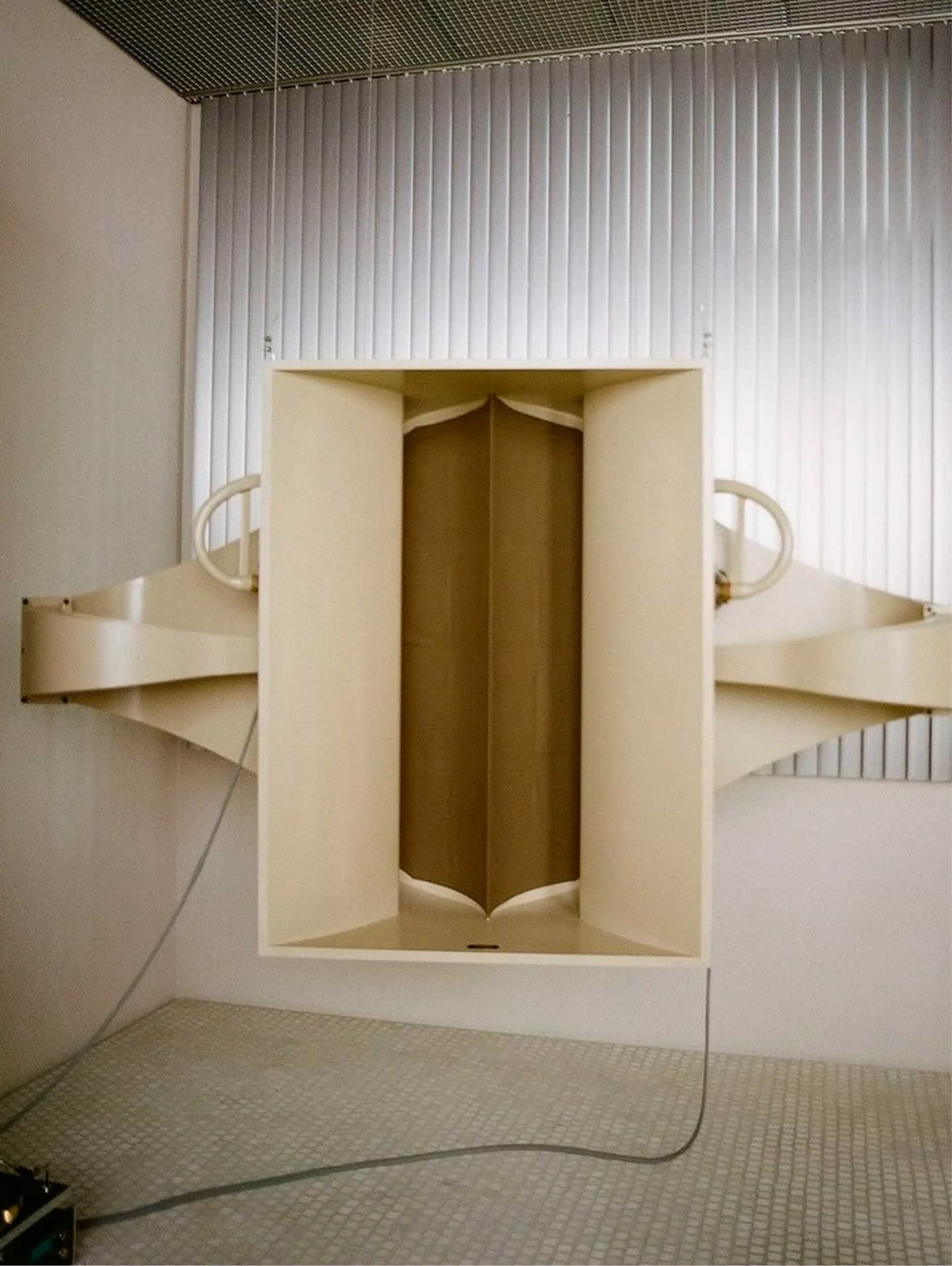
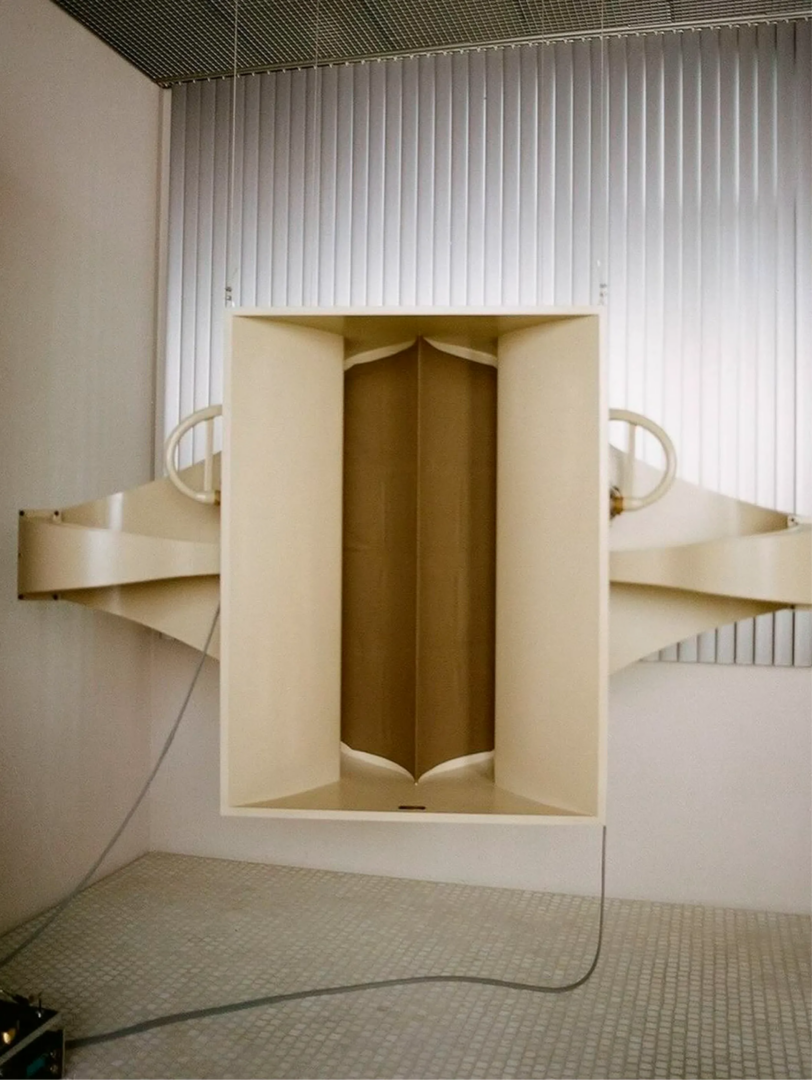
Horns did not disappear with the cone. The Western Electric 16A, a sheet-steel horn, was cinema technology of the Thirties. Contemporary builders have carried it into low-frequency engineering.
At this point, listeners were still hearing mono: every voice and instrument came from a single channel, collapsing an orchestra into one point in space. It lacked spatial perception.
From mono to stereo: The search for spatial sound
When British engineer Alan Dower Blumlein filed British Patent No. 394,325 in 1931, the problem with mono found its solution. He introduced principles of stereophonic recording and reproduction. His system offered two independent audio channels, reproduced through two separate loudspeakers, allowing listeners to perceive direction, width and depth. The listener could now experience an acoustic image stretching between the left and right speakers. This was the beginning of modern stereo.
When stereo entered everyday life after the launch of the LP by Columbia Records in 1958, it transformed home listening. Instead of a single speaker, people purchased a pair, positioning them in the room to create a soundstage. The speaker was no longer only placed in a space; the room itself became part of the listening experience, shaping how music was perceived through the distance between the two speakers, orientation and surrounding architecture.
The age of hi-fi: The stereo changes, the principles remain
The Sixties and Seventies marked the age of hi-fi. Stereo systems became part of interiors: they came with turntables, speaker cabinets, amplifiers. Companies like JBL, Bang & Olufsen, KEF and Bowers & Wilkins competed not only in acoustic performance but also in craftsmanship and design. Walnut veneers, sculptural forms, proportioned cabinets: the offerings reflected a growing understanding that the stereo speaker was no longer only a technical instrument. It was now an object that shaped both the sound and the visual identity of the room.
Italian hi-fi of the Seventies concealed electronics inside furniture. One wooden cube opens to reveal speakers, a turntable, a radio and an eight-track player. Willy Rizzo’s designs from the same decade inform the Commander, made of brushed silver-tone metal and lacquered wood.
Dieter Rams and Michele De Lucchi: The speaker as part of the interior
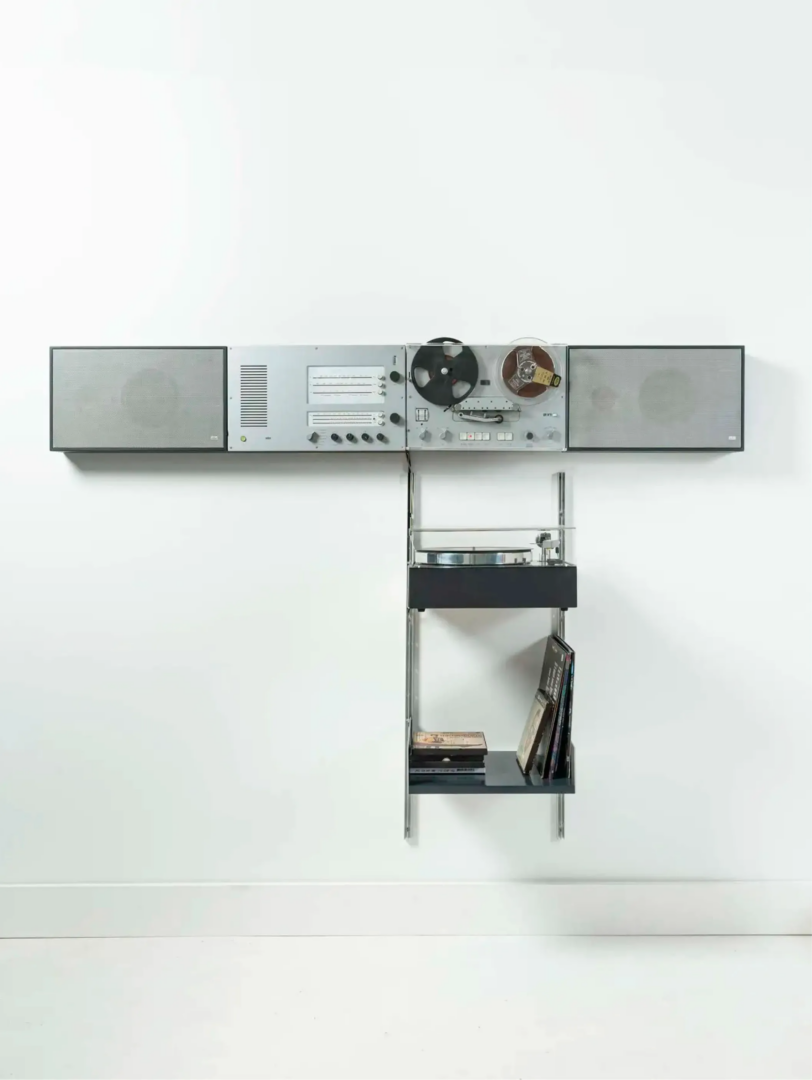
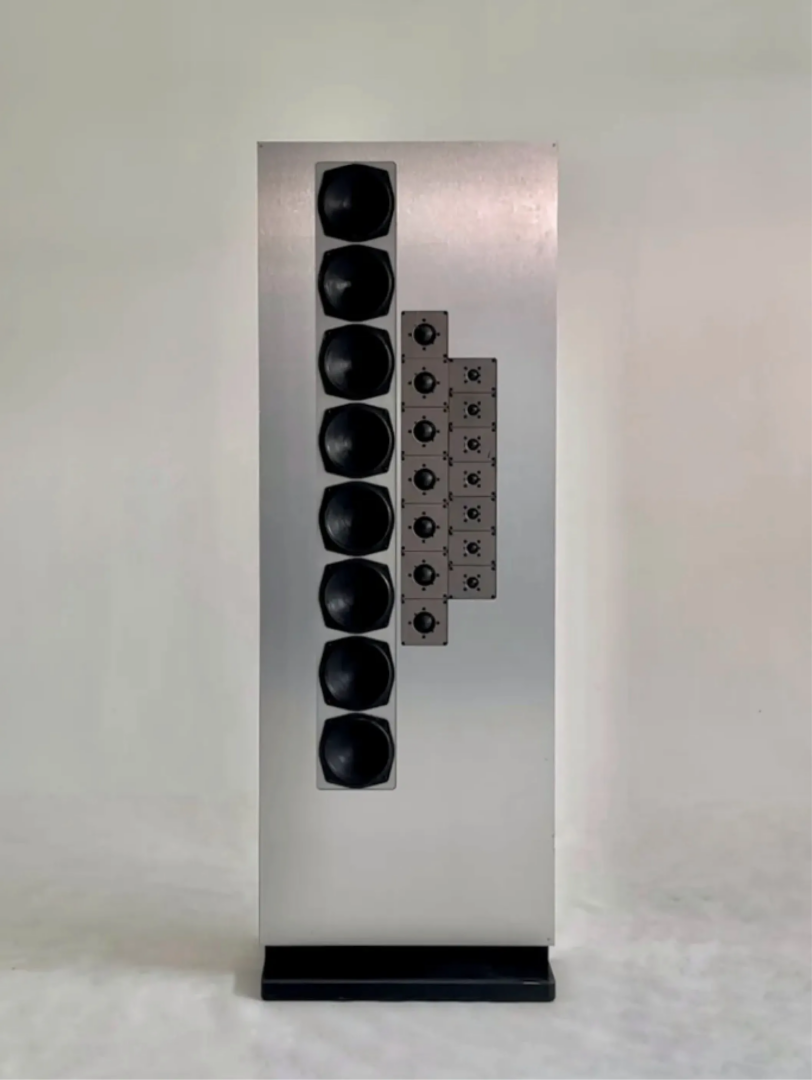
Dieter Rams at Braun gave this relationship between technology and visual order one of its expressions. From the SK4 to the Atelier systems and L1 loudspeakers, Rams developed a language for audio equipment based on proportion, legibility and reduction. One of his wall-mounted systems combines a radio-amplifier, a reel-to-reel recorder, a turntable and two loudspeakers. Rams made it from painted sheet steel, anodized aluminum and lacquered wood. The technology was not disguised; neither was it decorated. The controls, components and speakers were designed as part of the architecture of the home. Rams helped establish the idea that a hi-fi system could be considered without becoming visually excessive, a principle that continues to shape the language of audio design today.
Michele De Lucchi pushed this relationship between technology and the domestic environment further. He treated sound as something that belongs to the architecture of a room rather than sitting outside it. Across his work, objects are rarely considered in isolation. Their scale, material, position and relationship to the surrounding space are part of how they are experienced. Applied to audio, this changed the role of the speaker. It was no longer only a technical component placed inside an interior, but part of the interior itself. The cabinet became a surface, its proportions affecting the way it occupied the room. The position determined how sound traveled through it. The distinction between an audio object and a piece of furniture became less obvious. This is where the stereo speaker began to acquire a second function: it still produced sound, but it also structured the space in which that sound was heard.
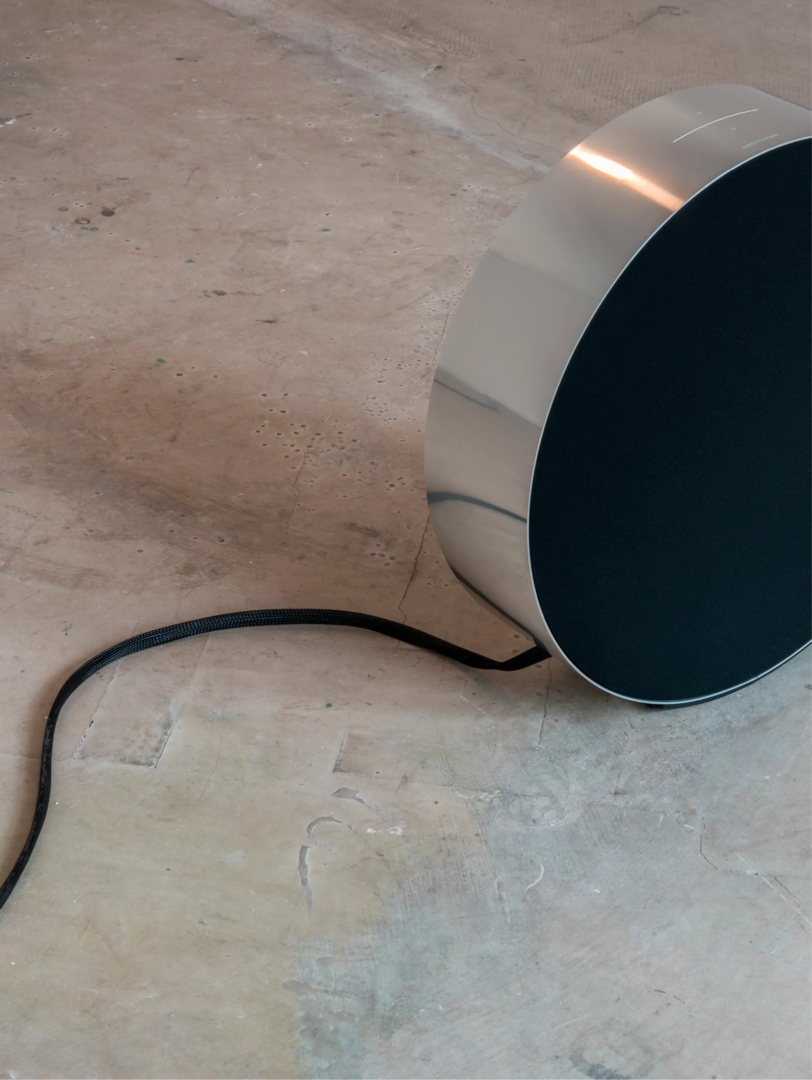
From the Eighties, updates were introduced: digital recording, compact discs, computer-aided acoustic modeling, wireless technologies. The stereo speaker transformed, but its principle remained consistent. It still depended on two channels working to construct an illusion of space. Bang & Olufsen’s Beosound Edge is a wireless speaker shaped as a fifty-centimeter (nearly twenty-inch) disc. It has a curved aluminum outer ring and fabric covers.
Transparent: When the stereo speaker reveals itself
The history of the stereo speaker was defined by concealment. Transparent proposed a different philosophy. The Swedish company, founded by industrial designers Martin Willers, Per Brickstad and Magnus Wiberg, came up with the Transparent Speaker while exploring how they could fit an electronic product into a space. The speaker exposes what traditional audio products tried to conceal for decades: drivers, wiring, structural components. The inner architecture of the speaker is enclosed in a tempered-glass cabinet framed by aluminum.
What started as an aesthetic idea expanded in different directions. “Transparent sound” is a term in audio engineering for a system reproducing music with accuracy and authenticity. This idea became one of the driving forces behind Transparent: making technology visible in the way it is designed, manufactured and maintained.
Transparency beyond aesthetics: The speaker built for circularity
The idea of transparency expanded to circularity too. Products are replaced when software becomes outdated or components fail, generating millions of metric tons of electronic waste each year. Transparent rejects this through a modular architecture designed around the principles of the circular economy. It does not require replacing an entire speaker but repairing an individual electronic module. The goal is to improve products with age rather than pushing newer ones.
Material choices support the approach. Aluminum and tempered glass are the main materials of the Transparent Speaker. They may have been chosen for their durability and minimalist appearance, but their potential recyclability played a role too. They can be reintroduced into existing material systems.
Beyond the box: Rethinking the speaker through space
Eventually, designers started questioning what a speaker had to look like. With his Sound Geometry, Jacopo Gonzato moved the speaker away from the cabinet-and-cone format. He used geometric structures as part of the acoustic system itself. The forms were not only sculptural shells around a speaker. Their surfaces and materials played a role in how sound was produced and dispersed, making geometry part of the acoustic design. His Paloma Console, engineered by Vismara, is built on the same method: shaping sound diffusion from the geometry of Platonic solids.
Working under the name Neuf Voix, Elvio Seta approached the same problem from a different perspective. The focus was more on spatial composition. His Acousmonium ODAE was a modular, self-built multichannel system designed to handle the spatial complexity of his work. Seta, a composer, built it on analog technologies of the Seventies, Eighties and Nineties. Seta stopped treating speakers as fixed points from which sound emerged. Rather, he chose to arrange them as active elements within the room. Sound could move, spread and change depending on where the listener stood. Seta’s approach was different from Gonzato’s, but both moved the speaker away from the idea of a finished box containing a technical mechanism. The object became part of the composition of the room, with its form, material and placement affecting what the listener heard.
Yont Studio at Milan Design Week 2026: The sound system as architecture
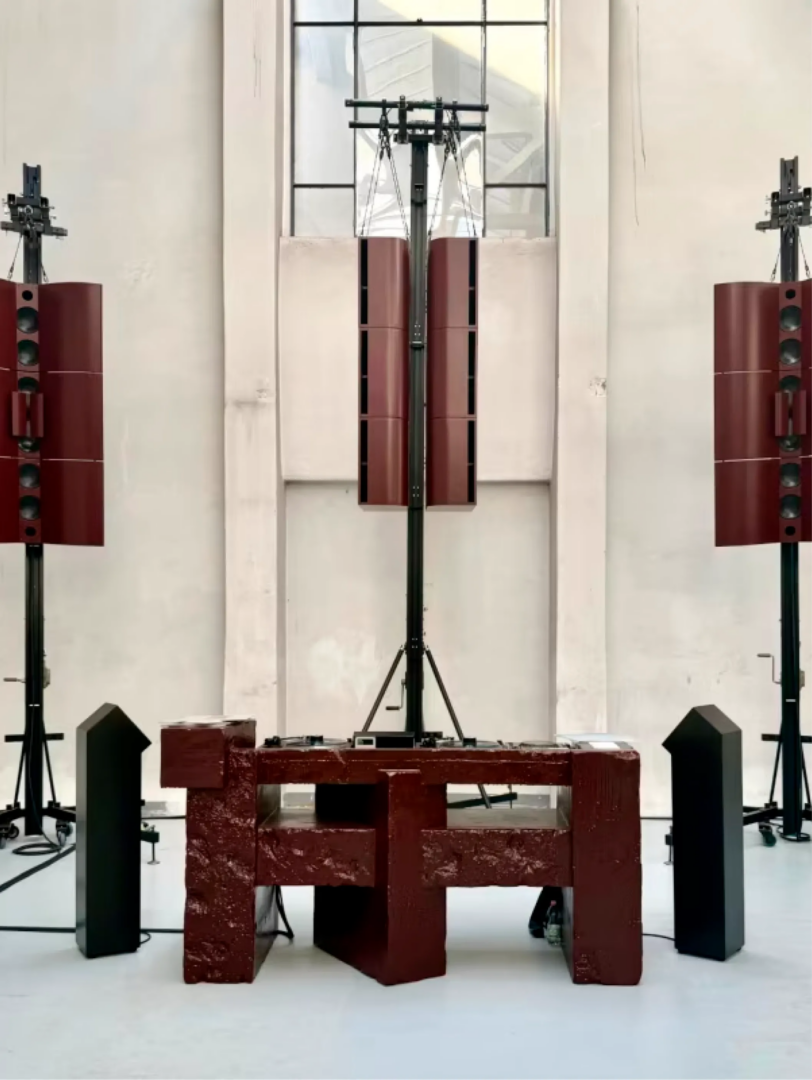
Today, the sound system increasingly behaves like architecture. Yont Studio, the Berlin practice founded by designer Serdar Ayvaz, explored this idea at Milan Design Week 2026 with a brutalist DJ booth positioned between two speakers developed with New Fidelity. The booth is made of styrofoam, epoxy and high-gloss paint, shaped to look like a block of concrete. The installation sat somewhere between a listening environment, a club and a piece of furniture. Its forms drew from the materiality of Berlin’s brutalist spaces, while the arrangement of the console and speakers helped organize the space around listening. The sound system was no longer only placed within the room. It became part of how the room was experienced.
The rise of sound as a cultural language in fashion
Sound, invisible by nature, has entered fashion spaces. If the speaker can define a room, fashion has a reason to pay attention. When Devon Turnbull founded OJAS in the 2010s, the idea of speakers as artisanal design objects existed largely outside the fashion conversation. His work began to change that perception.
Supreme’s Brooklyn outpost, for which the brand commissioned Turnbull in 2017, changed the relationship between fashion and sound. Virgil Abloh then purchased OJAS pieces and included Turnbull’s works in his Figures of Speech exhibition at Chicago’s Museum of Contemporary Art.
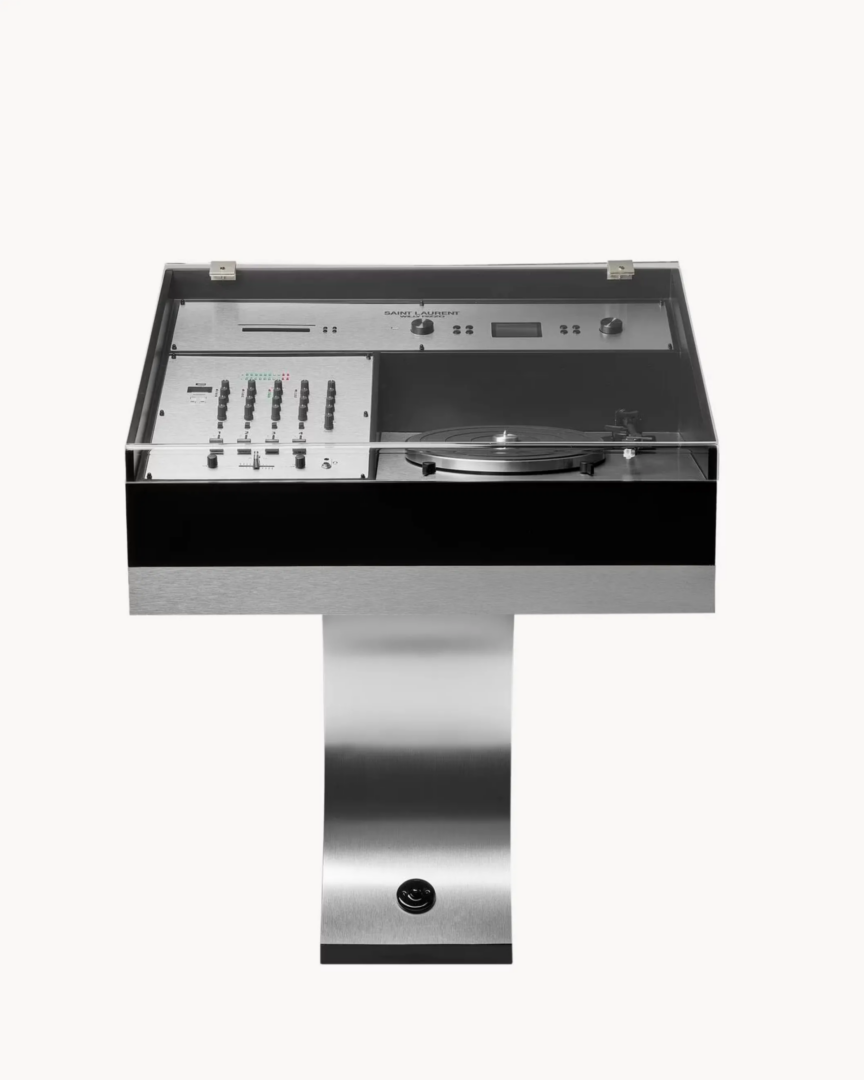
Around the same time, in 2019, Saint Laurent explored the relationship between fashion and audio through its collaboration with Bang & Olufsen, creating limited-edition speakers. At this point, the speaker was no longer an invisible technological element; it was now an object of aesthetic and cultural value.
Fendi and Valentino: Listening as spatial design
Luxury houses began treating listening itself as an experience to be designed. In 2024, Fendi transformed Palazzo Fendi Milano into an environment where fashion, art, design and craftsmanship coexist. The project incorporated an audio system designed to adapt to the different spaces of the building, making sound part of the atmosphere rather than a separate element. Here, listening became a layer of spatial design. Though still partially discreet, it shaped the experience of the space without competing with it.
The approach evolved further in the summer of 2025, when Valentino transformed its Madison Avenue boutique into L’Atelier Sonore, a listening room. At this point, sound became present. It no longer accompanied fashion but became something around which a space and an experience could be built.
Stone Island Sound: The speaker becomes material research
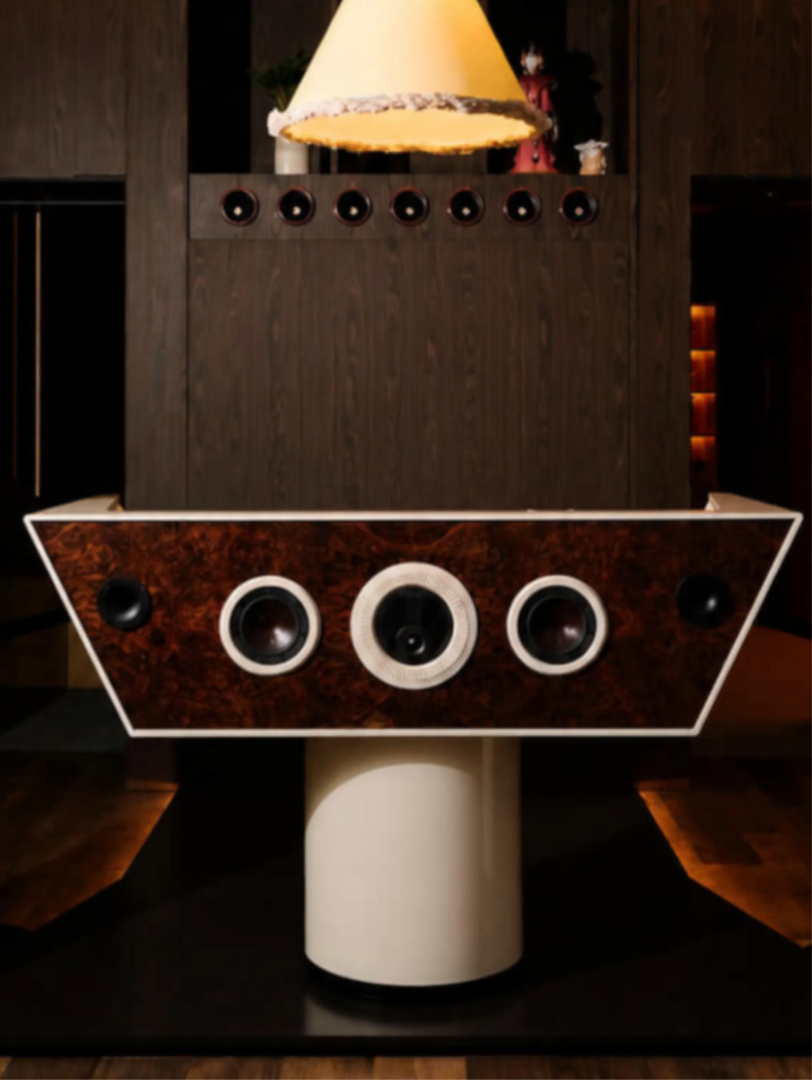
Since 1982, Stone Island has built its identity around material research. The brand approached sound similarly—as an area of research and an invisible material to engineer and experience.
Stone Island Sound launched as an ongoing cultural platform that explores the relationship between music, technology and community. The research into this relationship extended into the brand’s flagship store in New York. Opened in September 2025 at 70 Green Street, inside a SoHo cast-iron building, the store introduced a retail concept developed with AMO. The space was designed in collaboration with Jason Long.
Ledongil Workshop and Friendly Pressure: The sound system inside the SoHo store
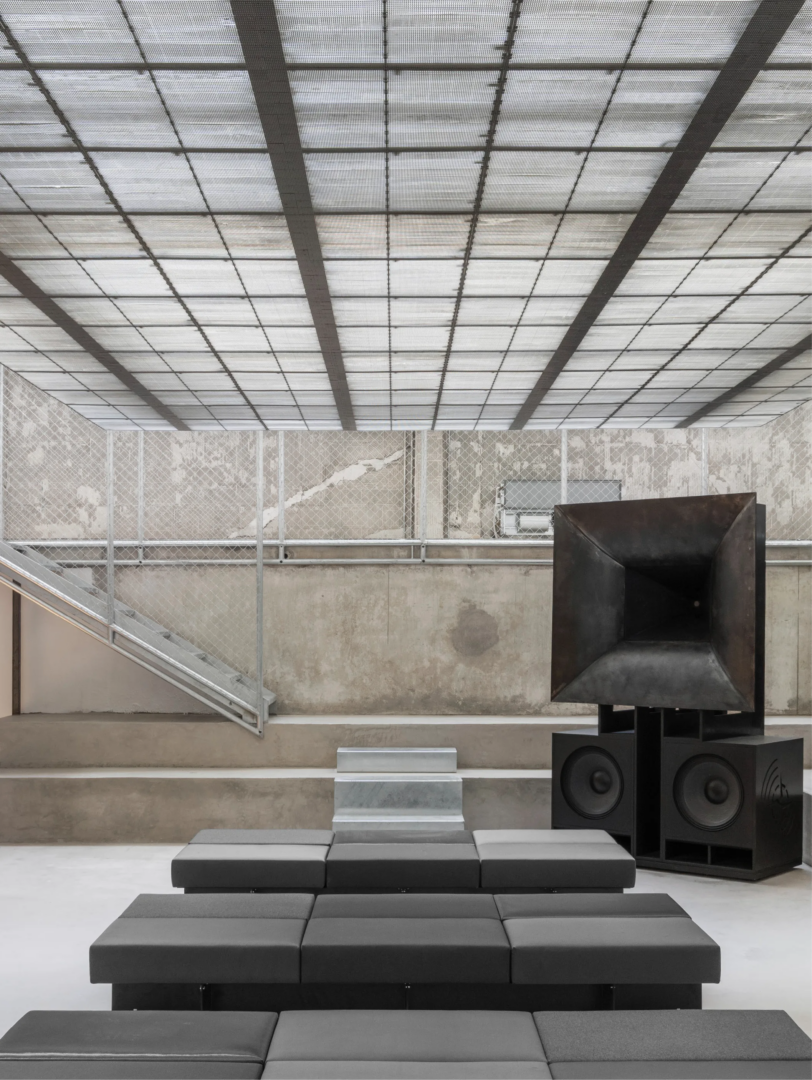
Sound is embedded into this architecture. The audio environment was developed through a custom system by Ledongil Workshop, with in-wall speakers integrated into the space. The lower level becomes an area dedicated to gatherings. Music, books, a bar and a DJ booth are activated by a sound system by Friendly Pressure, a London-based sound system studio. Its modular hi-fi system combines different frequencies into one sound source, drawing on the Klangfilm speakers of the Fifties. They opened with a listening experience that turned the store into a listening environment. Jazz, reggae, house, club, electronic and hip-hop performances placed the audio system at the center of the event.
What happens to the stereo speaker when fashion moves on?
Streaming is not going away anytime soon. As AI-generated music and algorithmic playlists grow, the consumption of sound detaches from the act of listening. When music becomes infinitely reproducible, differentiation shifts to how it is experienced.
This is how vinyl survived: it offers a different ritual of consumption. Mechanical watches remain desirable despite the popularity of smartphones. Film cameras survived the rise of digital photography. Bookstores remain despite e-books. They survived not because they are more efficient, but because they offer a different relationship with the object.
The stereo speaker is following a similar path. It is no longer a necessity. Its value is now in the experience. As audio continues to dematerialize through digital technologies, the speaker gets its value from physical presence, craftsmanship, endurance, the ability to shape space. It shifts from necessity to choice, and through that, to permanence.
Fashion’s fascination with the speaker is likely to subside. The industry is driven by novelty. Yet entering fashion remains one of the fastest ways to gain cultural visibility and attract new audiences. The stereo speaker may eventually leave the spotlight—like vinyl records, film cameras or fountain pens—but it is unlikely to disappear from fashion’s cultural vocabulary. Once absorbed into the worlds of design, interior and craftsmanship, objects tend to outlive the trends that first brought them there.