Michael Anastassiades and Flos: the designer’s own lamps enter the Flos catalogue
Tip of the Tongue, Relay and Frame 3X3 are the first three models Flos produces under the agreement announced on 7 October 2026, in mouth-blown opal glass, borosilicate and chrome-plated aluminium
On 7 October 2026, Flos and Michael Anastassiades announced an agreement. Lighting developed and sold through the designer’s own brand will be produced and distributed by Flos. The first three models arrive with the Fall 2026 sales campaign.
Michael Anastassiades and Flos: the terms of the 2026 agreement
Flos, the Italian lighting company founded in Merano in 1962, takes over a selection of lamps from Michael Anastassiades’ eponymous brand. The designer founded Michael Anastassiades Ltd in London in 2007 to produce his own lighting, furniture, jewellery and tableware. Flos manufactures the selected lamps, adds them to its catalogue and handles their international distribution.
“Since it began in 2011, my collaboration with Flos has become an important part of my work as a lighting designer,” Anastassiades said in the joint announcement. “I see it as a natural evolution that the projects I developed with my brand over the last twenty years continue with Flos.”
Tip of the Tongue, Relay and Frame 3X3: the first three Flos editions
Flos re-engineered each of the three models for industrial production and kept the original design.
Tip of the Tongue dates from 2013. It is a table lamp with a sphere of mouth-blown opal glass that sits on the edge of a cylindrical base, as though about to roll off. The name refers to a word you almost remember but cannot say. The Flos edition comes in 24K gold, black nickel, green, red, blue and grey.
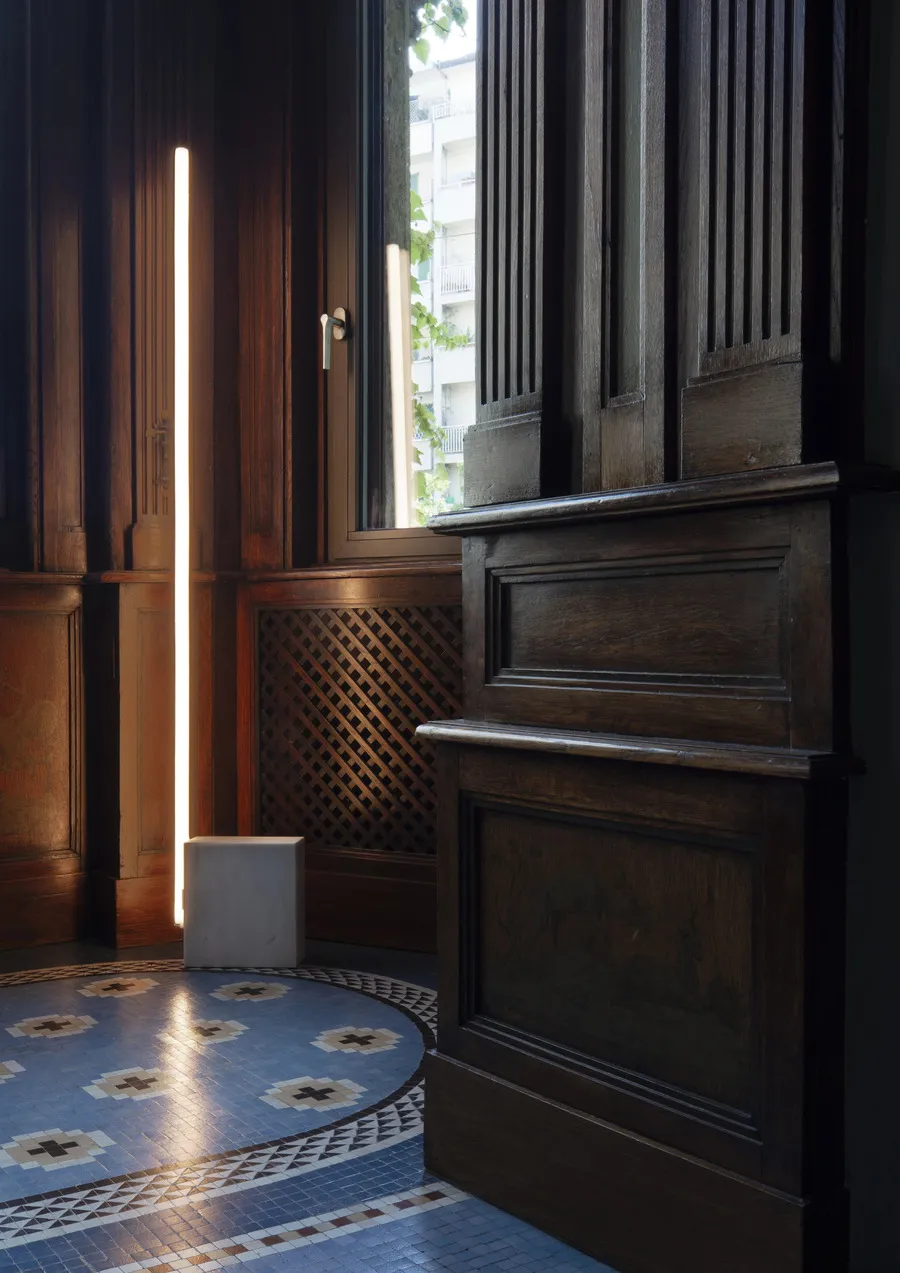
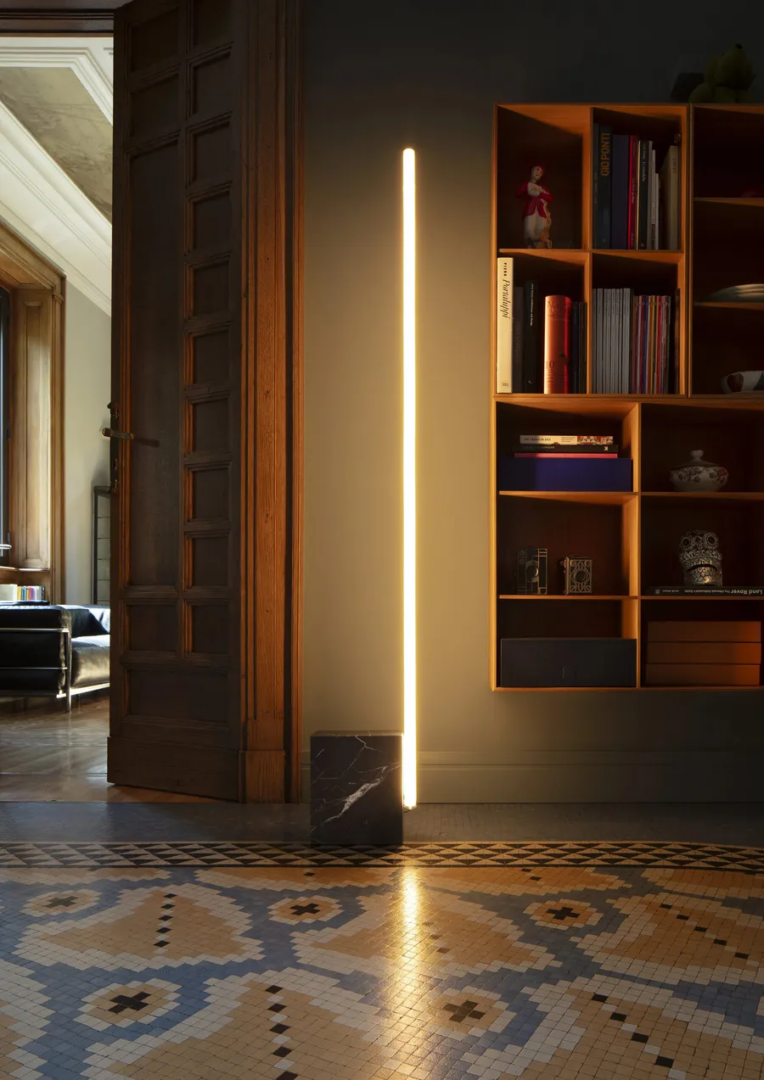
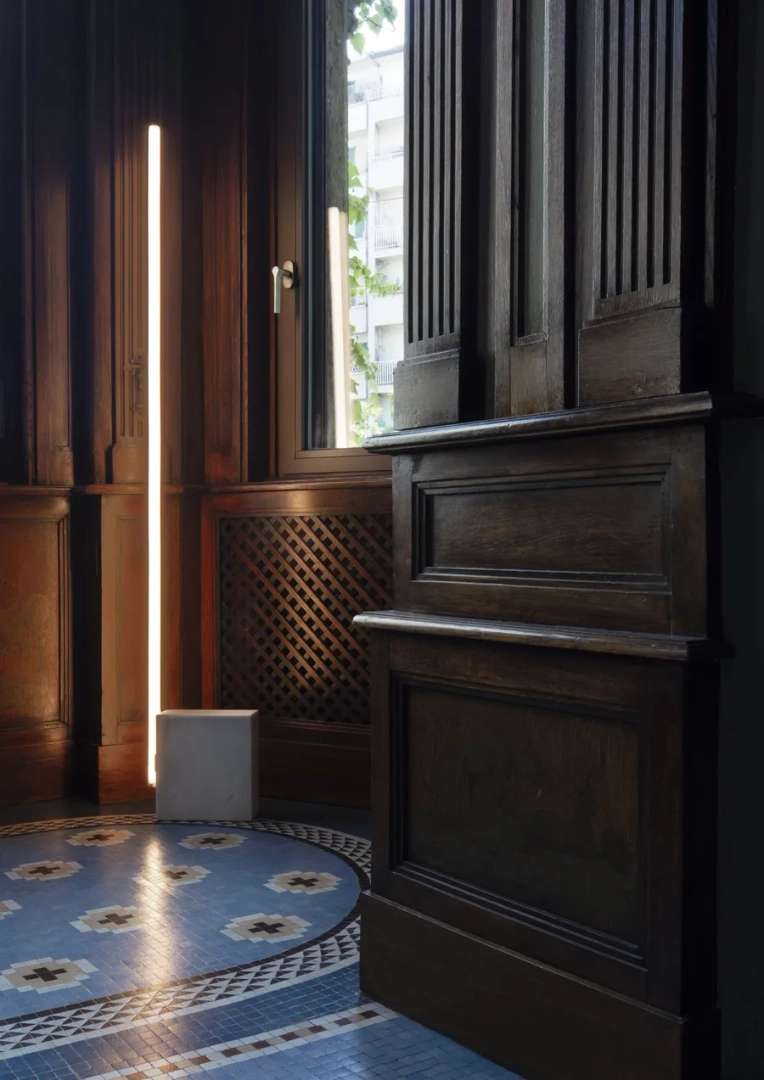
Relay (2022) is a floor lamp. A tube of opal borosilicate glass, 169.5 centimetres tall, rests against a stone block, held by a hidden magnet. The base comes in white Carrara marble, black Marquina marble or basaltina stone.
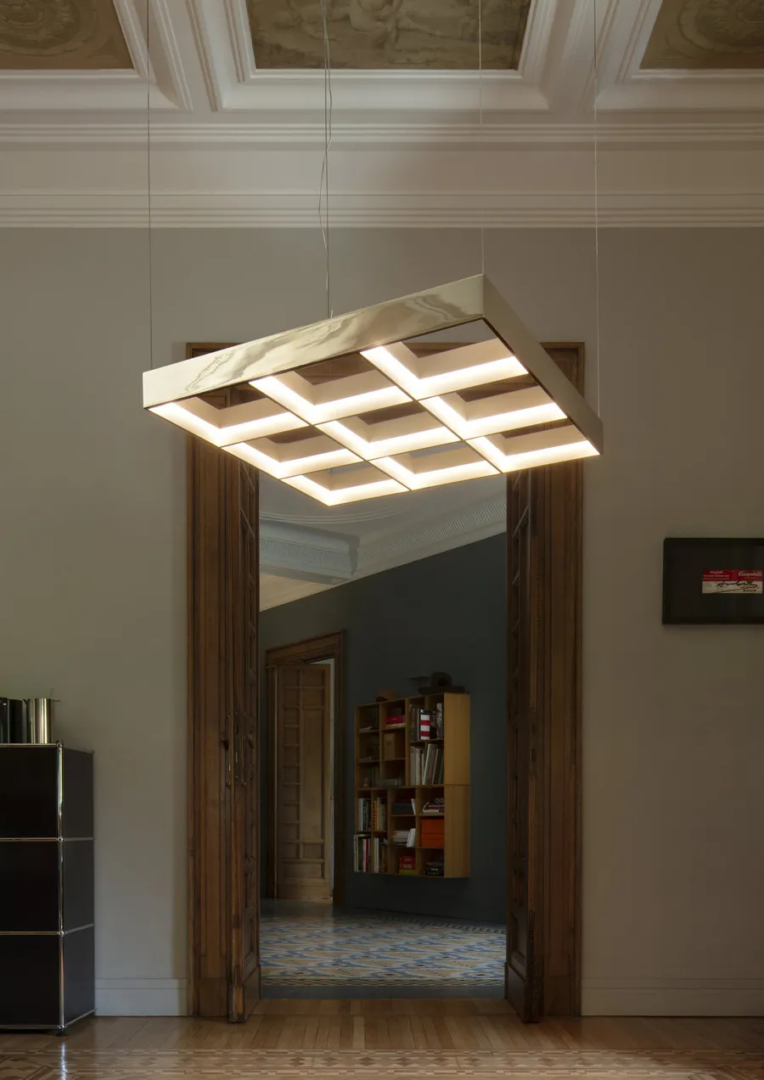
Frame 3X3 (2025) is a pendant lamp, 60 by 60 centimetres, in polished chrome-plated aluminium. Its grid of nine squares draws on the ceiling panels of ordinary offices and on the Windows series by the American painter Ellsworth Kelly. LED strips set into the frame light the inner surfaces.
Michael Anastassiades’ lamps for Flos, from String Lights to Linked
The collaboration began in 2011, when Anastassiades met Piero Gandini, now executive chairman and artistic supervisor of Flos B&B Italia Group. String Lights and IC Lights followed in 2013. String Lights uses the electric cable as a line the user arranges across a room. IC Lights balances a glass sphere on a thin stem.
Captain Flint, a floor lamp, came out in 2015. In 2018 Flos asked Anastassiades to work with cocoon, the sprayed material the company used for its first lamps in the 1960s: the result was Overlap, a pendant lamp. The same year saw Arrangements, a modular system of geometric LED elements that combine into walls of light, chandeliers and chains, on the model of a piece of jewellery. Coordinates, made of lines of light set at right angles, and My Circuit, a flexible ceiling track in white rubber, both date from 2019. At the 2025 Salone del Mobile in Milan, Anastassiades showed a first prototype of Linked, a system of glass light chains.
B&B Italia, for which he designed the Jack bookcase, has been part of the same group as Flos since December 2018.
How Michael Anastassiades designs a lamp
In an earlier interview with Lampoon, Anastassiades explained his approach to lighting: “When you design a lamp, I believe the next step is understanding how it can interact with the surrounding environment. You have to predict how it will move, what it will emanate, how it will reflect on the walls. Light manifests itself in many different dimensions in nature, and to capture just one of those instances would be enough.”
His lamps combine elementary shapes, spheres and long tubes, with reflective surfaces: mirrored glass, polished bronze. He has also worked with marble, translucent alabaster, metal and wood.
Michael Anastassiades’ design method: Cyprus, London, “no excess”
Anastassiades was born in Cyprus. He studied civil engineering at Imperial College London and industrial design at the Royal College of Art, and opened his London studio in 1994.
He started drawing early. “I have always held a pencil in my hand, since I was a little child. When an adult or another child spoke to me, I would instantly offer a pencil and a sheet of blank paper, inviting them to draw.”
He describes his method as subtraction: removing, cleaning, reducing a form to what it needs. He sums it up in two words, repeated often: “No excess.”
He names the Cypriot architect Neoptolemos Michaelides as an early influence. Michaelides, a friend of his father, designed the family’s country house. “I have always loved the ability of Michaelides, active since the Fifties, to translate material elements and types of Cypriot vernacular architecture into the island’s weather conditions, within the Modernism debate. It is comparable to the style code pursued by Aris Konstantinidis, active in Greece during the same era.” Konstantinidis was a Greek modernist architect.
In 2019 the NiMAC in Nicosia, his birthplace, held Things that go together – A survey exhibition, a retrospective of his work, from 7 March to 20 July.
Michael Anastassiades and wood: the Dansk Møbelkunst collection in Oregon pine
Dansk Møbelkunst is a Copenhagen gallery with a space in Paris, on the Quai des Grands Augustins. Its owner, Marie-Louise Høstbo, deals in twentieth-century Scandinavian design. Anastassiades first worked with the gallery in 2016 on Stilleben, an installation built around chandeliers and furniture. He later designed a collection of numbered pieces in Oregon pine: a square table, and a folding screen that encloses a semicircular chair.
“The work for Dansk Møbelkunst introduced me to fine carpentry,” he said. “Oregon pine is honest, not normally used in art like mahogany or oak. My aim was to transform it.” The pine furniture of the Swedish designer Axel Einar Hjorth was a reference. “I tried to express a timeless style in terms of the materials and ways of using them. There is no choice: you have to approach them with honesty, without being tempted by any nostalgia.”
On the gallery’s choice to commission a living designer: “A gallery like Dansk, which followed a strict historical itinerary, moving into the contemporary becomes a statement. It spurs you to go beyond clichés.”
Michael Anastassiades beyond Flos: glass, sound, public space
Anastassiades has designed glassware for Lobmeyr in Vienna and Puiforcat in Paris. For Svenskt Tenn, the Stockholm company founded by Estrid Ericson in 1924, he made lamps and vases. In 2018 he designed Beosound Edge for Bang & Olufsen, a round aluminium speaker: rolling it along the floor adjusts the volume.
The same year, during the London Design Festival, he installed The Fleet in the garden of the Victoria and Albert Museum. It is a fluted column clad in reflective bronze, with a drinking fountain on top. Leaning in to drink from its curved surface, visitors see their faces lit by golden reflections.
In Mint Street, Southwark, he laid a carpet of recycled Portuguese marble, made from offcuts and samples rejected by producers, architects and designers. “I wanted to highlight the beauty of Portuguese pink marble combined with other distinctive tones. A carpet that marks a portion of space or a trail. I imagined this dynamic pathway winding through the street, closely connecting the park with the rest of the neighbourhood.”
His work is in the collections of MoMA in New York, the V&A and the Crafts Council in London, the FRAC Centre in Orléans and the MAK in Vienna.