Stone Island Milan flagship: hand-fused green glass leads a material laboratory by OMA/AMO
OMA/AMO and Samir Bantal fill six hundred square meters in Milan with hand-fused green glass, carbonized cork and resin steps, applying garment treatments to space
Stone Island Milan flagship: green glass at Corso Matteotti 18
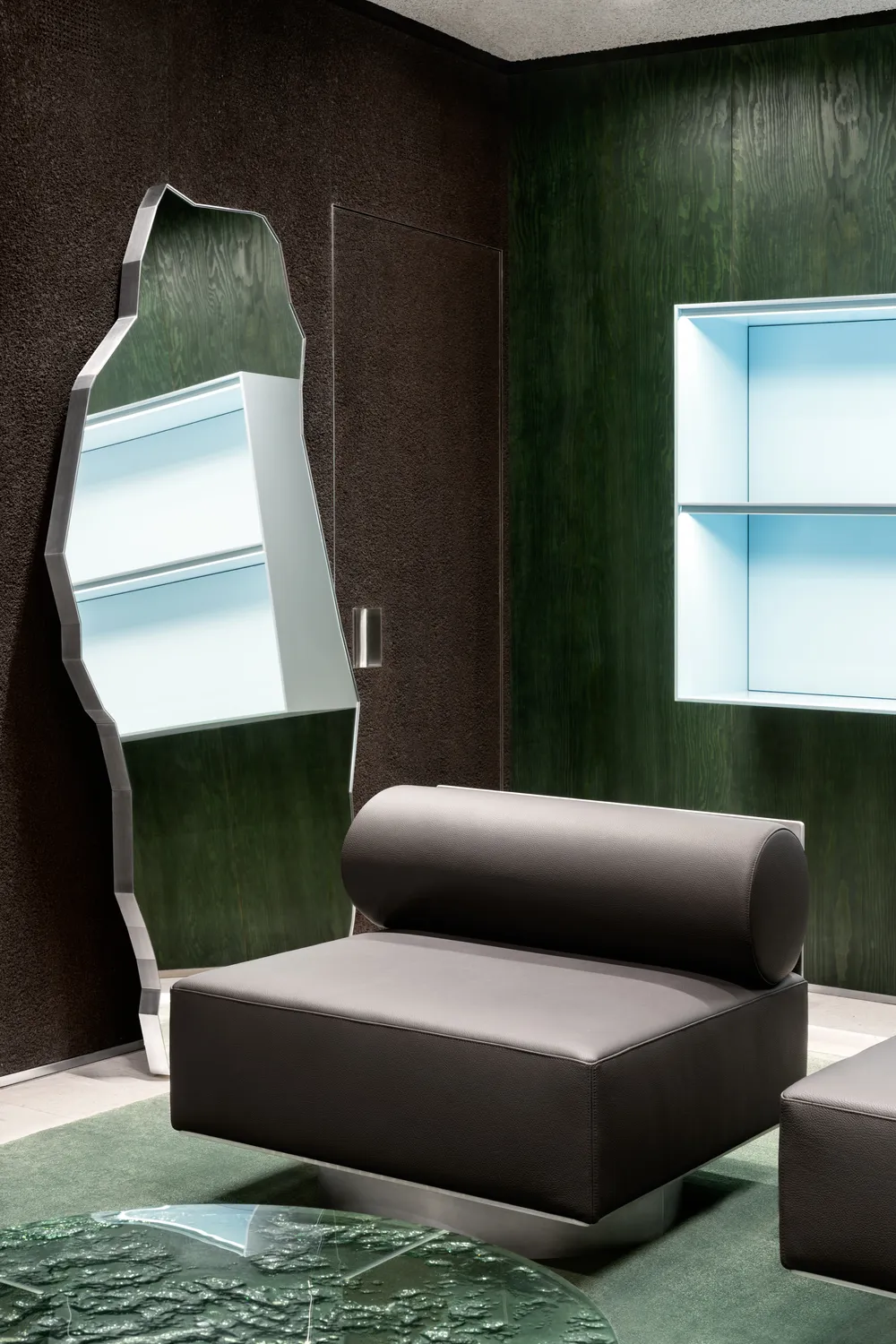
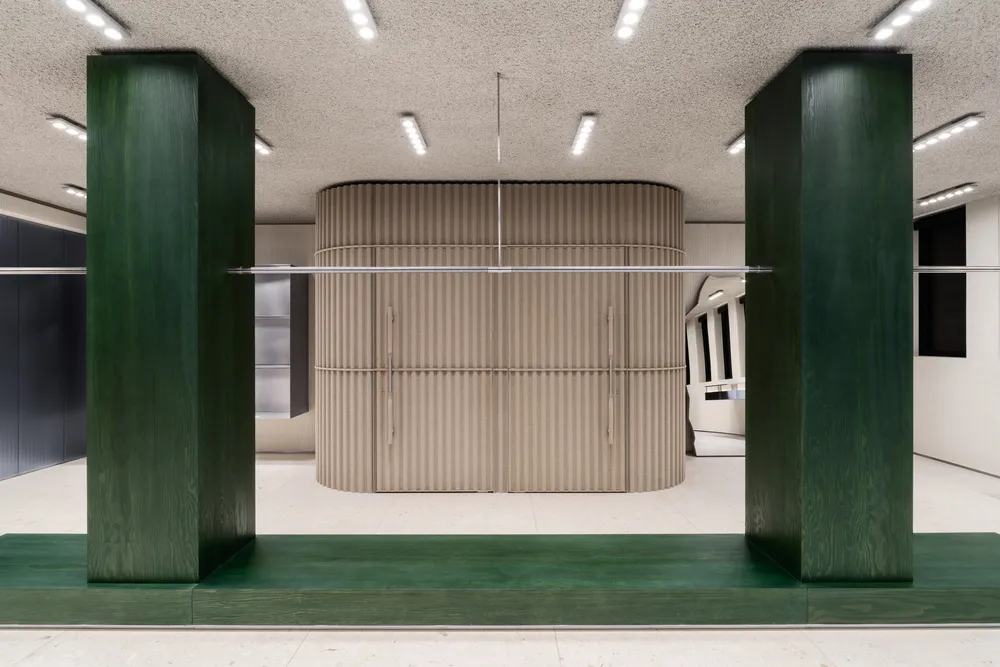
At the rear of the Stone Island Milan flagship, a column disappears behind a wrap of green glass. The glass is fused by hand and shaped over sand, so its surface keeps the grain of the mold. Glass has long been a constant in Stone Island stores. In Milan it returns as a material that shows how it was made. The same rule runs through the rest of the interior.
Stone Island reopened the store on November 20, 2026 at Corso Giacomo Matteotti 18, inside the Palazzo del Toro. The building dates to the nineteen-thirties. OMA/AMO redesigned the interior, with Samir Bantal, partner at OMA/AMO, leading the project. The store covers about six hundred square meters across two floors. It is currently the largest Stone Island store in the world.
The project applies the brand’s method for garments to architecture. Materials undergo treatment, and the treatment stays visible. Glass takes shape over sand, cork is burned, and resin fills a metal grid. The ground floor works as the main retail space. The upper floor serves as a venue for talks, art, music and sport.
Stone Island opened its first Milan store in 1999, on Corso Venezia. In 2019 it moved to Corso Matteotti, a short walk from Via Montenapoleone. The current renovation replaces the 2019 interior with the OMA/AMO concept the brand now uses across its network.
The Palazzo del Toro stands at the corner of Corso Matteotti and Piazza San Babila. Emilio Lancia and Raffaele Merendi designed it in the second half of the nineteen-thirties. The complex also houses the Teatro Nuovo. The store occupies two levels of the building, with windows on the Corso and onto the internal gallery.
The Hyperobject: a carved cork volume through the Stone Island Milan store
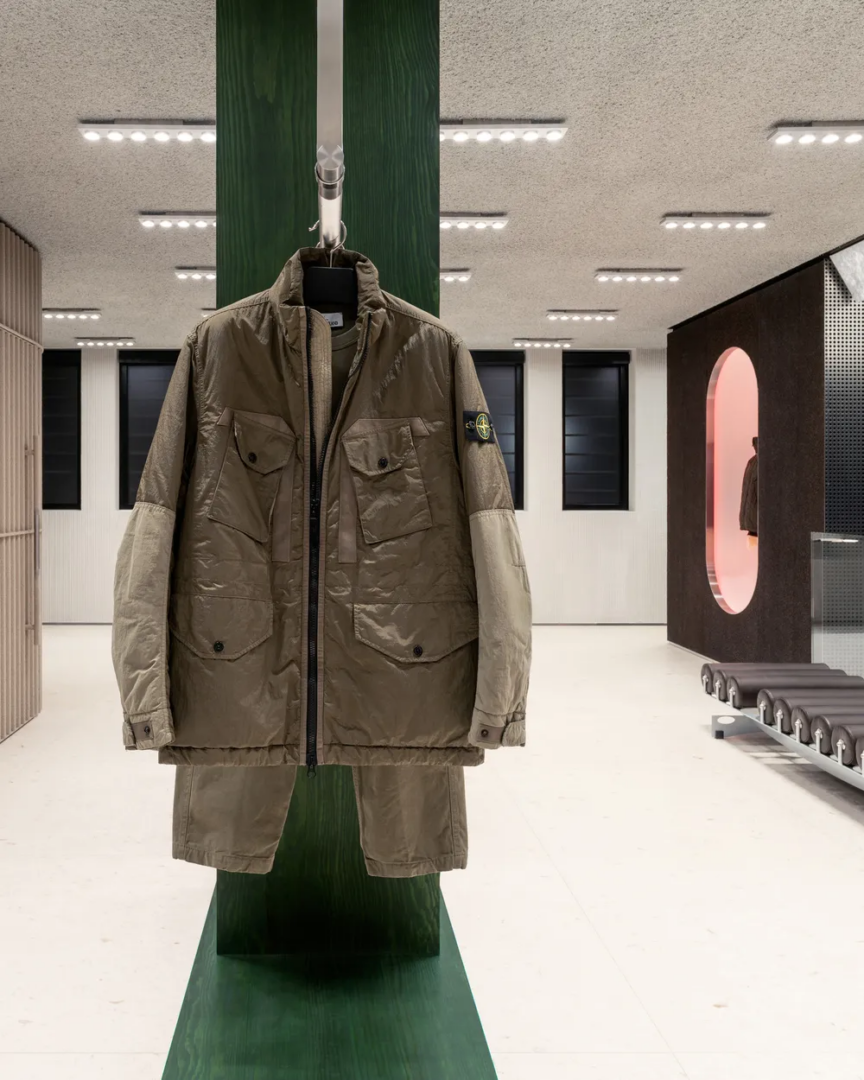
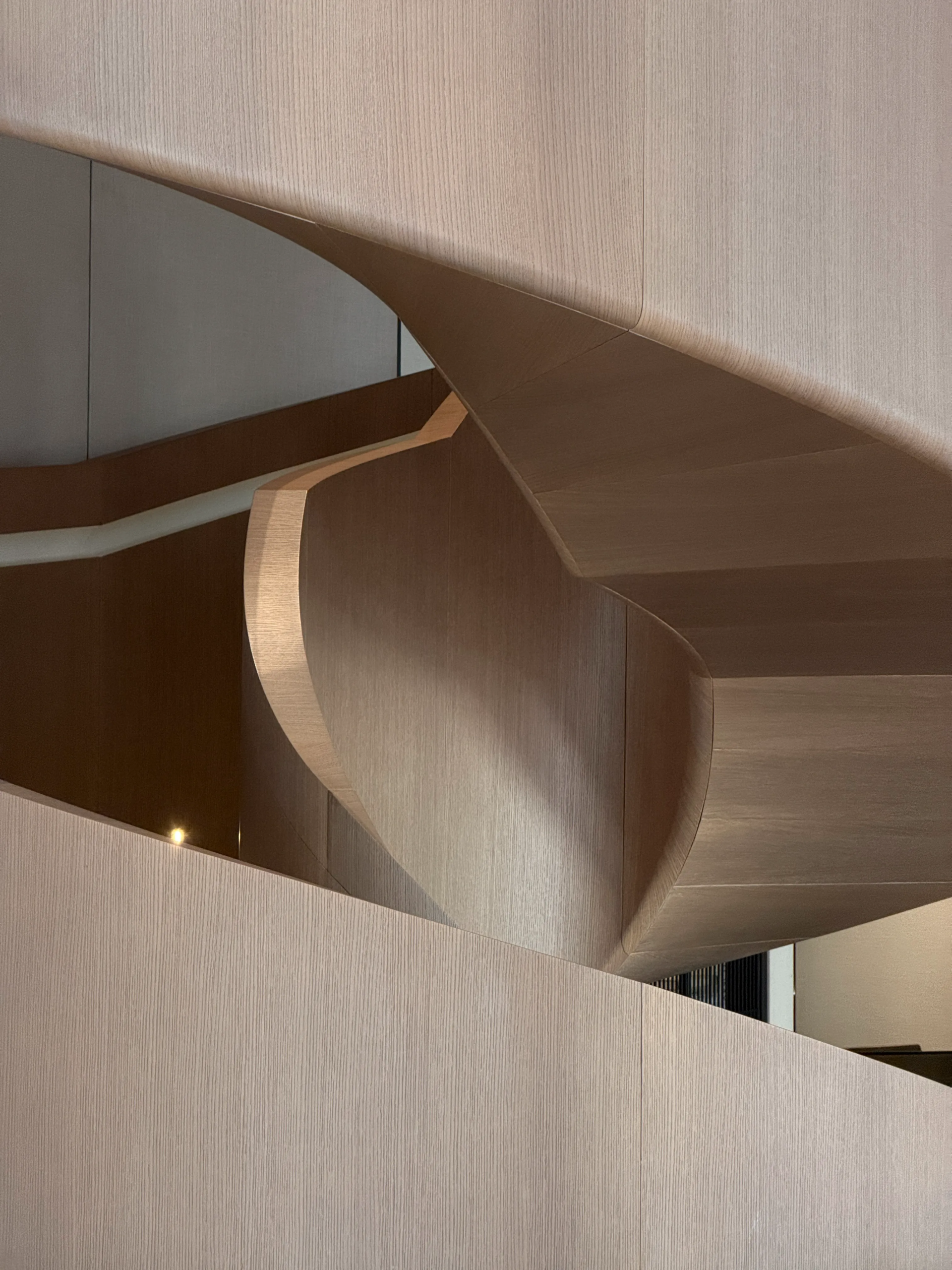
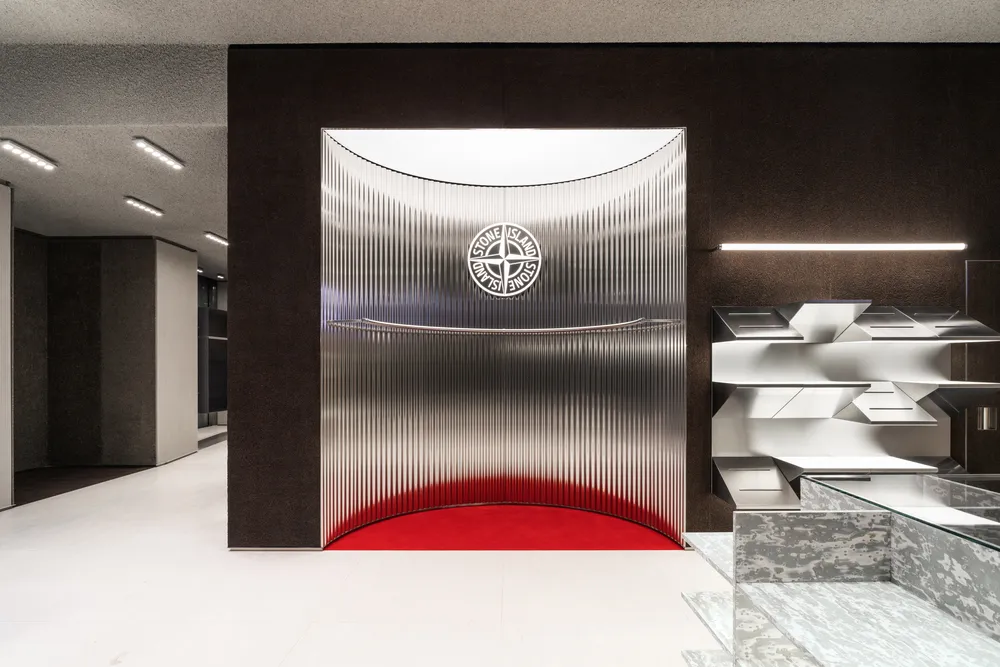
The center of the project is the Hyperobject. It is a monolithic volume of carved cork that runs through the store. It links the separate rooms of the floor plan into a single route. Recessed niches cut into its mass hold garments and accessories. The volume then continues into the staircase and joins the two levels.
The cork goes through three steps before installation. It is burned, sandblasted and coated. The result is dark and rough, closer to mineral than to bark. The material keeps its original properties. It absorbs sound and regulates humidity inside the rooms.
Cork comes from the bark of the cork oak, stripped from the trunk every nine to twelve years without felling the tree. Its cell structure traps air, which explains its acoustic and thermal behavior. Burning seals the outer cells and darkens the surface. Sandblasting then opens the grain again. The coating fixes the result and protects it from handling.
OMA/AMO used the same element in the Rome flagship on Via del Babuino, which opened in July 2026. There, the cork volume absorbs a concrete staircase and stitches together a sequence of separate rooms. In Milan, it adapts to the plan of a nineteen-thirties palazzo.
Bush-hammered stone, rammed earth and carbon fiber: the surfaces of the Stone Island Milan store
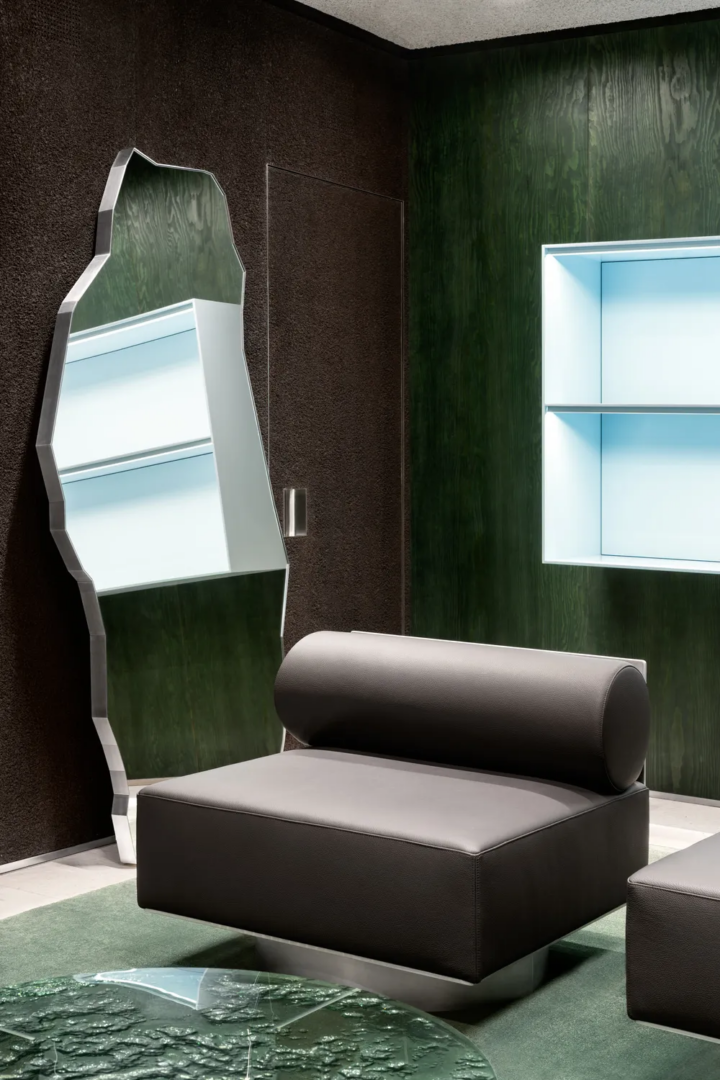
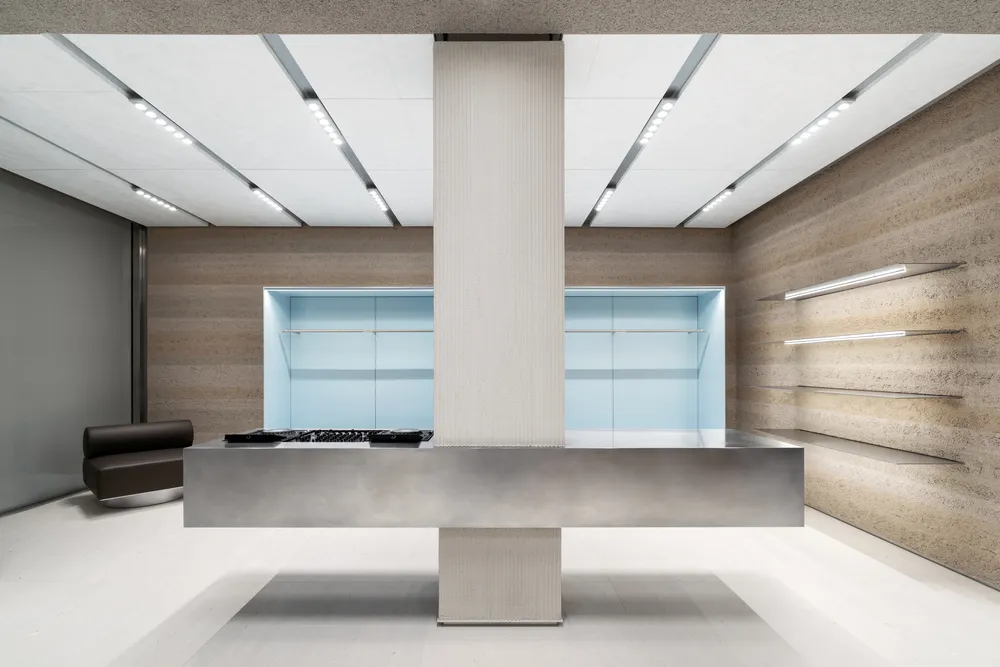
Around the cork core, the architects set out a sequence of surfaces. Bush-hammered stone covers both the floor and the ceiling. Painted metal mesh lines sections of the walls. Other walls use compressed mud, or rammed earth, whose layers recall soil strata. Dark-green painted wood leaves its grain exposed.
Both stone and earth carry the marks of their making. Bush hammering strikes the stone with a toothed head, leaving a pitted texture in place of a polished face. Rammed earth involves compacting damp soil in layers inside a formwork. Each layer leaves a line, so the wall records the sequence of its construction.
The display system mixes industrial and technical components. Hanging rails are made of carbon fiber. Anthracite modular shelves carry a lining of fine black felt. Seating comes in compressed felt, in yellow or in its natural tone. Each pairing sets a raw surface against a soft or engineered one: stone against felt, earth against carbon fiber, mesh against wood.
Orange resin staircase and fused green glass: process left visible
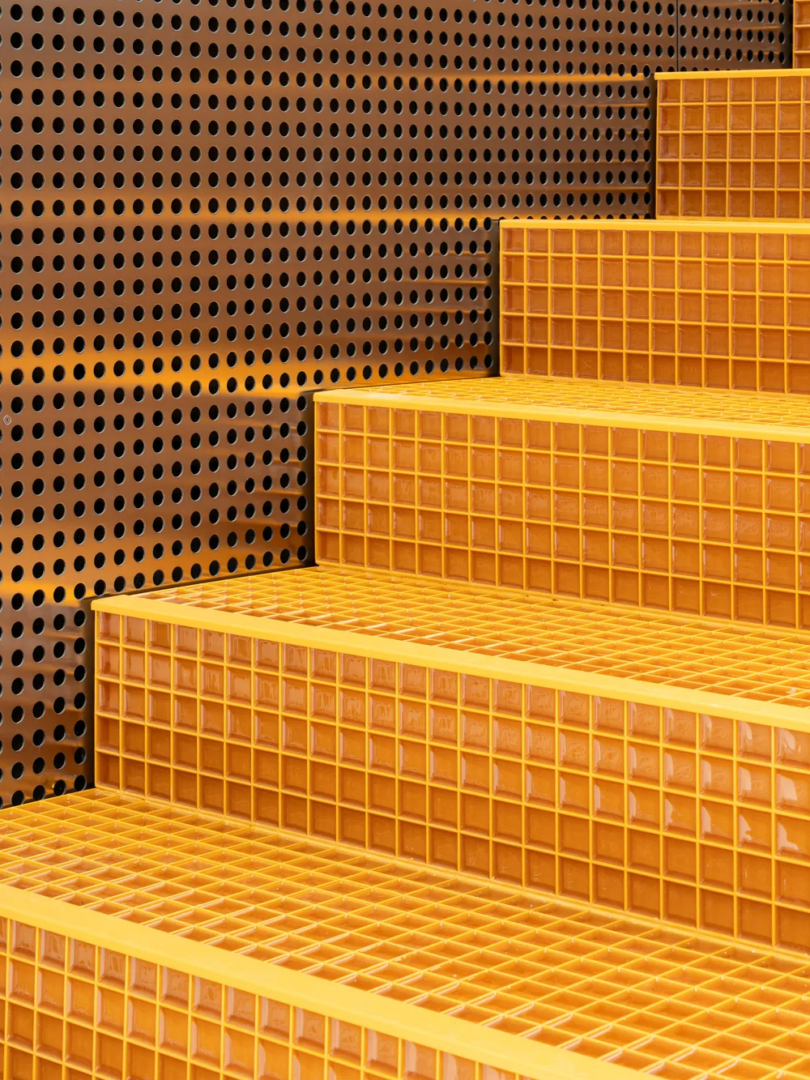
An orange staircase connects the two floors. Its structure is a powder-coated metal grid filled with resin. The resin gives the treads the look of a poured liquid, fixed in place. The steps serve more than one purpose. Visitors sit on them, staff display products on them, and the brand uses them as an amphitheater for talks, DJ sets and cultural events.
At the rear of the store, the green glass column reinterprets a material Stone Island has long used in its stores. The glass is fused by hand and shaped over sand, so its surface records the grain of the mold. Movable furniture and display modules use pressed paper combined with recycled resin. These stand apart from the monolithic Hyperobject, and staff can reconfigure them to fit each new collection.
The three elements share a logic. Each starts from a common input: a metal grid, a sheet of glass, a stack of paper. A single process then fixes its final form. Resin sets inside the grid, heat fuses the glass against the sand, and pressure binds paper fibers to recycled resin.
Material recipes: Stone Island garment treatments applied to architecture
Stone Island built its identity on what happens to fabric after weaving. Massimo Osti founded the label in 1982, and the company is based in Ravarino, near Modena. Its archive holds thousands of dye recipes. Garment dyeing, washing, coating, deconstruction and functional treatments define the collections. Some fabrics change color with temperature. Others carry reflective finishes.
The first collection used Tela Stella, a canvas treated to look different on each side. In garment dyeing, a finished piece goes into the dye bath after sewing. Thread, fabric and trims absorb the color in different ways, so the seams stay legible. Stone Island runs this work in its Ravarino color laboratory, alongside tests on new fibers and coatings. The removable compass badge on the left sleeve marks every garment.
The Milan store handles its materials in the same way. Each surface works as a recipe with visible steps. Cork turns carbonized and geological. Sand molds glass. Resin converts a grid into solid steps. Pressure turns paper into a usable composite.
The interior shows these processes instead of hiding them behind a finish. The architecture follows the logic of a Stone Island garment. It starts raw, gains technical qualities through treatment, and is made to be touched and used.
«Starting from decades of the brand’s research on textile treatments and dyeing processes, I wanted to transfer the same approach to the materials used in the stores: pressed paper, cooked cork, green glass», said Mr. Bantal.
He also points to the territory around Milan, where companies and artisans keep a manufacturing tradition alive, along with the technical know-how and material craft that come with it.
The upper floor: a venue for talks, music, sport and culture
The two floors divide by function. The ground floor holds the collections and the main retail activity. The upper floor works as a flexible venue. Its program includes product discussions, art projects, music and sport. Movable furniture lets the room shift between formats, from a talk to a listening session.
Stone Island has used its stores this way in other cities. In 2026, the New York store in SoHo hosted an exhibition of archival pieces from the collection of the British rapper Dave. In April, during Milan Design Week, Stone Island presented NO SEASONS, a revival of a Massimo Osti concept first explored between 1989 and 1994.
Milan has a specific history with the label. In the nineteen-eighties, the Paninari, a youth subculture centered on the bars around Piazza San Babila, adopted Stone Island jackets as part of their dress code. The new venue sits a few steps from that square. Football terraces in the United Kingdom and, later, rap and grime scenes took up the brand in turn.
Young designers inside Stone Island Milan: lighting, furniture and sound
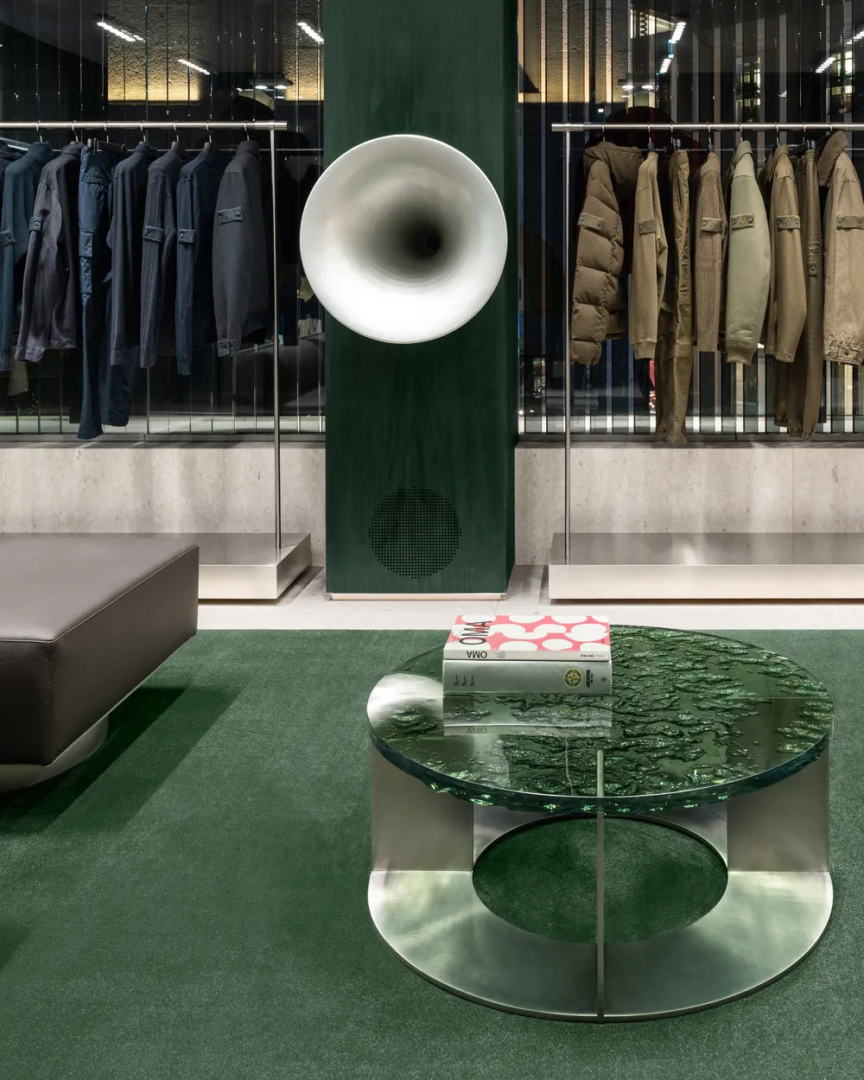
OMA/AMO invited younger designers and studios to contribute objects, many of them developed for the Milan store. Tim Hooijmans designed the lighting. Markus Töll created the Supersedia lounge chair. Neuf Voix produced the speakers, and Ledongil Workshop the audio systems. Tim Teven designed furniture, 6:AM made a glass table, and Elvis Wesley produced display objects.
The roster spreads authorship of the interior across several studios. The store operates as a collaborative platform as much as a branded environment.
Several of these pieces sit on the upper floor, where sound and seating carry most of the program. The speakers and audio systems serve DJ sets and listening sessions. The lounge chair, the furniture and the glass table can move or regroup when the room changes format.
OMA/AMO and Stone Island: one retail concept across several cities
Milan is the latest stop in a program that began in Chicago. AMO, the research arm of Rem Koolhaas’s OMA, debuted the concept there. The collaboration, directed by Mr. Bantal, started in 2021. Stores in New York, Munich and Shanghai followed. In January 2025, Paris moved to 223 Rue Saint-Honoré, with over two hundred square meters. Naples opened in Palazzo Fusco on Via Filangieri in 2026, followed by Rome in July.
The material recipes date back to the first stores of the series. For the New York flagship, OMA/AMO worked on a dense cork that is cooked and then sandblasted to bring out its grain. The studio had to test its own formulas to produce the blocks, in the way the brand tests dye baths for a fabric. Milan extends that method to stone, earth, glass and paper.
The stores share a base vocabulary: treated cork, rammed earth, felt and resin. Each adds elements tied to its site. Speaking to the Italian trade press at the Milan opening, Robert Triefus, president and CEO of Stone Island, said the priority is to upgrade the stores the brand already operates. The Corso Matteotti renovation follows that line: a relocation in 2019, a new interior seven years later.
Stone Island
Stone Island is an Italian menswear label founded in 1982 by Massimo Osti and based in Ravarino, near Modena. The company works on fibers, fabrics and finishing treatments, from garment dyeing to reflective and thermosensitive coatings. It has been part of the Moncler Group since 2021. Its network of flagships includes Milan, Paris, New York, Munich, Naples and Rome.
Melis Ozek