A transparent dome turns The Louis Shanghai into a concert hall
Yuja Wang and the Mahler Chamber Orchestra perform Brahms beside Louis Vuitton’s monumental ship, extending The Louis beyond retail into live cultural programming
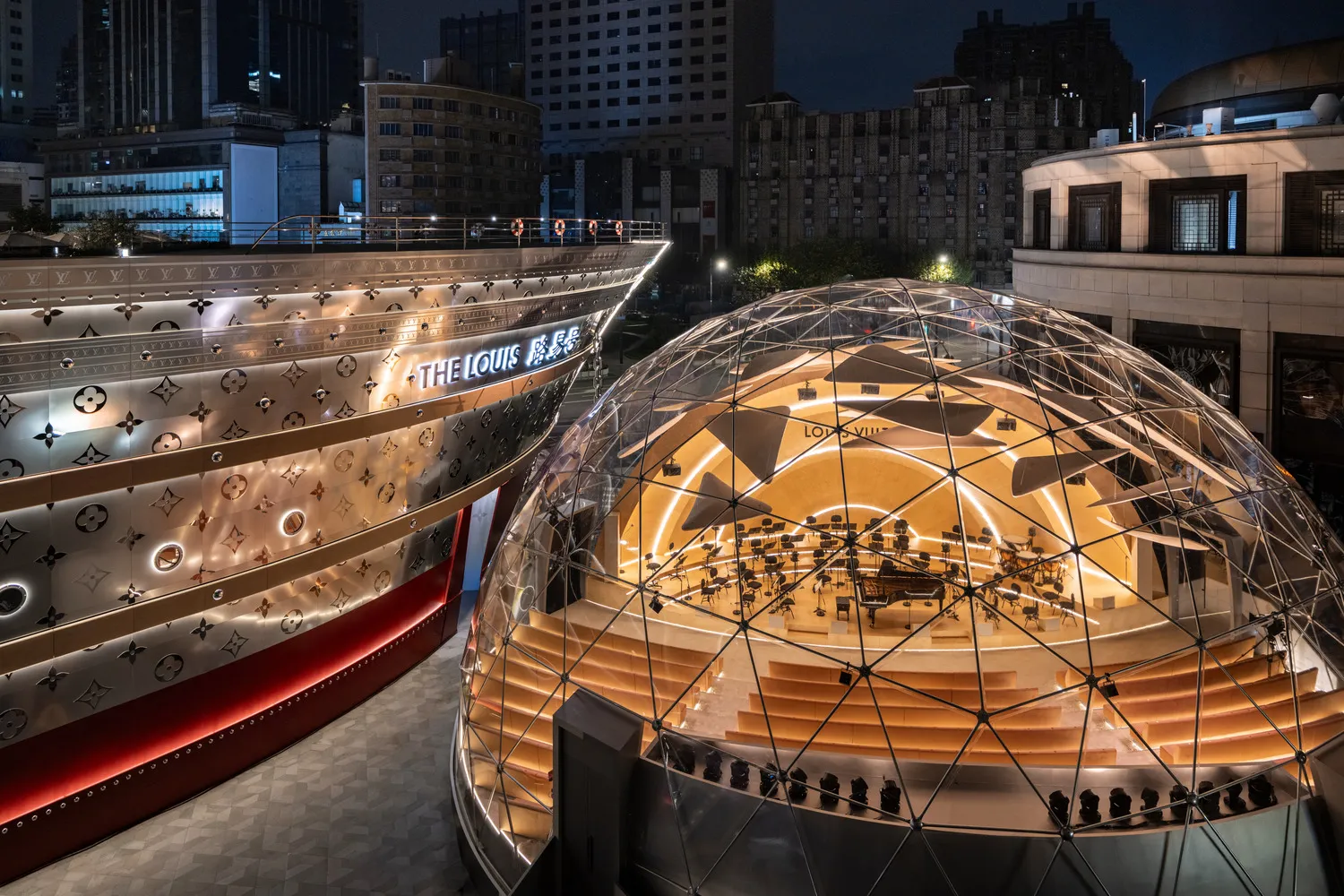
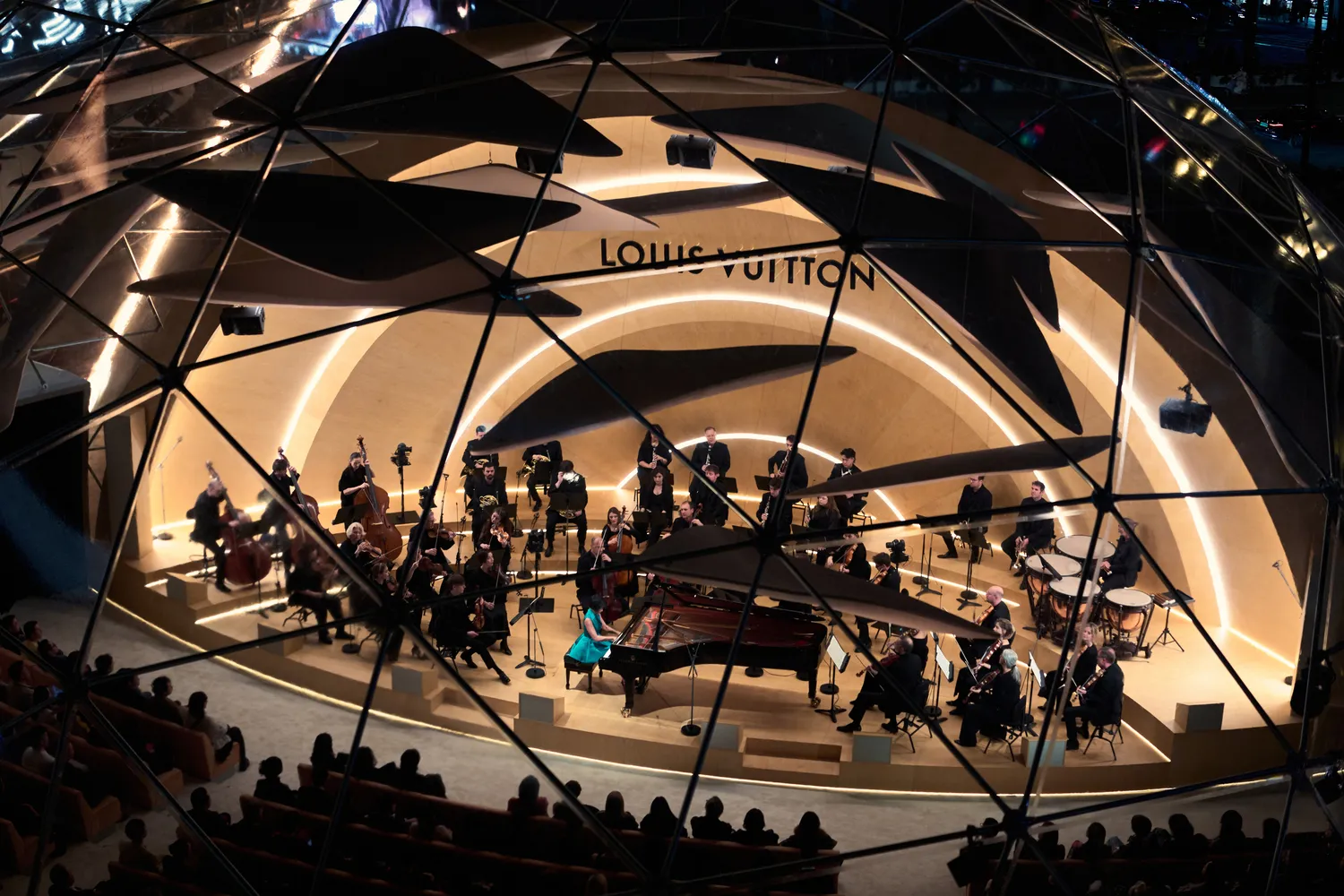
A transparent dome, an orchestra and a grand piano. Behind them the metal hull of a monumental ship, wedged between the towers of Shanghai. On 26 November 2026 Louis Vuitton turned an outdoor space beside The Louis, in the Jing’an district, into a temporary concert hall for Yuja Wang and the Mahler Chamber Orchestra. The structure was designed for the evening, with a glass roof and acoustic solutions worked out for live performance. The transparency kept the city in view, holding the music against the architecture of The Louis and the skyline behind it.
At the centre of the programme, the Piano Concerto No. 2 in B flat major, Op. 83 by Johannes Brahms. Completed in 1881, it is among the most demanding works of the Romantic piano repertoire. Where the conventional structure runs to three movements, this concerto has four, and gives the orchestra an extended role, with passages in which the piano enters writing of an almost symphonic character.
The third movement, Andante, opens on a cello solo that introduces the most lyrical stretch of the piece. The relationship between piano and orchestra demands constant mutual listening, with the soloist inside the ensemble instead of in front of an instrumental backdrop. At the end of the concert Wang returned to the piano several times for encores, among them Mozart’s Turkish March in the virtuoso transcription by Arcadi Volodos and a reworking of themes from Bizet’s Carmen by Vladimir Horowitz. Among the guests were Liu Yifei, Jackson Wang, Ouyang Nana, Mavis Fan and James Li.
The Louis Shanghai, 114.5 metres of ship on West Nanjing Road
The concert belongs to the programme of The Louis, opened on 25 June 2025 in the HKRI Taikoo Hui commercial area, along West Nanjing Road. The building reproduces the outline of an ocean liner, with a hull clad in metal elements decorated with the Louis Vuitton Monogram and a sequence of upper volumes that read as travel trunks stacked on one another. The structure stands about thirty metres high and 114.5 metres long. The ship refers to two histories at once: that of the French house, founded in 1854 as a maker of trunks and travel goods, and that of Shanghai, a port city built on international trade. Inside, retail space, a restaurant and an exhibition route coexist in the same building.
Visionary Journeys by Shohei Shigematsu and the Trunkscape installation
The permanent exhibition Visionary Journeys, with scenography by Shohei Shigematsu of OMA, follows the evolution of Louis Vuitton through archives, historical objects and installations, across rooms given to the origins of the house, to travel, fashion, perfumery and craft.
Among the elements of the display is Trunkscape, a monumental installation of trunks covered in Monogram canvas, arranged into an architectural structure: the objects that built the commercial identity of the house reworked as contemporary set design. On the third level sits Le Café Louis Vuitton, with a menu developed by chef Leonardo Zambrino and pastry chef Zoe Zhou, combining French references with the culinary traditions of Shanghai. The project follows a shift in how the large luxury houses conceive their spaces. The store becomes a structure that holds exhibitions, dining and cultural programming, with the architecture building a destination recognisable beyond the commercial activity.
Yuja Wang from Beijing to Curtis, and the night she replaced Martha Argerich
Born in Beijing in 1987, Yuja Wang began her musical studies in China and continued in Canada and at the Curtis Institute of Music in Philadelphia with Gary Graffman. Her international career developed through work with major orchestras and concert halls; in 2007 she replaced Martha Argerich in a concert with the Boston Symphony Orchestra, an episode that marked her arrival on the international circuit. Known for a precise pianistic technique and for a repertoire that runs from Romanticism to contemporary music, Wang has built a career in which interpretation coexists with a recognisable stage presence.
Since 2024 she has been Artistic Partner of the Mahler Chamber Orchestra, the ensemble founded in 1997 and tied from the start to Claudio Abbado. The orchestra works on self-governance by the musicians and on a chamber approach to symphonic repertoire, and the collaboration with Wang involves projects in which she leads the ensemble from the keyboard. The relationship has developed through European and Asian tours, including the Brahms concertos in November 2026. Wang had already performed at the Fondation Louis Vuitton in Paris, with the Mahler Chamber Orchestra in 2017, and is now an ambassador of the house.
Leopold Stokowski’s score trunk of 1930 and the Fondation Louis Vuitton
The relationship between Louis Vuitton and music goes back well before the collaborations with contemporary artists. In 1930 the house made a bespoke trunk for Leopold Stokowski, the British-born American conductor, built to carry his scores. The object belongs to the tradition of special trunks developed for travellers, artists and professionals, where the relationship with music ran through the function of the object and the mobility of its owner.
Today the relationship also works through the production of events, the support of performers and the use of architecture for cultural activity. The Fondation Louis Vuitton in Paris, designed by Frank Gehry and opened in 2014, is one of the main venues for that programming, with art exhibitions and a musical season of concerts and recitals.
In Shanghai the same approach moves into a commercial destination that uses architecture as its signature, instead of an institutional auditorium. The direction is one the luxury industry has taken more widely, building cultural occasions around its own buildings, with artists and institutions involved in programmes that reach different audiences.
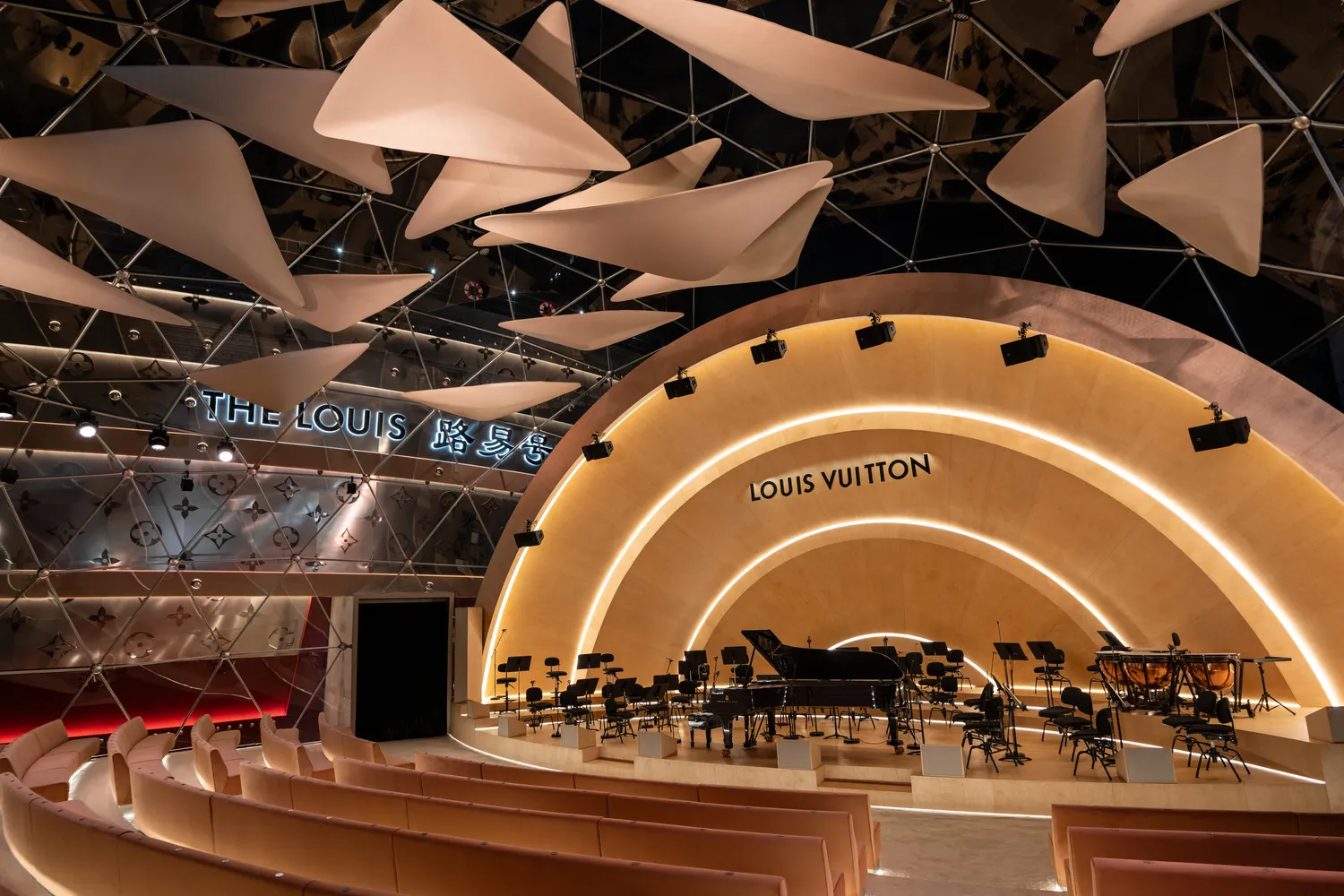
The Louis Music for the City and the velvet benches sent to Aranya
The Shanghai project went beyond the concert of 26 November. For the following day Louis Vuitton opened the glass dome to the public with a programme of recitals and musical interventions, among them the pianist Wei Luo, putting the structure at the disposal of musicians and audience. The materials of the staging entered a reuse programme. The velvet-covered benches produced for the concert will be donated to the Aranya Theatre Festival and the Pingyao International Film Festival, where they can be used in later events, which matters for a staging designed to stand for two days. For those two days The Louis added a musical function to its programme, turning the space beside the ship into a place for performance and listening.