Open Studio Homme Plissé Issey Miyake: Henri Matisse, The Snail and the pleats
Matisse cut and pinned paper coated in gouache; Homme Plissé Issey Miyake sets pleats in with heat and pressure. At Tate Modern, Open Studio puts the two methods side by side.
OPEN STUDIO by HOMME PLISSÉ ISSEY MIYAKE in dialogue with The Snail(1953) by Henri Matisse
At Tate Modern, for the second edition of Open Studio, Homme Plissé Issey Miyake encounters Henri Matisse’s The Snail (1953): a spiraling assemblage of gouache-covered paper across a two-meter-wide canvas. Oranges, emeralds and blues reveal the freedom of Matisse finding new ways to create. Solid colors recall those of Homme Plissé Issey Miyake and, once applied, the paper ripples like pleats. The Japanese fashion house answers it through dance.
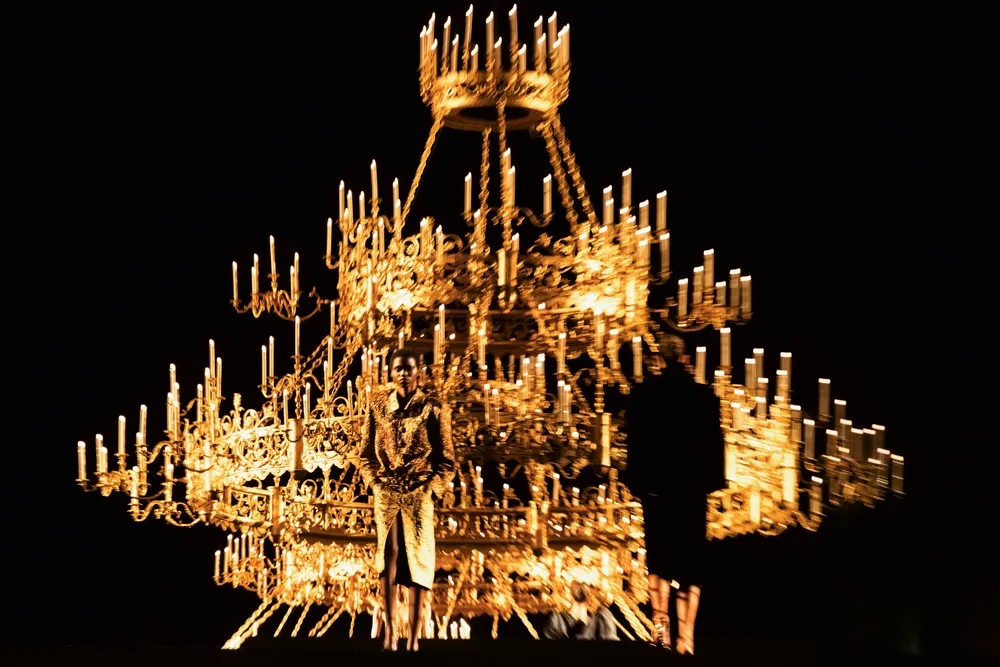
For one night, the museum’s Tanks become an atelier in motion: cut-out forms rise from the floor as pleated garments, then scatter across the space in the hands of dancers. The performance doesn’t just illustrate Matisse’s late gouaches découpées; it treats them as choreographic material, asking what happens when color, shape and body move together.
In the summer of 1952, a bedridden Henri Matisse is living in the Hôtel Régina on the Côte d’Azur. Crippled by arthritis and unable to paint, he begins experimenting with gouaches découpées. Studio assistants first paint large sheets of paper with gouache thinned with water, then weight them until dry. Matisse selects a sheet and, using large shears—often the kind used for dressmaking or wallpapering—cuts directly into the color, a method he describes as “drawing with scissors.” For larger forms, an assistant rotates the paper so he can maintain smooth, continuous curves
He pins the cut shapes to a board, a sheet of paper, or directly to the studio wall, using sewing pins, thumb tacks and thin nails, which allows him to shift and reconfigure the composition before anything is fixed. Conservation analysis of some cut-outs reveals up to 1,000 pin-pricks, evidence of repeated rearrangement. Only when satisfied does he note each position, remove the pins and have the forms glued in place—often by Lefebvre-Foinet in Paris, where The Snail is ultimately assembled and mounted. For Matisse, cutting into these solid forms represents a new practice, what he calls «drawing in color».
Pleats, movement and the body in OPEN STUDIO
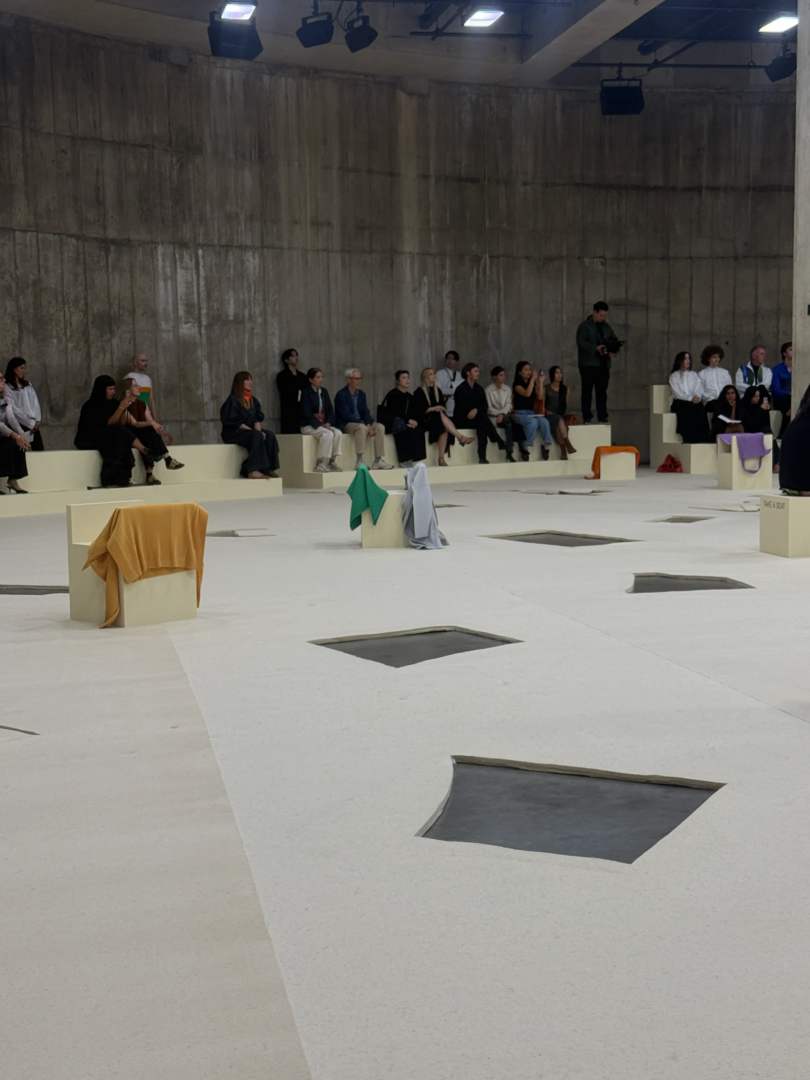
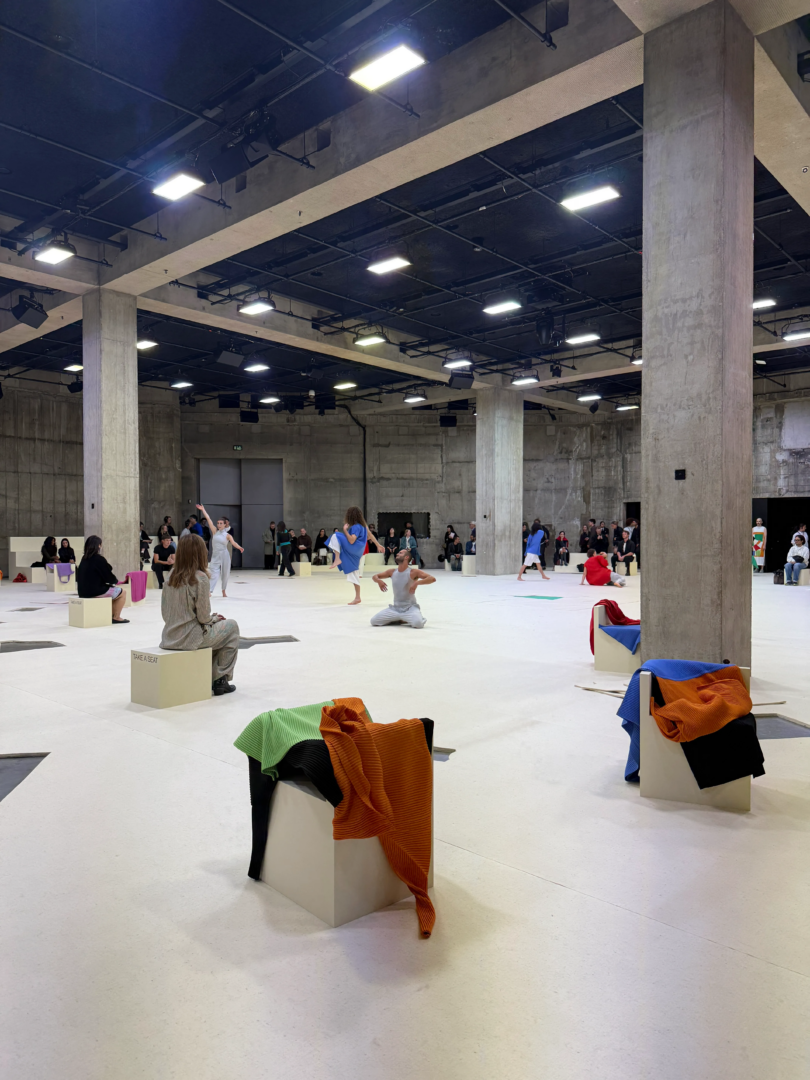
Homme Plissé Issey Miyake, in collaboration with the Dresden Frankfurt Dance Company, begins by transforming the South Tank at Tate Modern into a canvas.
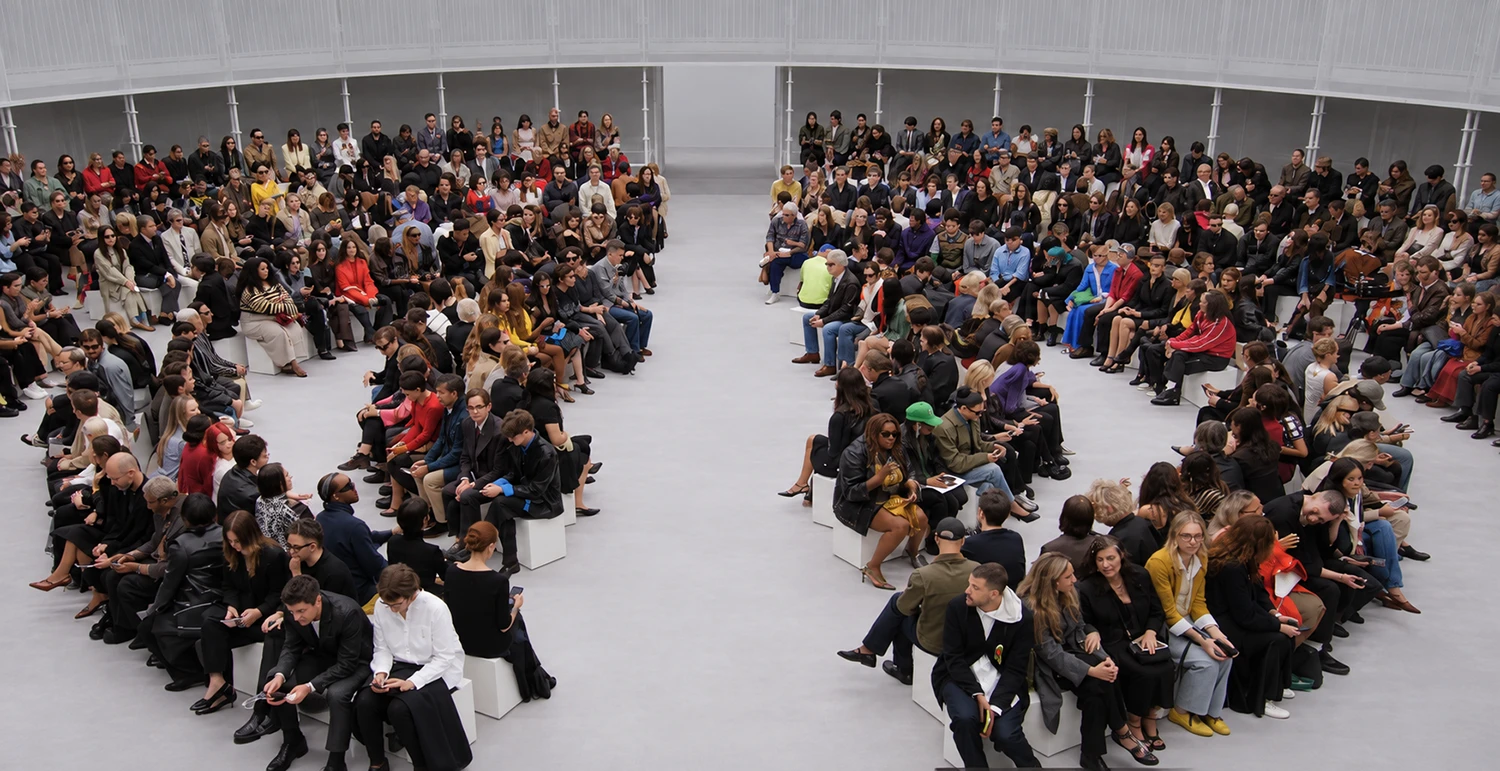
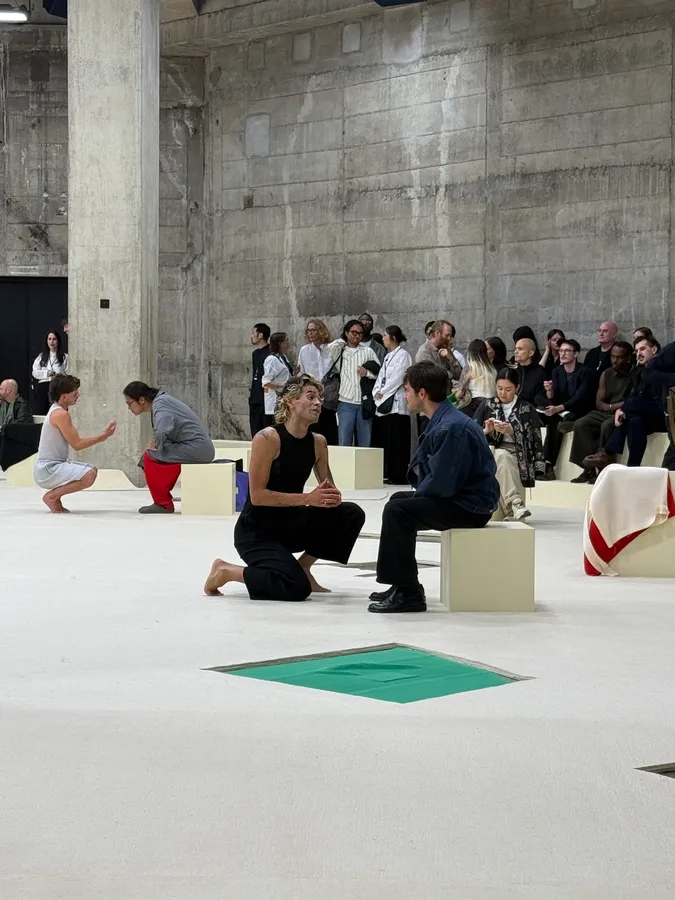
Previously a space to store oil when the museum was a power station, the concrete basement has been covered in white felt flooring, with a circular array of outer seating.
A single dancer emerges and lifts a cut-out from the floor to reveal a pleated garment. Then others. Though some are solid blocks of color, others feature a new print of The Snail (1953) on white. They are thrown into movement when worn by the dancers, who scatter them in a scene resembling materials strewn across an atelier.
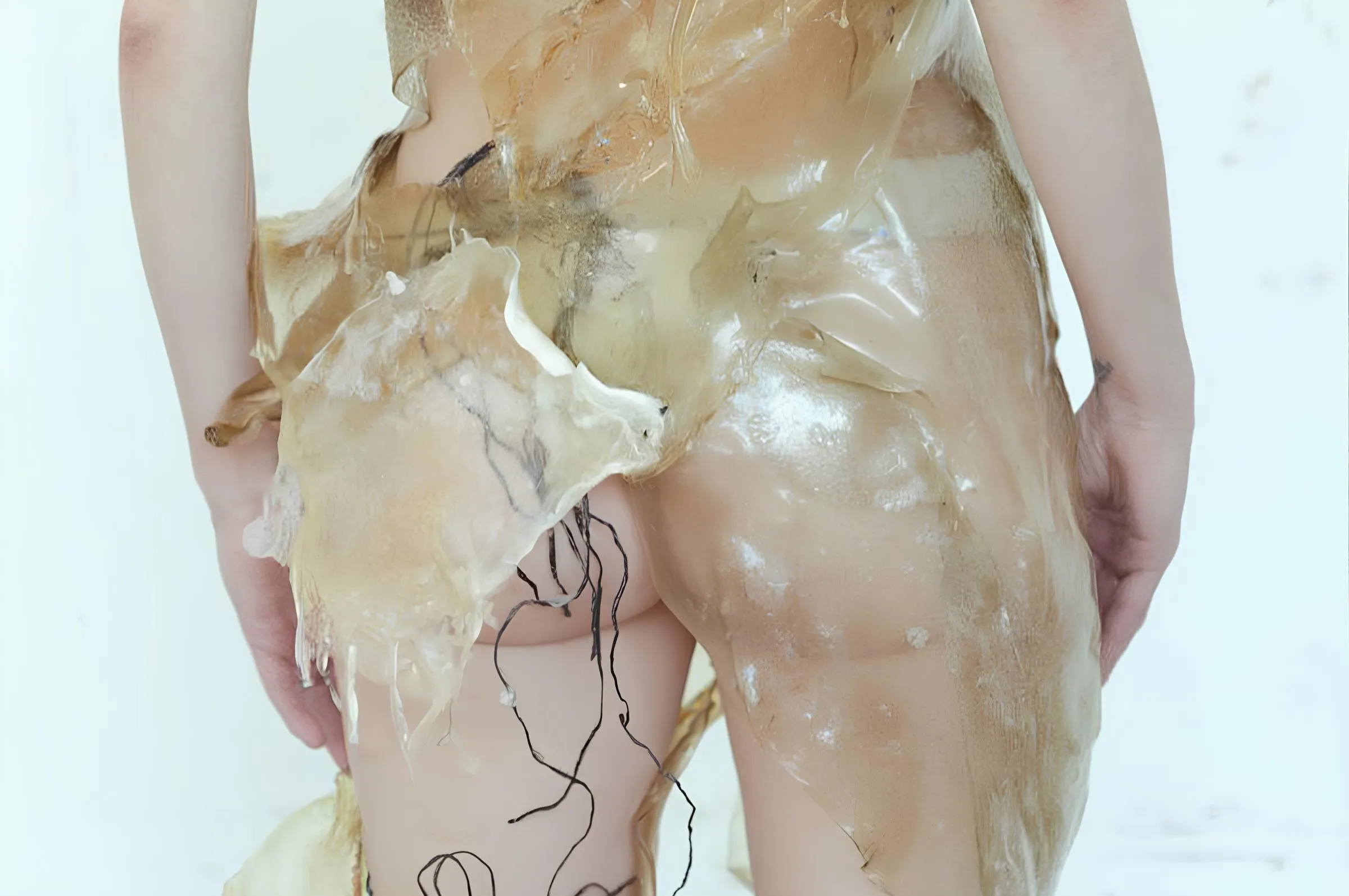
Though dance and fashion often occupy separate spaces, there’s a link between these moving bodies and Homme Plissé Issey Miyake. By pleating the garment after it has been constructed, Issey Miyake developed a new way for material to flow alongside the wearer. Dancing in the pleats allows the cut-outs from The Snail (1953) to become animated in movement.
Each piece begins as flat polyester or polyester-blend fabric, cut and sewn into a garment sized to compensate for shrinkage during pleating. The finished garment is then sandwiched between two sheets of paper and fed into a heat-set pleating machine, where it is folded according to precise templates and subjected to high temperature and pressure to lock the pleats’ “memory.” After cooling and quality inspection, the paper is cut away and the pleated garment is complete. This garment-dye and pleat sequence—refined over decades at the brand’s R&D facility in Kakegawa—ensures that color saturates the fiber before the permanent folds are set, so the pleats move as a single, living surface.
Like Matisse’s cut-outs—painted, cut, pinned, then fixed—the garments are constructed, colored, then permanently transformed by heat and pressure, turning flat cloth into a three-dimensional, mobile architecture.
From gouache to heat-set pleats: two processes in conversation
Matisse’s late technique begins with paper and pigment: assistants coat large sheets with gouache, the artist cuts shapes with shears, and pins hold them in place while the composition evolves. Homme Plissé Issey Miyake’s method starts with cloth and thread: garments are cut and sewn, then dyed and heat-set in a pleating machine that imprints permanent folds. In both cases, color is applied before the final form is locked in—on paper for Matisse, on fabric for the fashion house. The difference lies in fixation: pins and glue for the cut-outs; temperature, pressure and cooling for the pleats. OPEN STUDIO stages the meeting point between these workflows, treating Matisse’s cut forms as patterns for movement and the pleats as their living support
Issey Miyake, William Forsythe and the Frankfurt dancers
The choice of dance company has a history. The Dresden Frankfurt Dance Company descends from William Forsythe’s Frankfurt ensembles: Ballett Frankfurt, which he directed from 1984 to 2004, and The Forsythe Company that followed. In 1991, Issey Miyake designed pleated costumes for Forsythe’s The Loss of Small Detail at Ballett Frankfurt. On stage, the garments had to hold their shape through the choreography, performance after performance. The collaboration is often cited as a step toward Pleats Please, launched in 1993, and later toward Homme Plissé Issey Miyake.
Thirty-five years on, Open Studio brings the pleats back to that lineage, this time cut to the shapes of Matisse’s The Snail (1953).
The Dresden Frankfurt Dance Company uses One One One sessions to invite spectators into encounters with The Snail (1953)
There are also stools in the center of the South Tank’s white space, where the audience can activate One One One sessions. These are improvisational moments connecting spectator and performer, a staple for the Dresden Frankfurt Dance Company under artistic director Ioannis Mandafounis. When it’s my turn, the performer kneels before me. He wears a pleated orange shirt from a new Matisse-inspired capsule collection with Tate Modern.
The One One One is circular. The choreography is created live as dancers translate the spectator’s presence—their smiles, laughter, tears—into movement. At points, my dancer runs in circles. At other moments, he is slower. This two-way performance becomes the core of Open Studio, translating the joy of creativity through new processes—an ode to The Snail (1953).
OPEN STUDIO and how fashion can engage with art as a process
Fashion houses have expanded their cultural reach by collaborating with artists. Open Studio represents one of several approaches. Another is the reference. Early examples are the Mondrian collection by Yves Saint Laurent and Elsa Schiaparelli’s Lobster Dress, created with Salvador Dalí. More recently, after discovering a nineteen-thirties leather suitcase with drawings by Keith Haring, Nicolas Ghesquière partnered with the Keith Haring Foundation for the Louis Vuitton Cruise 2027 collection. The show featured the artist’s works, reproduced in the visual language of the designer. This is art through the lens of fashion.
Crossing further into the art world is the Loewe Foundation Craft Prize. Established in 2016, the Prize elevates works by international artists reinterpreting craft for contemporary audiences. Each year, it exhibits a shortlist of thirty finalists—most recently at the National Gallery in Singapore. By leveraging the Spanish house’s institutional power, the initiative is a form of modern-day patronage, showcasing artists without putting them on a runway. Alongside the Paul Smith International Art Prize, the LOEWE Foundation exists to further art supported by fashion.
Open Studio is what happens when fashion approaches art as an exchange—as something of an equal partner in the collaboration. At Tate Modern, The Snail (1953) is the inspiration for a multidisciplinary experience rooted in the movement and freedom uniting brand and artist. Homme Plissé Issey Miyake is producing art. Open Studio shows how art and fashion can create works in a shared language that exists between—and within—disciplines.
Joshua Beutum