Louis Vuitton SS27:Ghesquière takes the weight out of a dress
Nicolas Ghesquière removes weight layer by layer: chiffon controls opacity, mesh releases air and tailoring loses its internal structure
Louis Vuitton SS27: a white dress and the weight of chiffon
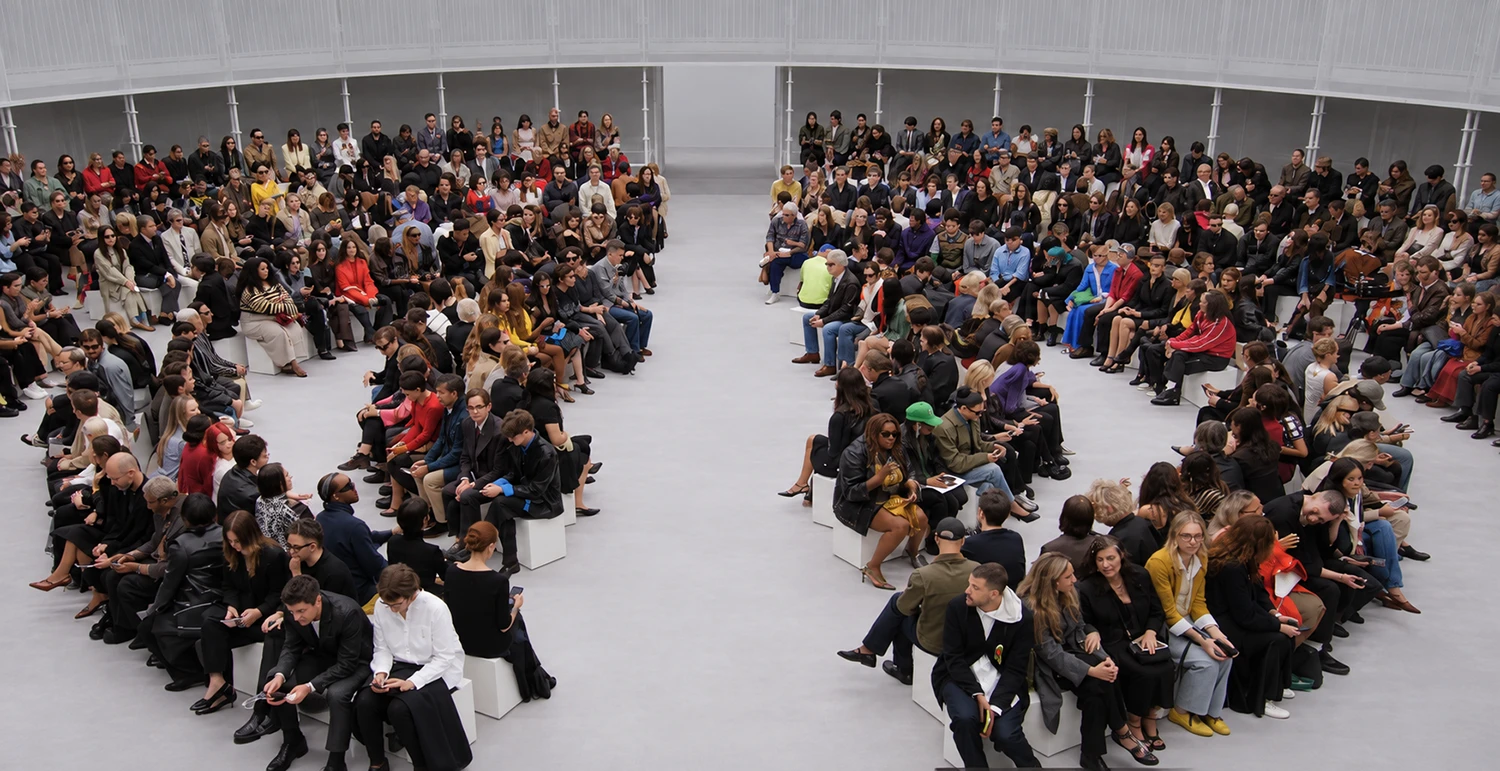
A square meter of silk chiffon weighs between twenty-six and thirty-five grams. One layer shows the body through it. Louis Vuitton Spring-Summer 2027 starts from that problem: how to dress a body in a cloth of that weight. Nicolas Ghesquière presented the collection in Paris on October 6, under the title Ergonomie.
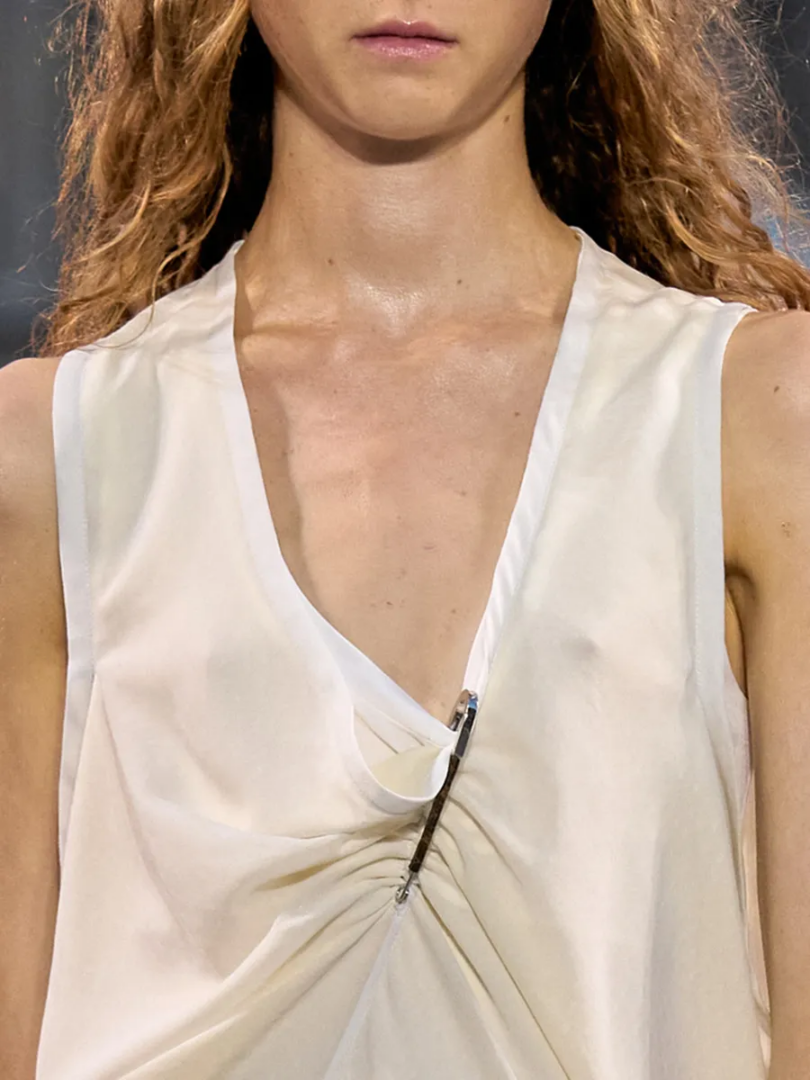
Look one is a white dress that ends at mid-calf, worn with loafers. The outline is plain. An opaque surface gives way to semi-sheer sections, where the cloth opens and skin shows. The construction has to settle three variables at once: weight, opacity and the passage of air.
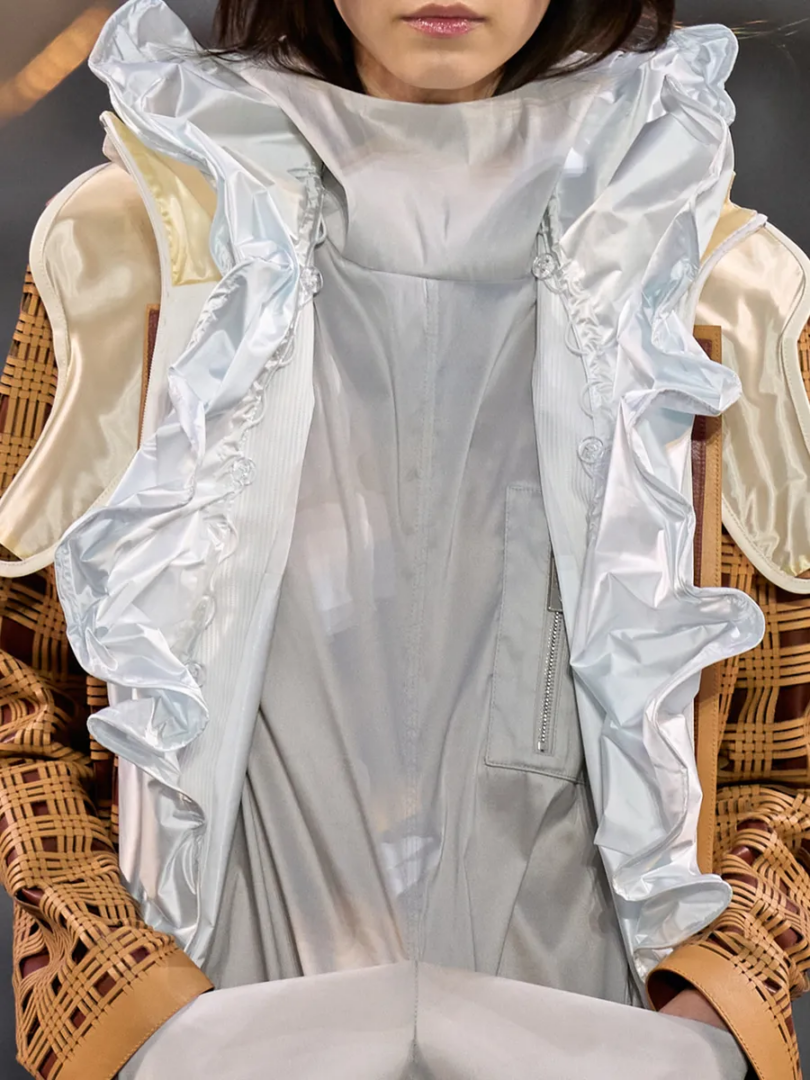
Louis Vuitton names the materials of the season. They are double and triple composite chiffons, carré silks, and scarf fabrics in silk and cashmere. The house gives no fiber content for the chiffon, no weight and no joining method. It does not assign a fabric to a look. The rest is read from the garments.
Composite chiffon: two and three layers, opacity without a lining
Chiffon takes its name from the French chiffe, a rag. It is a balanced plain weave of crepe yarns, twisted hard in alternating directions. The twist gives the cloth its dry hand, its slight stretch and its transparency. Silk came first. Nylon chiffon followed in 1938 and polyester in 1958. Mills measure silk in momme, a unit of Japanese origin equal to about four grams per square meter. Silk chiffon runs from six to eight momme.
One layer of such a cloth shows the body. The standard answer is a lining, a slip or an underdress: a second garment under the first. A composite chiffon moves that function into the cloth. Two or three layers act as one textile surface, and the lining stops being a separate component.
The term does not say how the layers join. In production, three methods are possible. Binding threads can be woven through both layers. The layers can be stitched, or bonded under heat with an adhesive film. The methods are not equivalent. Woven binding keeps the hand of the cloth. Stitching perforates it and adds local tension. Bonding makes one stable ply, stiffens the hand and adds a third substance. At the end of use, woven and stitched layers come apart as fiber, and adhesives complicate the separation.
Each method also changes drape, the way a cloth falls under gravity. Textile laboratories express it as a drape coefficient. The Cusick test hangs a circular sample over a smaller disc and records the area of its shadow. A low figure means a fluid cloth. Chiffon sits at the low end, and each added layer or adhesive raises the figure.
GSM: the arithmetic of a light dress
Ghesquière ties the collection to a summer of heatwaves across Europe. He speaks of weighing the clothes and judging how they perform. The unit for that is grams per square meter, or GSM.
A chiffon of thirty GSM becomes sixty in a double layer and ninety in a triple. A midi dress takes two to three square meters of cloth. The single layer would then weigh sixty to ninety grams. The triple would weigh one hundred eighty to two hundred seventy. Seams, hems and closures come on top. These figures are estimates from standard fabric weights, and not house data.
The arithmetic states the problem. Layering buys opacity and stability and costs weight. Mesh is not weightless, but an open structure holds less material per area than a solid weave. Placed in selected zones, it lowers the density of the dress where opacity is not required.
Chiffon in the workroom: grainline, bias, seam slippage
Low weight does not mean simple construction. Chiffon has little mass, so it shifts during laying-up and cutting. Cutters pin it to paper to hold the grainline, the direction of the warp. A small deviation from the grainline changes the fall of the garment.
The bias adds a second difficulty. Madeleine Vionnet made the diagonal cut the basis of her work in the twenties. Cloth cut on the bias follows the body without darts, and it lengthens under its own weight. Ateliers hang a bias-cut piece before they hem it, to let the cloth drop.
Under the machine, chiffon ripples and puckers. Machinists answer with fine needles and short stitches. Smooth, loosely set yarns also slide apart at a seam under stress, a fault known as seam slippage. Transparency exposes every seam allowance and every raw edge. Narrow French seams enclose the cut edge and spread the load, and rolled hems finish the border. These details add labor and close to no weight.
Ghesquière describes lightness as an engineering problem. A light fabric does not produce a controlled garment by itself. Without stability, chiffon collapses, twists or clings. Removing material raises the precision required of what remains.
Mesh panels: bobbinet, warp knit and air permeability
Mesh is defined by the spaces between its yarns. Two families exist. Bobbinet tulle twists its threads into a hexagonal cell, on a machine John Heathcoat patented in 1808. Warp-knitted mesh forms its openings from interlocking loops and extends under tension. Bobbinet is the more stable of the two. The house does not say which structure it uses.
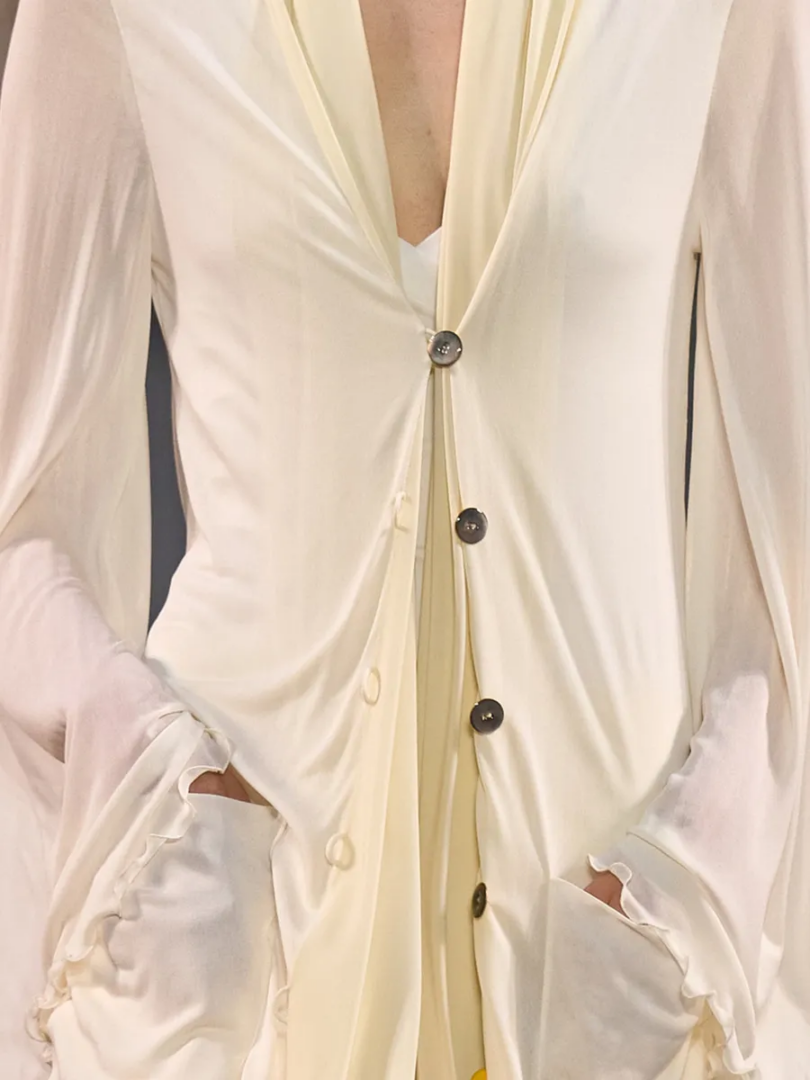
The open sections of look one read as pattern pieces. In that case the cutting stage fixes their position, width and orientation. The join is the critical point. The dress poses a problem of material compatibility. Chiffon and mesh do not behave alike under tension. Chiffon is a woven surface of low mass. It shifts, stretches on the bias and deforms under the needle. Mesh takes its behavior from its open geometry. It can be knitted or woven, elastic or stable. At the junction, the seam has to absorb two rates of extension. Neither material may pull the other out of plane. Weight is one variable among several. Thickness, yarn tension, extensibility, recovery and seam slippage also count. A stable join needs three things. The grain of both pieces has to align. The seam allowance has to stay low in bulk. The stitches have to sit close enough to hold the layers and far enough apart to spare the chiffon.
The open zones change the microclimate of the dress. Air permeability is the volume of air that crosses a textile under a set pressure difference. The standard ISO 9237 measures it at one hundred pascals for clothing fabrics. A closed weave scores low and holds a layer of still air against the skin, which insulates. A mesh scores high.
Insulation is counted in clo. One clo corresponds to a business suit worn at rest indoors. A light sleeveless dress rates about a quarter of that. Walking lowers the figure again through what textile researchers call the pumping effect. Each step pushes warm air out and draws cooler air in.
Double-face cashmere and tailoring without internal layers
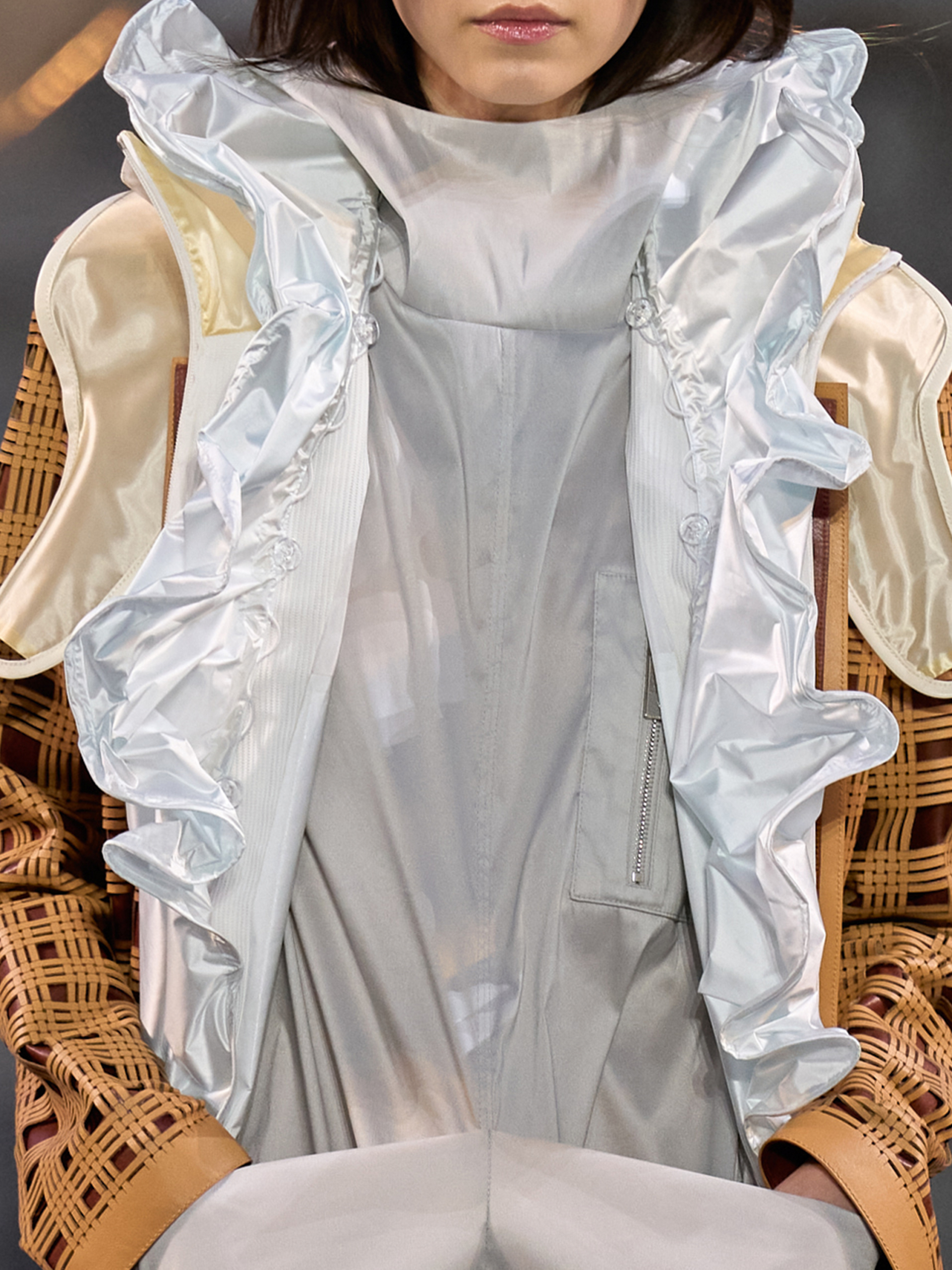
The method extends to outerwear. Ghesquière cuts coats from a checked cashmere in the weight of a shawl. The coats are double-face and reported to weigh less than a T-shirt. Double-face cloth has two faces developed as one fabric and joined by binding yarns. At each edge the maker splits the layers, turns them inward and closes them by hand. The coat needs no lining and no facing.
The weight claim sets a limit on the cloth. A cotton T-shirt weighs around one hundred fifty grams, and a coat takes about three square meters. The cashmere would have to stay under fifty GSM. A standard coating weighs eight to ten times more. The estimate rests on standard weights, and not on house data.
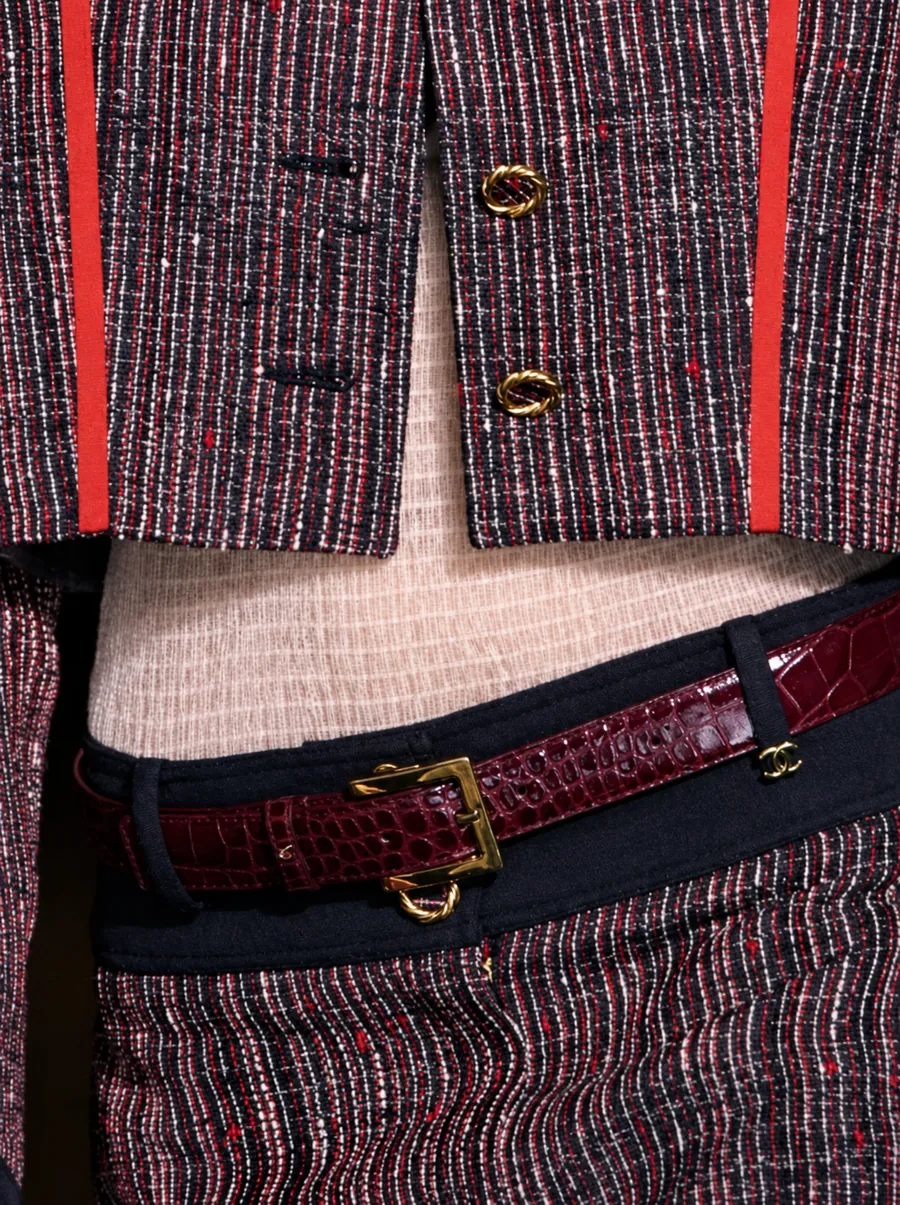
Jackets follow. A tailored jacket hides canvas in the chest, pads in the shoulder and a lining over both. Louis Vuitton states that it has removed these internal layers. Jersey and knit take over the job. A knit is made of loops, so it stretches and returns to its form without internal support.
The earlier garments shielded the body with density. Spring-Summer 2027 counts grams, opacity and air permeability.
Melis Ozek