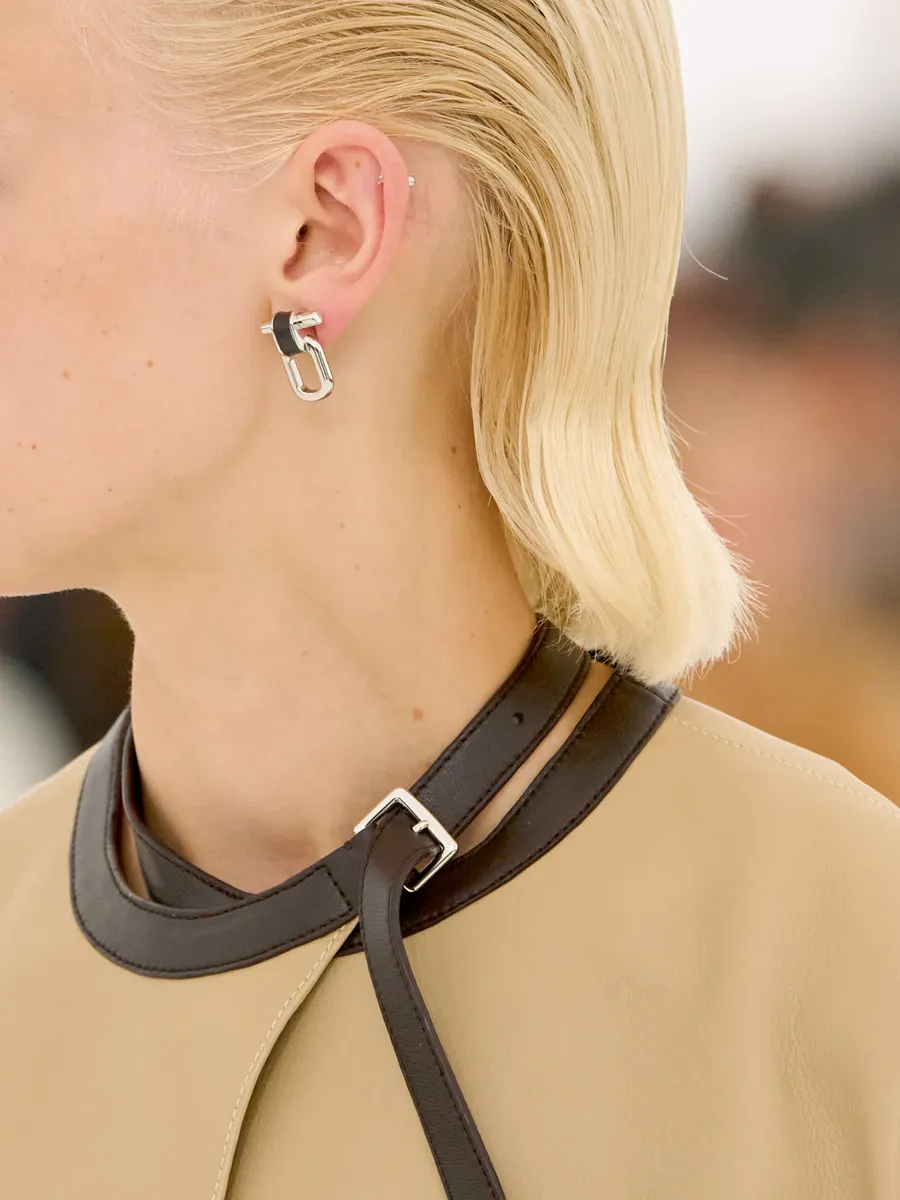
Chanel, SS27, the aquamarine suit: tweed légèreté
Matthieu Blazy’s anti-Ozempic tweed. A response to the recent status quo. It frees; it does not constrain. It is the result of a year and a half of testing. “A stretch fabric, a feat that was previously impossible to achieve.”
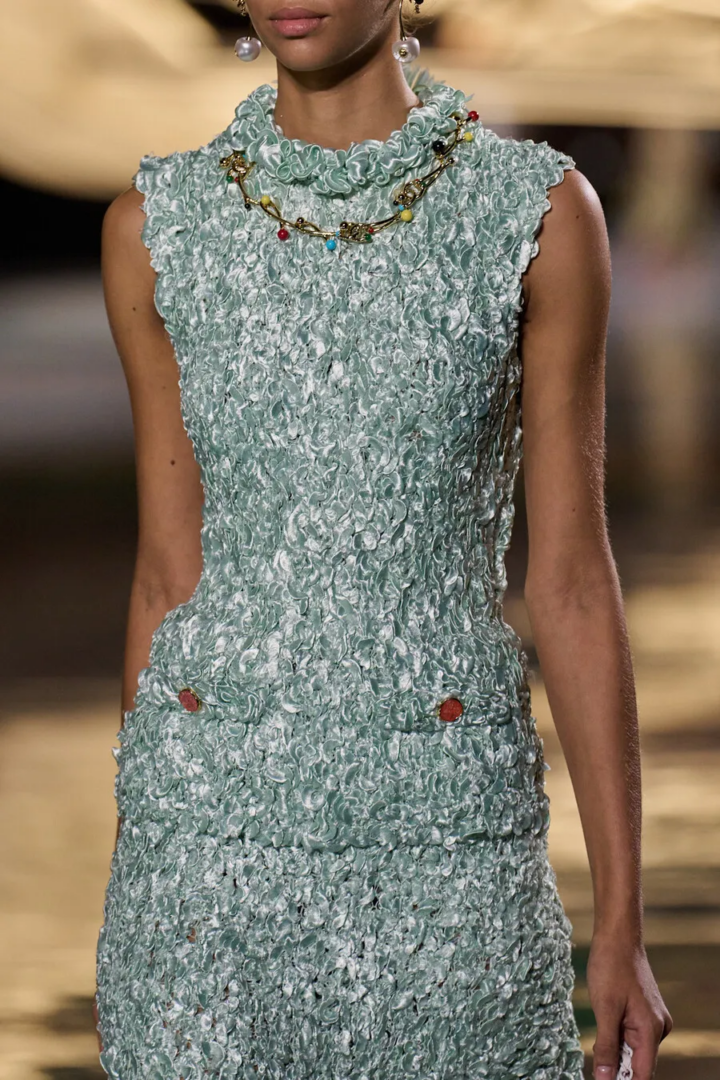
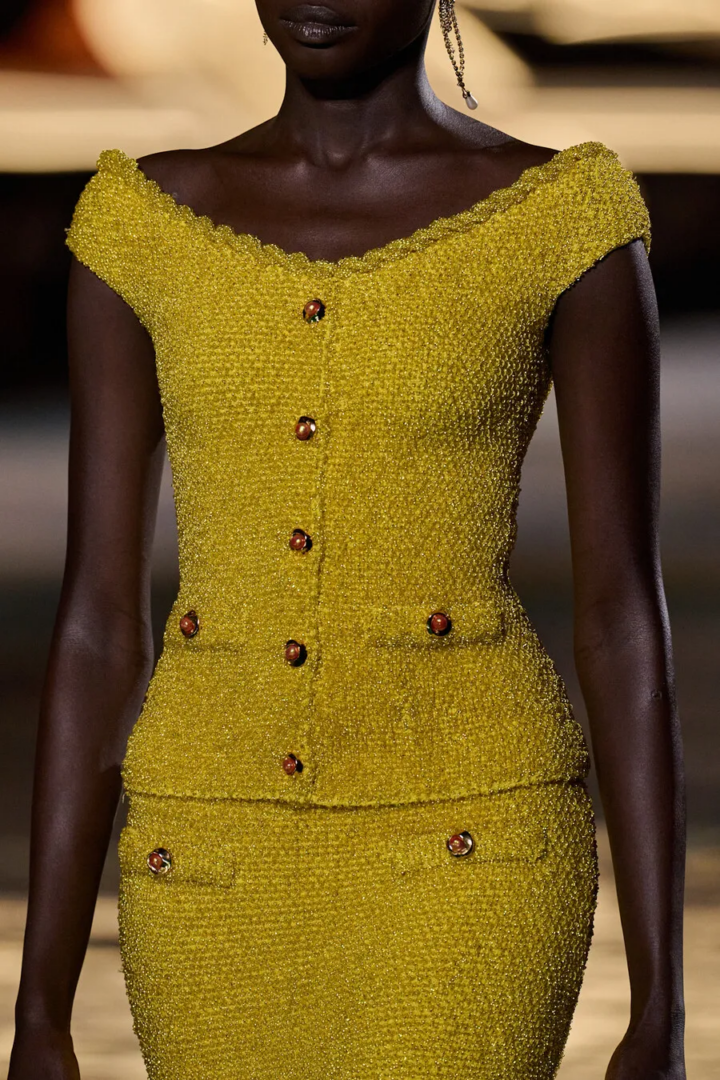
Chanel SS27, Look 081, the suit: Tweed légèreté
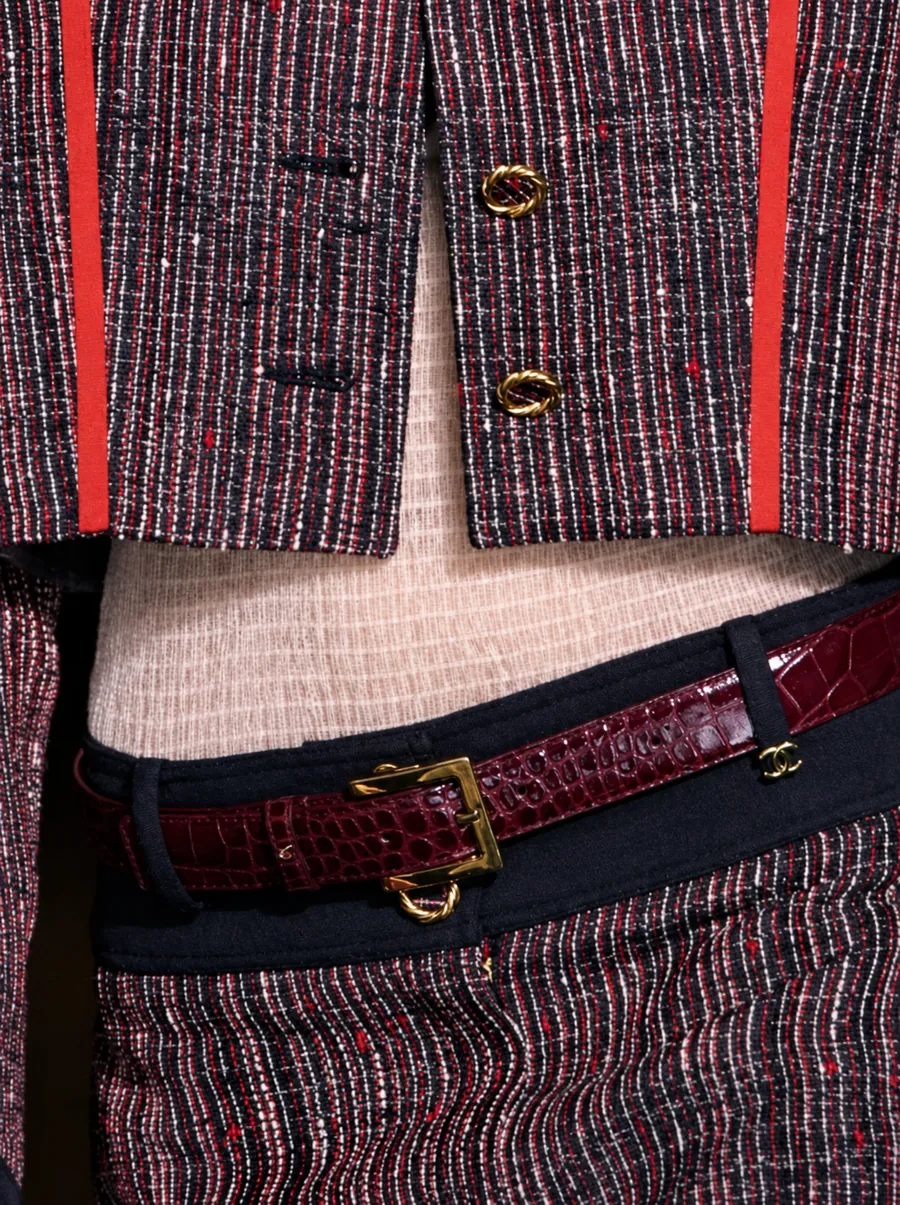
Innovation is a rare commodity. Matthieu Blazy changes things. The atrium beneath the glass dome of the Grand Palais was transformed into an aerial landscape, with ninety-five birds suspended in midair, mid-flight. Backstage, Blazy compared Mademoiselle Chanel herself to a bird of many lives, whose flight carried her toward freedom. The set was inspired by the village in southern Italy where the designer spends his vacations: a sanctuary of sorts for migratory birds. Creating fairy-tale worlds is Blazy’s modus operandi: “[…] I think there is room for poetry, beauty, joy, and that they are a good remedy for dark times.” All of this could come across as cloying. But Blazy is a designer capable of astonishing. With the looks as evidence, number 081 is the deconstruction of tweed. A two-piece aquamarine suit in which the Maison’s most recognizable fabric acquires, through an osmotic process from color to cloth, an elastic consistency, like water, crinkled like a rippling sea. It is close-fitting. It has an epidermal quality. Blazy has made tweed as light as a camellia, another symbol of the house. The innovation had been previewed in a series of black-and-white photographs by the British photographer David Bailey, centered on the motifs of the nest, of flight, and of légèreté.
A year and a half of testing. The anti-Ozempic tweed
To rejuvenate Chanel tweed at any cost. That is Blazy’s mission for Spring/Summer 2027. On Monday evening he presented to the industry the result of a year and a half of testing: smocked tweed. He describes it as “a stretch fabric, a feat that was previously impossible to achieve.” It is an anti-Ozempic tweed. That is to say, designed to free rather than to constrain. A response to the recent status quo. In recent years, Blazy has been one of the few able to fill stores with shoppers, against the downward trend of the luxury industry. He knows what women want: muslin skirts with pockets, roomy shirts, long tunics, vests, shackets, ensembles that are soft, slouchy, a little disheveled, featherlight. Although the women who can afford a Chanel piece are unlikely to dust their own homes, that does not mean they are not working hard at the helm of some company. Blazy is one of the few focused on selling them something more than a vial of perfume.
So he devised for them a new machine capable of ruching organza and silk into a honeycomb structure, compressing and gathering the material until it takes on the appearance of tweed. The surface, subjected to this dense contraction, acquires tensile strength: it stretches with the body, following its movement. The material expands and retracts, passing from elastic knit to the finished form of a jacket, a polo, a little black dress. Elastic, in every sense of the word. Tweed for “the woman who lives and works.” That is how Mr. Armani would have described it.
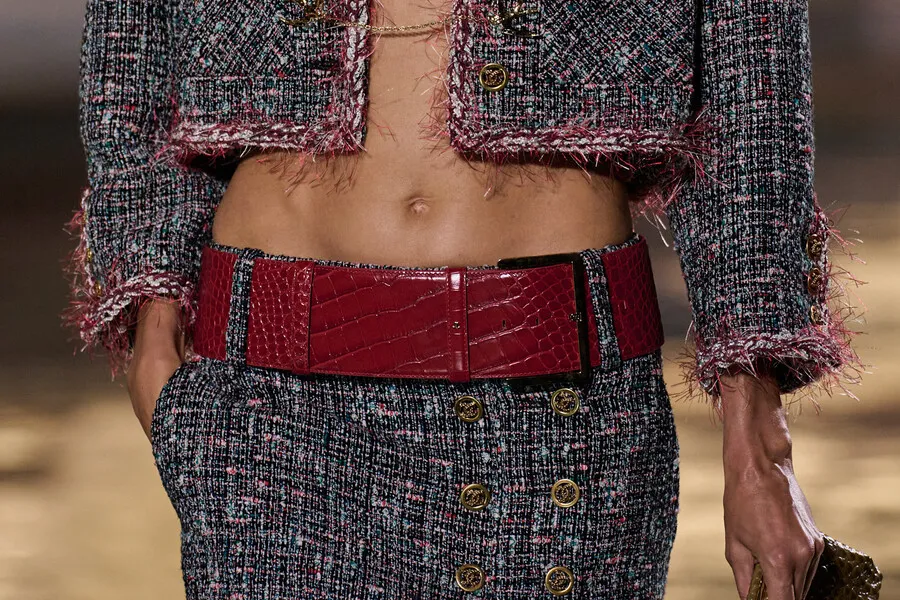
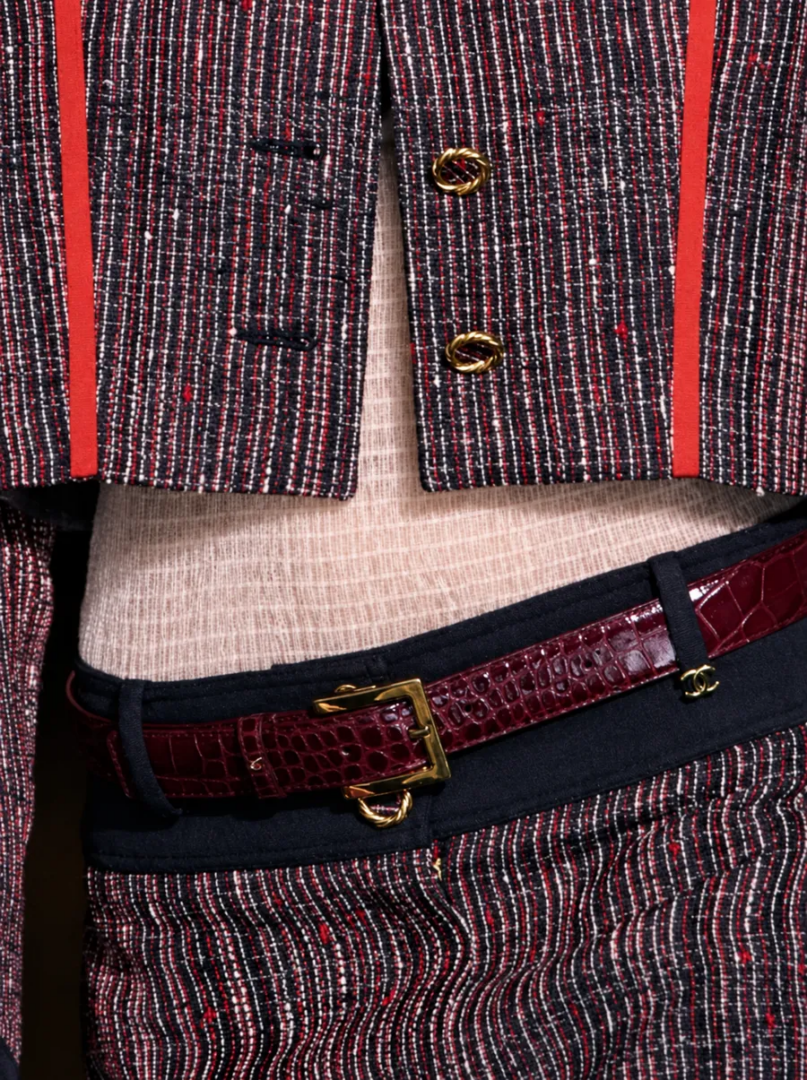
This elastic tweed, able to return to its own geometric form once taken off so that it can be folded perfectly, is not the only technical breakthrough signed Blazy x Chanel. Together with his team, he has also developed a machine capable of weaving pearls and sequins directly into the filament, so that they do not have to be sewn on afterward. This means that the tweed suit of Look 81, like the pearl-inlaid shirts paired with the many tweed ensembles, can be stuffed haphazardly into a suitcase and pulled out later without a single crease. It is the kind of practicality Chanel would have appreciated. This is what it means to carry a Maison forward without designing yet another version of a black sheath dress.
1920, lightweight tweed: first trials
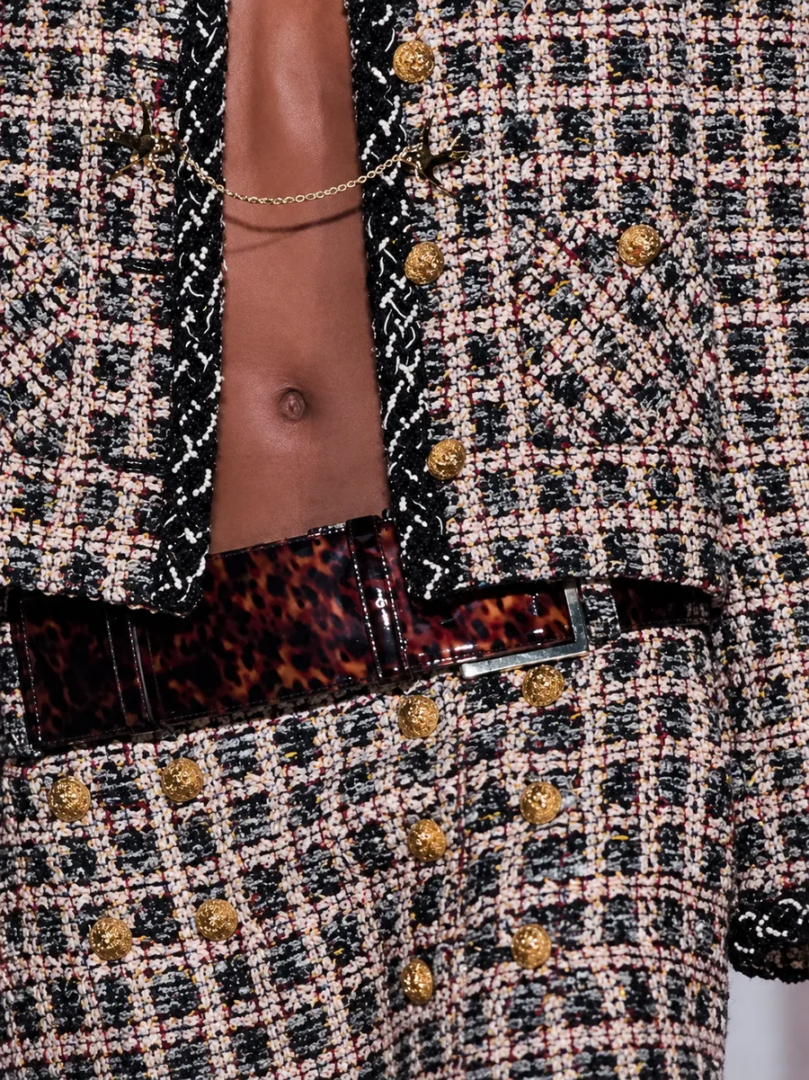
“It is in an old suit that I feel truly at ease, but not with those coarse, heavy fabrics… Oh no! Absolutely not… In truth, I was the one who taught the Scots to make lighter tweeds. I swear, convincing them took a great deal of effort!” The words of Coco Chanel. Initially the couturière had entrusted the production of her tweeds to a Scottish factory. Then, in the early 1930s, she turned to the weavers of Nord-Pas-de-Calais, a region renowned for its expertise in textiles. Her intent was to make it light by combining artificial fibers with wool yarns, for an effect of softness. In her eyes, this raw material had every quality for a woman who plays sports and drives cars: carded wool is soft and downy; left uncombed, it keeps its irregularities. The fabrics were initially made in the colors of the Scottish countryside she traveled with the Duke of Westminster, who had introduced her to tweed (from the River Tweed, which flows between England and Scotland).
From Bottega leather to Chanel tweed: Matthieu Blazy’s modus operandi
The idea of craft as nostalgic and dusty has always struck Matthieu Blazy as wrong. As creative director of Bottega Veneta first, and of Chanel today, he has championed artisans not only for the quality of their creations, but also for the quality of their creativity. A practical creativity—the oxymoron, in this case, works. It is not a collaboration but a juxtaposition of knowledge: Blazy starts from precise ideas; the artisans enrich the design. In an industry where craftsmanship is dwindling and production is ever cheaper and faster, Blazy is a radical. The Chanel atelier is as quiet as a library. It is a trait that suits Blazy’s personality: in 2014, New York Magazine ran the headline “The Most Famous Designer You’ve Never Heard Of.” A kind of fashion phantom, a specter spoken of in hushed tones. For years his name was hearsay, or little more: “the man behind the renaissance of Margiela couture,” “the secret formula of the Céline collections (under Phoebe Philo),” “Raf Simons’s right-hand man at Calvin Klein,” “Lee’s number two at Bottega Veneta.” Then he became number one.
His favorite gelato flavor is stracciatella—the entrance to his office at Bottega Veneta was taken up by a white rug with chocolate-colored spots. In New York, the department store Bergdorf Goodman filled three windows with “his” Bottega. He redefined not just a brand, but a direction. He played with the hierarchies of taste like a conjurer. He designed a world in which nothing is what it seems: it looks like denim, but it is leather; flannel? No, leather. Ribbed cotton? Leather, again. After all, Bottega Veneta is a leather goods brand—Blazy knew exactly where he was going. The very artisans on his team told him it was impossible to make jeans that looked like jeans, but in leather. Forty tests later, they handed him a prototype. Blazy thought it was cotton—it was leather. Those jeans, priced at six thousand nine hundred euros, sold out. With Chanel tweed—the equivalent of Bottega leather—he is heading in the same direction.
Stella Manferdini