Torre, Fondazione Prada: Rémy Savage brings distilling back to Largo Isarco
At Torre, Rémy Savage’s Archivio Isarco reconnects Fondazione Prada with the former Largo Isarco distillery through twelve drinks made from house-produced bases
Torre, the restaurant and bar at the top of Fondazione Prada’s tower in Milan, has a new cocktail list. Rémy Savage, the French bartender behind A Bar with Shapes for a Name in London, joined in September 2026 as lead mixologist. His menu, Archivio Isarco, lists twelve drinks. Each one uses a distillate, a liqueur or a vermouth that the bar makes and bottles itself. The choice has a reason. The tower stands on the site of a former distillery, and Largo Isarco now produces alcohol again.
Torre, Fondazione Prada: OMA’s tower in Milan
OMA completed the tower in 2018, three years after the rest of the Fondazione Prada campus. It rises sixty metres in white concrete, over nine levels. The floor plans alternate between rectangles and trapezoids, and the ceilings grow taller on the way up, from 2.7 metres at the bottom to eight at the top. Meanwhile, a lift, half pink marble and half glass, carries visitors between the galleries. Rem Koolhaas described the result as “a radical diversity within a simple volume.”
Torre restaurant: Four Seasons chairs, Lucio Fontana and artist-designed plates
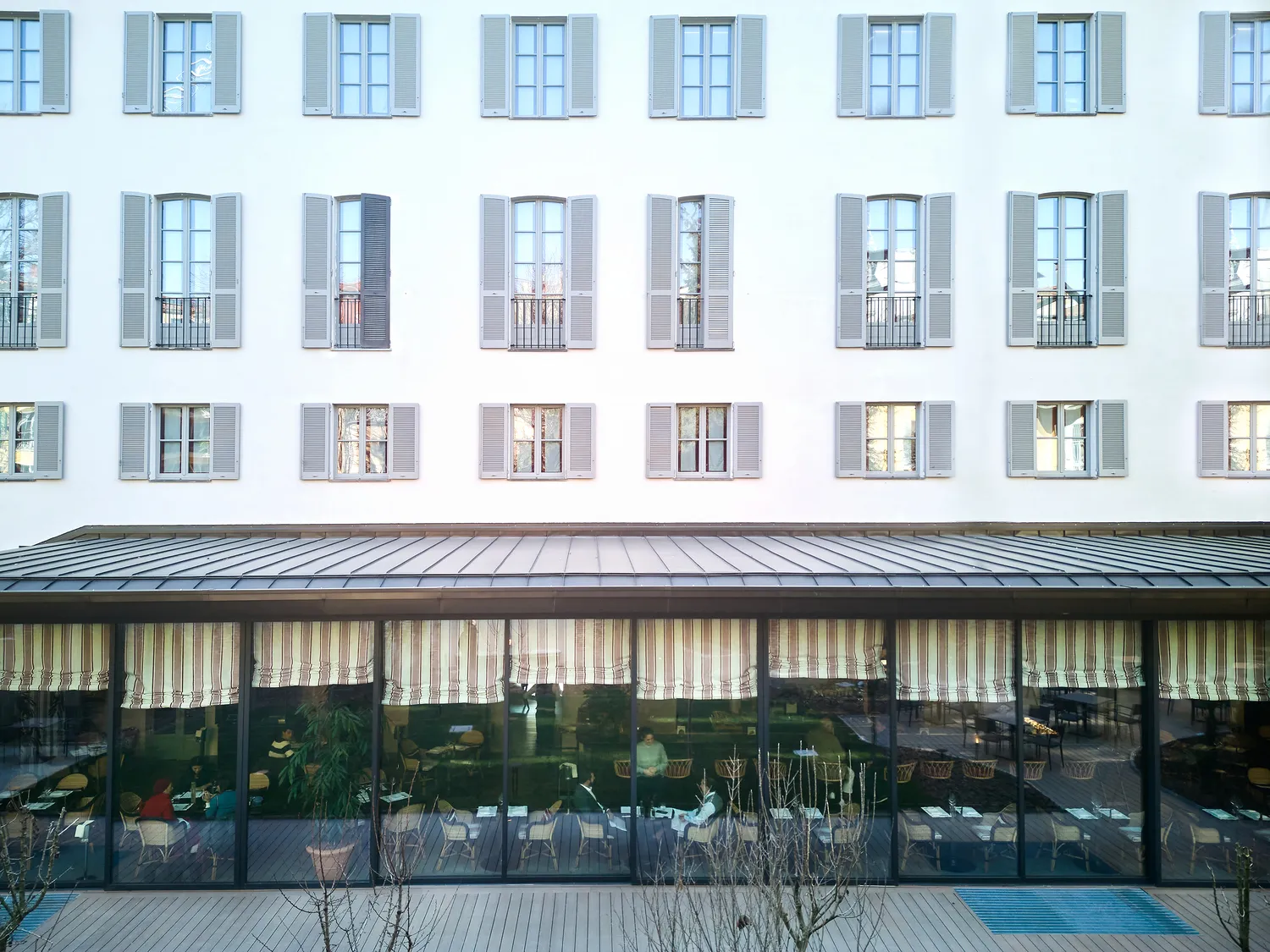
The restaurant occupies the sixth floor. It opened on 9 May 2018 and covers 215 square metres on three staggered levels, with windows on the rail yard and the south of the city. Koolhaas called it “a collage of pre-existing themes and elements”, and the list of sources is long. The lowest level uses original chairs from the Four Seasons, the New York restaurant that Philip Johnson designed in 1958. Next to them, pieces of Carsten Höller’s installation The Double Club sit nearby. The walls carry walnut panels and hemp, over parquet floors.
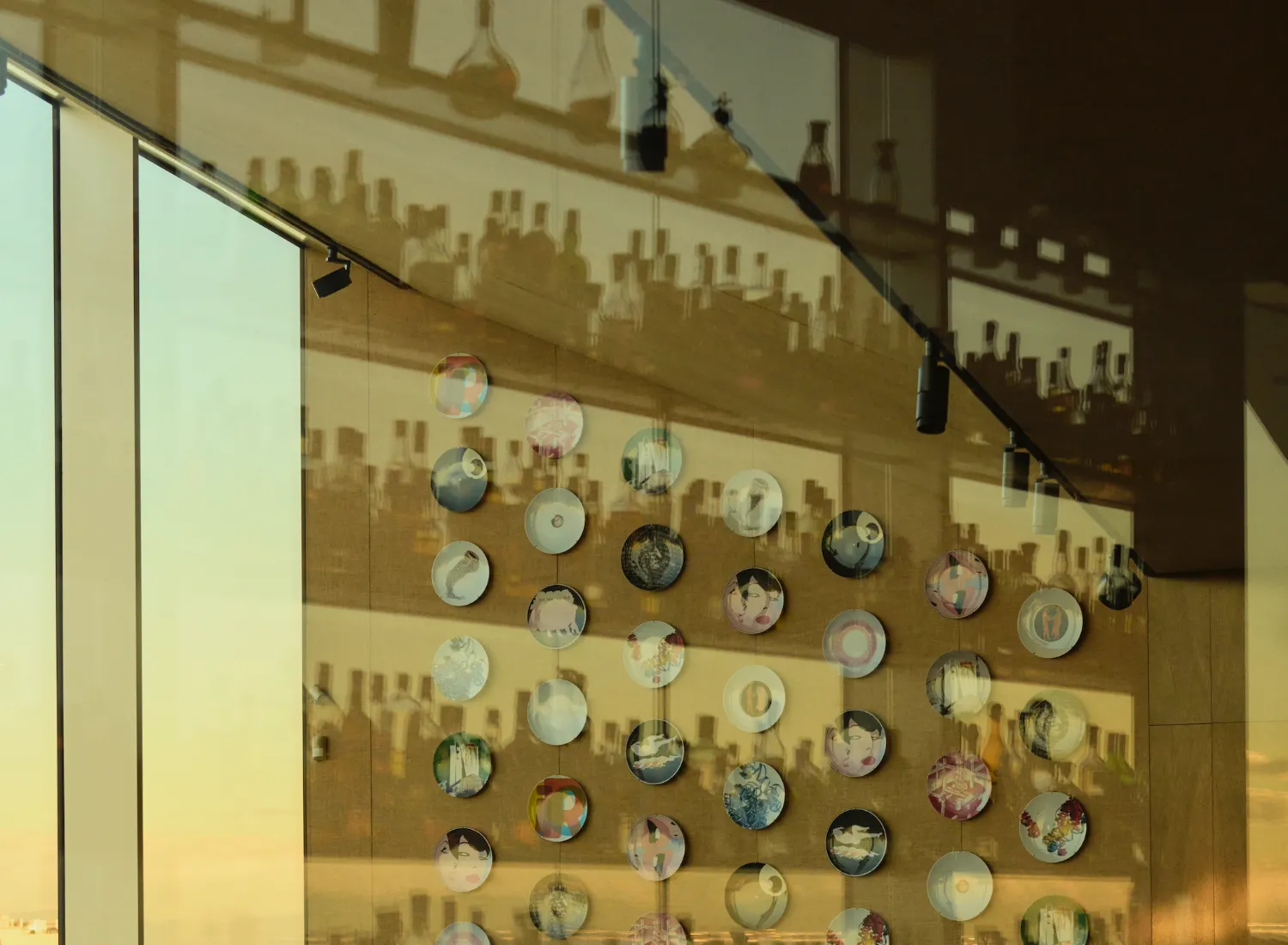
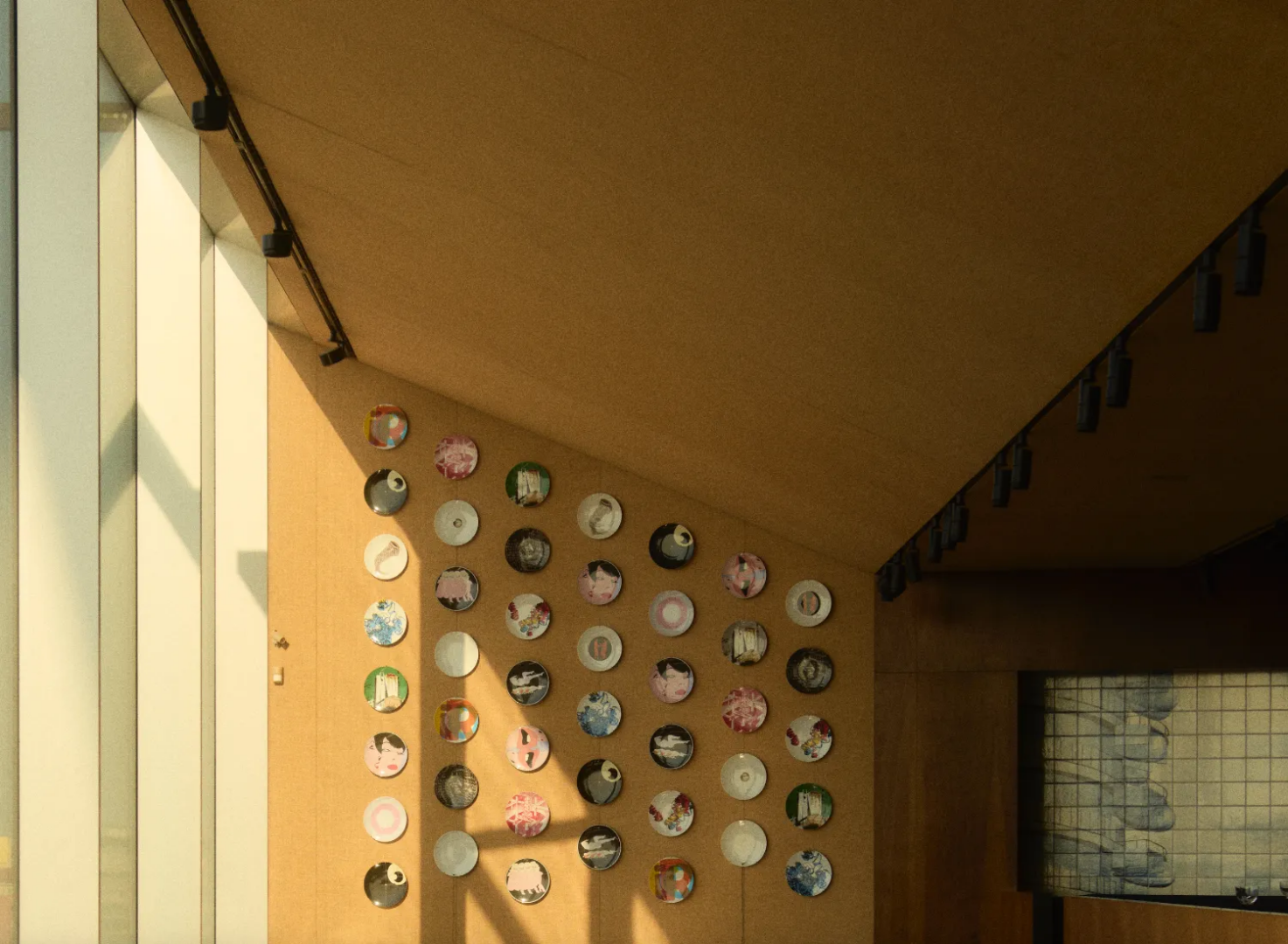
The art is part of the room. Three works by Lucio Fontana stand near the bar, among them the installation Pilastro. Paintings by Jeff Koons, William N. Copley and John Wesley hang in the dining areas. Artists also designed the plates: John Baldessari, Thomas Demand, Nathalie Djurberg and Hans Berg, Goshka Macuga and Mariko Mori. Outside, moreover, a triangular terrace of 125 square metres, paved in porphyry, seats about twenty people. Lorenzo Lunghi runs the kitchen.
The bar works on different terms from the restaurant. It needs no booking. From Wednesday to Friday it opens at 6pm, and at weekends it runs from noon to midnight.
Largo Isarco before Fondazione Prada: the Società Italiana Spiriti distillery
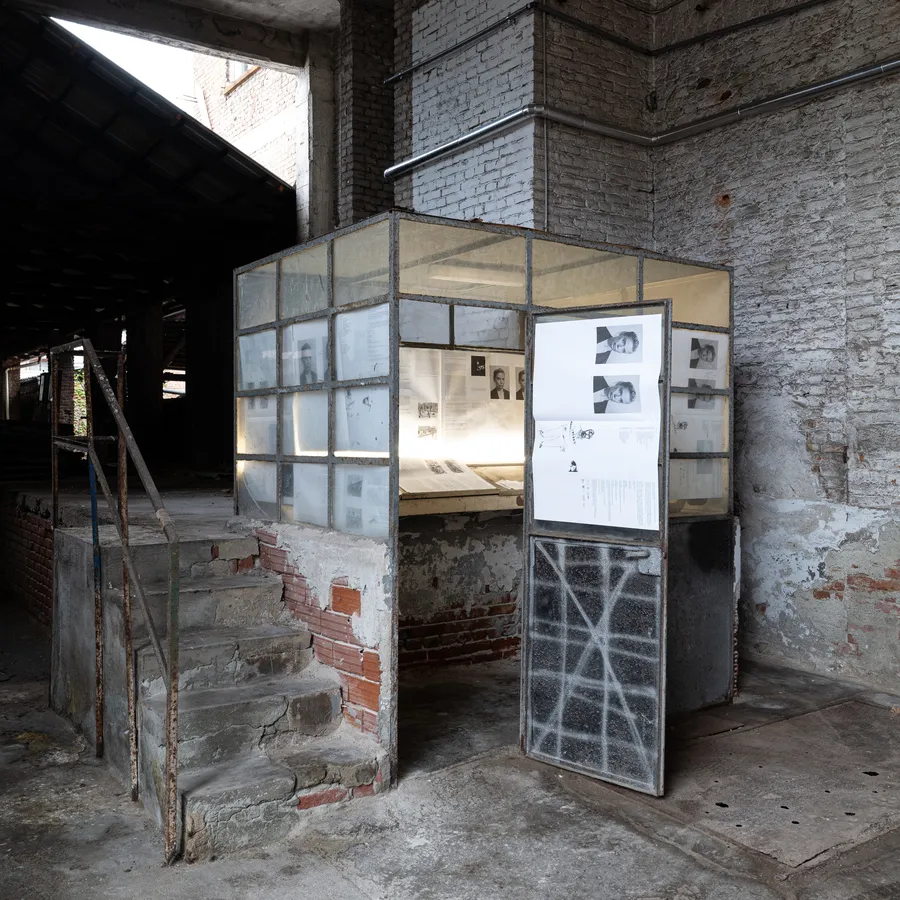
The building below holds the history that the menu draws on. From the 1910s, Largo Isarco 2 housed a distillery, served by the tracks of the Porta Romana rail yard. In the 1950s, Società Italiana Spiriti (SIS), a liquor company from Asti, took over the site from Distillerie Italiane, part of the Genoa sugar group Eridania. Soon after, SIS moved its operational headquarters here.
SIS sold Grappa Barolo, Anisetta, Triple Sec, Prunella, Crema Caffè and Elixir Moka. In 1957 it relaunched its brandy as Cavallino Rosso, with a red horse drawn by the graphic designer Severo Pozzati. Each bottle also came with a plastic horse, and the brand competed with Vecchia Romagna and Stock 84. By 1966, the company filled three million bottles a year and employed three hundred workers. It also imported whisky, rum and Moskovskaya vodka, for which it held the Italian exclusive.
Cavallino Rosso, Carosello and Agente 00SIS
Television, however, made the brand famous. In November 1965, the boxer Nino Benvenuti shot five Carosello spots as Agente 00SIS, two years before he won the world middleweight title. Still, the name had another layer. According to the historians Aldo Giannuli and Giuseppe De Lutiis, Italian military intelligence owned SIS from the mid-1950s until 1967. That year the company returned to Eridania, and in the early 1970s it passed to Cadbury-Schweppes.
Fondazione Prada at Largo Isarco: OMA and the distillery buildings
Fondazione Prada opened on the site on 9 May 2015. There, OMA kept seven of the industrial buildings, among them warehouses, laboratories and the Cisterna, whose three volumes once held tanks for distillates. Later, the architects covered a four-storey distillery building, the Haunted House, in 24-carat gold leaf. At ground level, Wes Anderson designed Bar Luce after an old Milanese café.
Archivio Isarco: Torre’s cocktail menu with house-made spirits
Archivio Isarco takes its name from that address. The list runs in three chapters, Distillati, Liquori and Aperitivi, and each chapter follows a production method. First, a distillate is what crosses the still. Next, a liqueur adds sugar after extraction. Finally, a vermouth starts from wine, flavoured with artemisia and fortified. Most bars buy all three finished. At Torre, instead, the bar decides the botanicals, the strength, the sugar and the dilution, choices that normally belong to a liquor producer. Head bartender David Ciccia and bartender Marina Barazzetti run the programme day to day.
The Torre Negroni and the other Archivio Isarco cocktails
The Negroni shows the method. It keeps Campari and red vermouth, but a house distillate, Hound Viola, replaces the gin. Hound Viola, in turn, starts from purple basil, yuzu and lemon. In the still, the basil gives up its aroma and leaves its purple pigment behind, so the spirit runs clear. Campari, meanwhile, remains a Milan product, made at Sesto San Giovanni since 1904.
The other drinks follow the same logic, although each one uses a different base. The Olive Oil Sgroppino, in Liquori, reworks the Venetian lemon sorbet drink with Limoncino, lemon, extra virgin olive oil and Franciacorta. In the Tequila Jungle Bird, the bar replaces rum with tequila and uses Amaro della Fondazione, a blend of amari steeped for a day with green shiso. Coccodrillo Azzurro, a mint and chocolate distillate, goes into a Grasshopper with clarified vanilla yogurt. Drupa, a liqueur of peach kernel, peach, apricot and Nocellara olive, anchors a Dirty Pendennis with cognac, orgeat and olive brine. Saffiano Sonic, instead, uses a vermouth blend aged in a leather bag, and its garnish copies the crosshatch of Prada’s Saffiano leather. Every drink costs €18.
Rémy Savage: from Little Red Door and Artesian to A Bar with Shapes for a Name
The approach, however, comes from London. Savage was born in Paris, studied philosophy and started in pubs. At Little Red Door in Paris, he wrote menus around artworks and architecture. At Artesian, the bar of the Langham, he and Paul Lougrat wrote concept menus from 2017; their 2019 Minimalism list built each drink on two main ingredients. In 2021 the pair opened A Bar with Shapes for a Name, after the Bauhaus. Later came Bar Nouveau in Paris and Abstract in Lyon, whose lab distils single-ingredient spirits.
Savage moves the work out of service and into production. At Shapes, the team cuts its own ice and bottles the cocktails in advance, so the bartender pours each one over a single cube. In 2024 the production space opened to the public as Bauhaus Warehaus. Since then, by day, staff cut ice and repair glassware there; from 5pm the same room works as a bar. Prada first hired Savage at Mi Shang Prada Rong Zhai in Shanghai, where his menu tells the history of a villa built in 1918. Torre is his second project for the group.
Largo Isarco returns to alcohol production
Still, the scale has changed. SIS filled three million bottles a year across its plants. Torre bottles bases for a single bar, a few floors above the former distillery. The list includes no SIS products, no Cavallino Rosso and no Elixir Moka. What returns to Largo Isarco is the method: alcohol, wine, plants and sugar, worked on site.