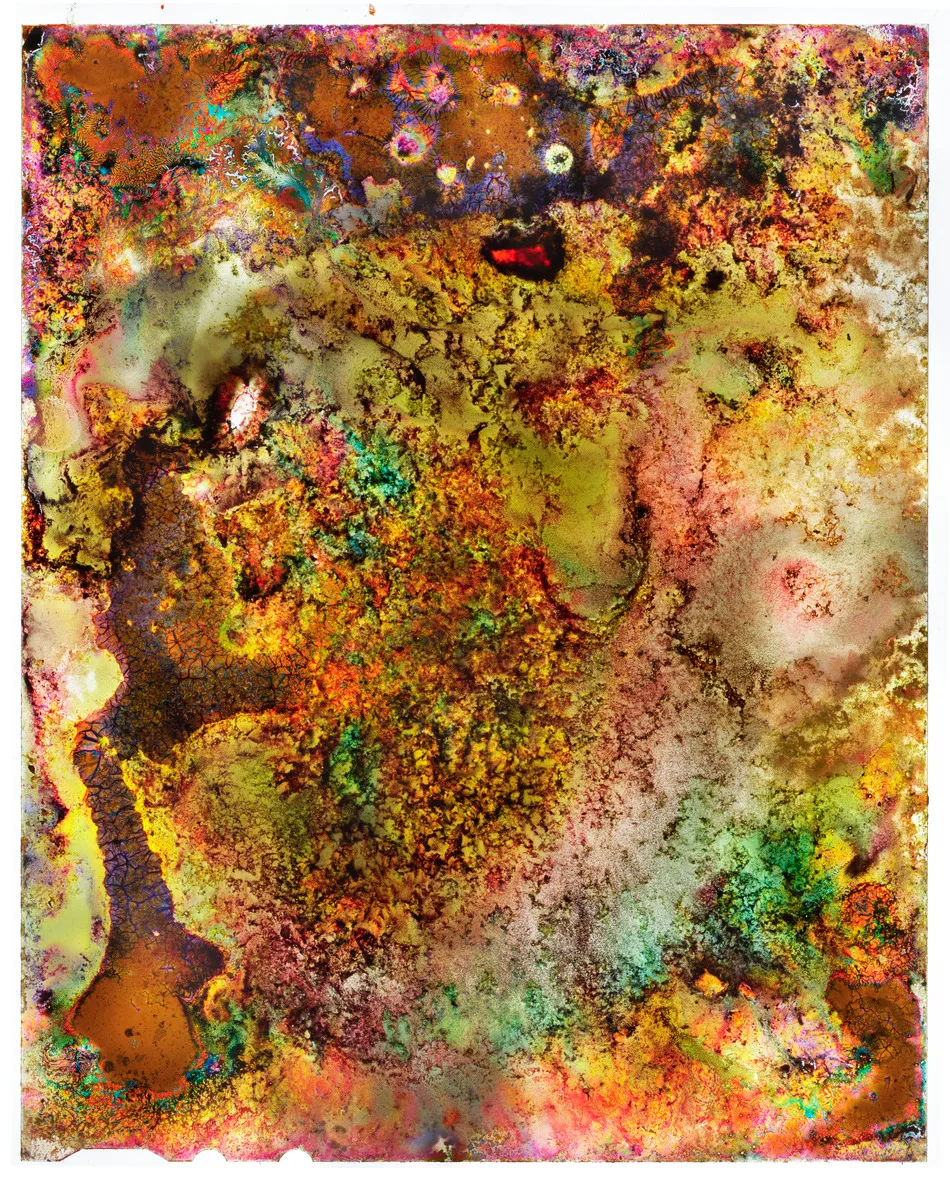
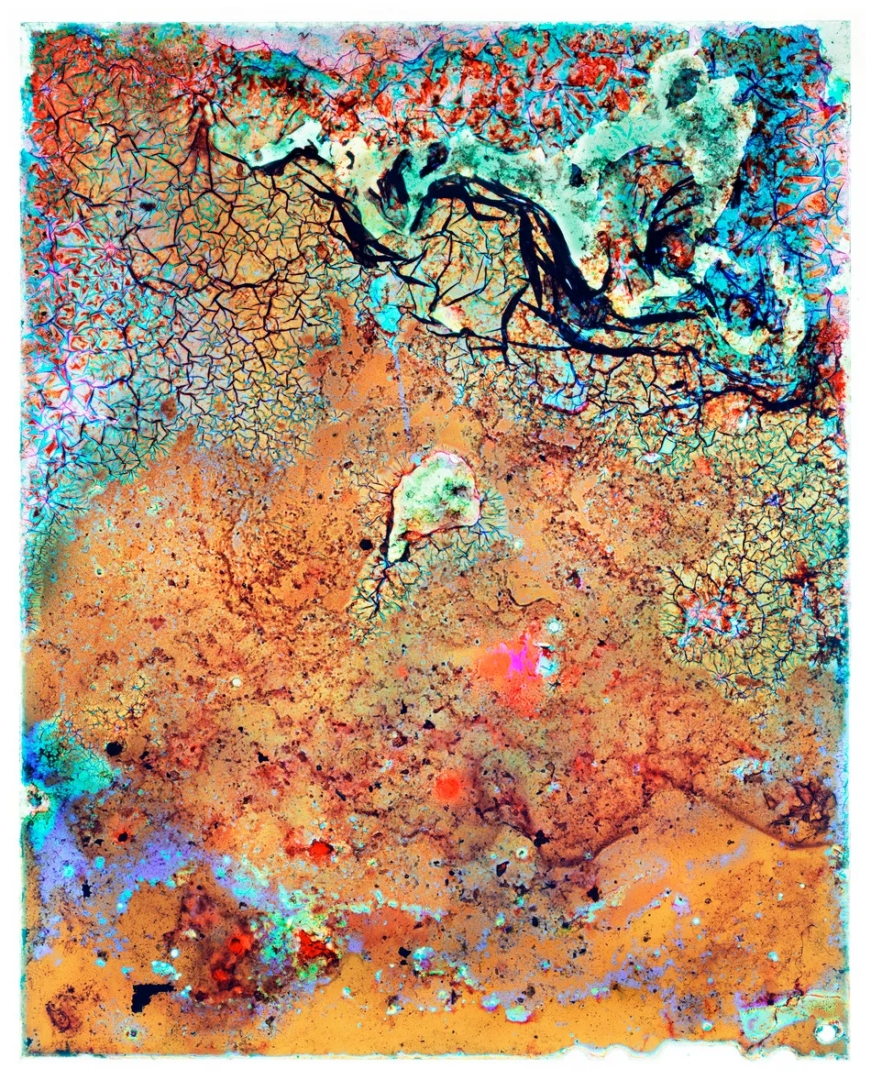
Bacteria from the waters of Marseille, printed on glass
Lara Tabet: microorganisms on photographic film, glass from eleven illuminated panels at Arles to three new bioplastic works at Paris Photo in November – the BMW art makers
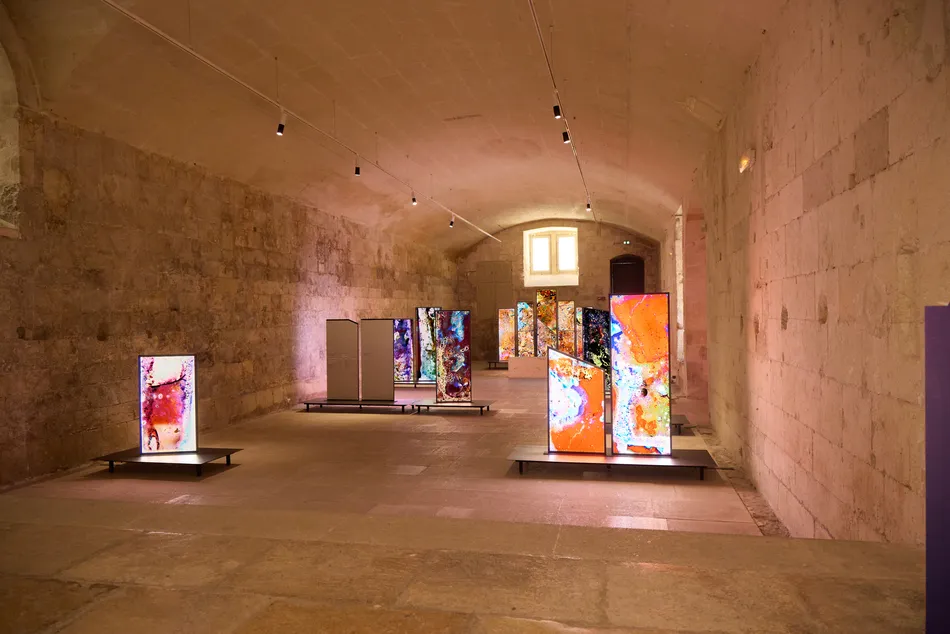
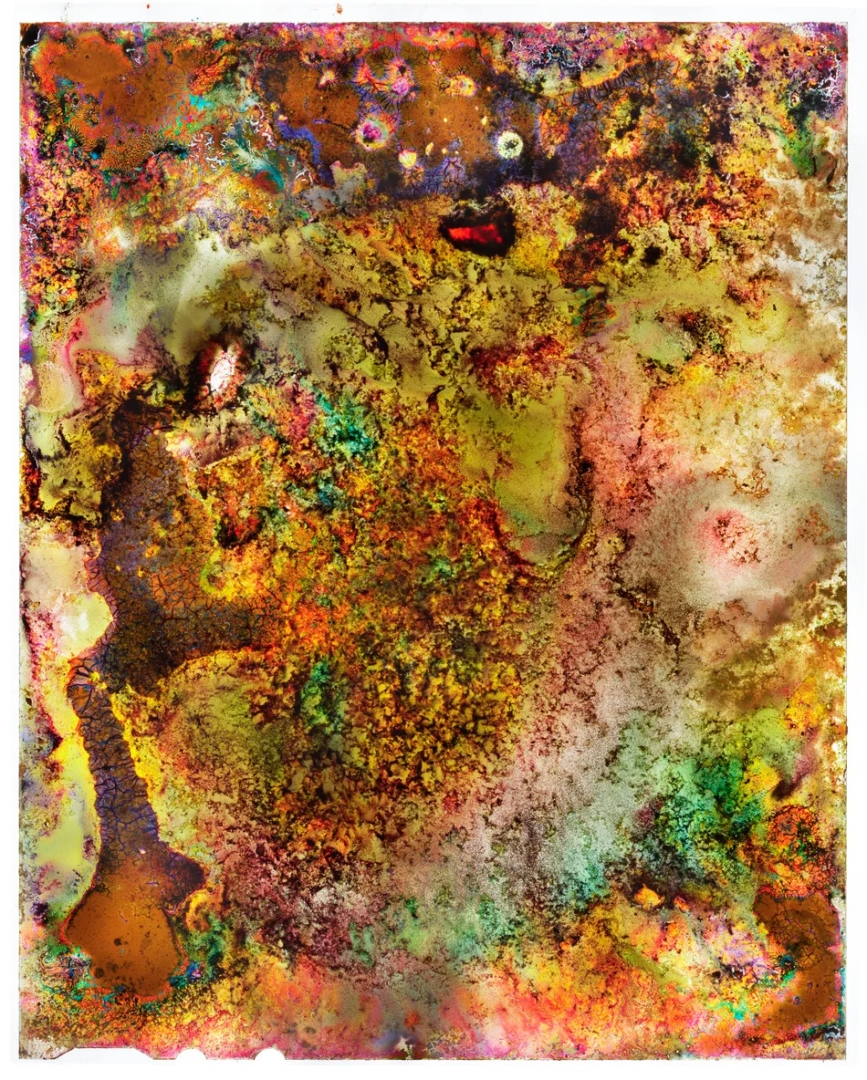
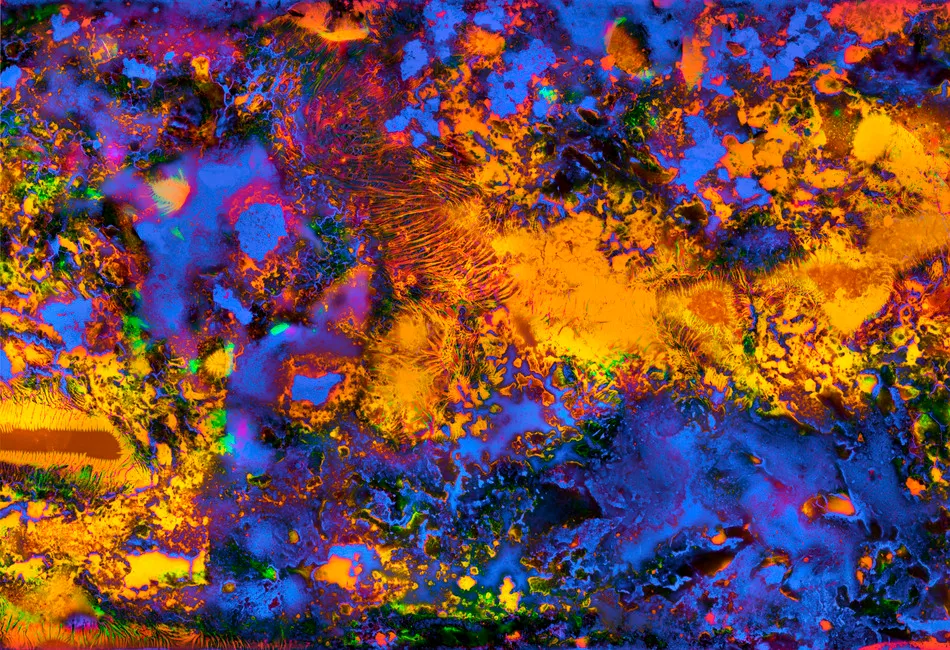
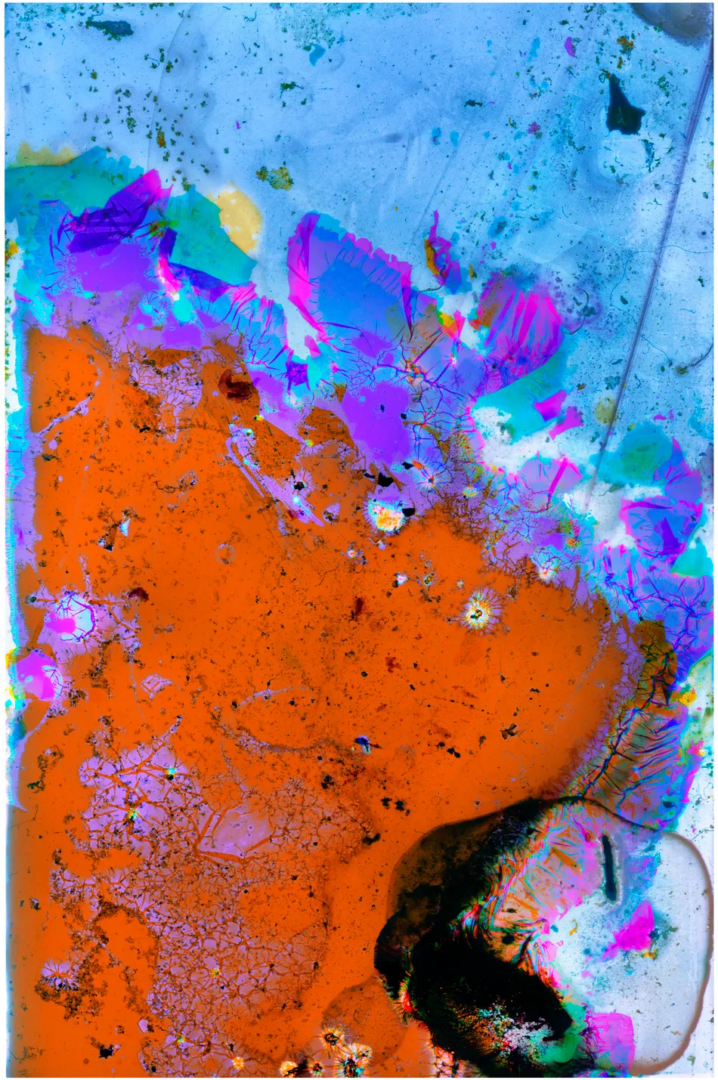
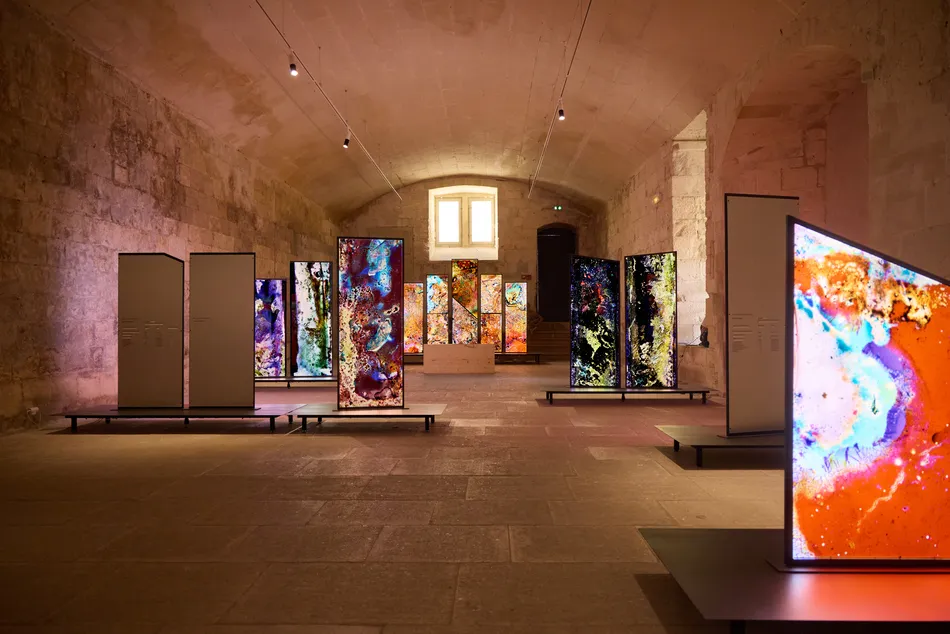
Lara Tabet, a Lebanese artist and medical biologist based in Marseille, collects water samples and cultivates their microorganisms on photographic film. Bacterial activity alters the gelatin emulsion, producing chromatic configurations that depend on the interaction between living organisms and the chemistry of the photographic support. Once digitised, the results are printed onto glass. In Le corps vitré, presented at Les Rencontres d’Arles from 6 July to 4 October 2026, these experiments took the form of eleven illuminated glass panels in the former refectory of the Cloître Saint-Trophime. Developed with the curator Yasmine Chemali, the installation culminated in an altarpiece drawing on the history of Marseille’s water supply. The work was produced within the fifth edition of BMW ART MAKERS.
The title refers to the vitreous body, the transparent gelatinous substance that fills much of the human eye. It connects that gel with the gelatin coating of photographic film and the glass used for the finished works.
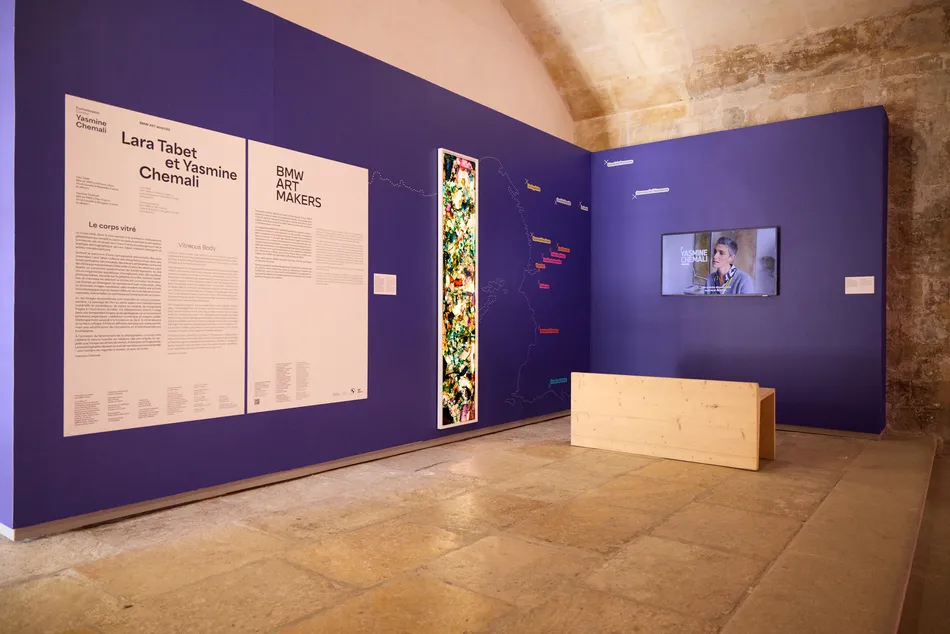
Against a deep-blue wall, an illuminated panel contains an accumulation of colour. Green, yellow and reddish marks spread across a pale surface, interrupted by darker formations. Beside it, a map identifies places across Marseille: the Old Port, the Canal de Marseille, Les Aygalades and other points in the city’s network of waterways. The map shows where the samples were taken. The panels reveal what microorganisms did to the film. No camera was involved.
Lara Tabet from the Beirut River to Marseille, a personal cartography of water
Tabet began working with bacteria and photographic film before moving to France. In The River (2018), she collected microorganisms from the Beirut River, cultivated them on a continuous strip of colour film and transferred the resulting image onto textile. Measuring 65 by 747 centimetres, the work recalls the horizontal course of a river while recording an activity inaccessible to unaided vision. Sections of the Beirut River had been altered by urban development and infrastructural intervention, confined within concrete channels and affected by the changing relationship between the waterway and its surroundings. Tabet’s experiment approached this environment through the microorganisms present in the river itself.
Her subsequent research extended along the Lebanese coast and to bodies of water encountered during residencies and travels. She developed a project she describes as a personal cartography of entangled toxicities, in which geographical movement, environmental investigation and personal history become difficult to separate. The trajectory follows her migration from Beirut to Marseille. «I started sampling all the water bodies that I encountered along the way», she explains.
The commission encouraged her to concentrate on the city where she lives. «It focuses on Marseille, but not only in terms of seawater or freshwater, but all the waters combined in the city: fountains, urban waters, rainwater, as a way to have this representation of the city through its many waters», Tabet recalls. Each location contains a microbial community capable of interacting with photographic material. The sampling sites provide the geography. Microorganisms from their waters produce the marks on film.
The investigation enters a history of the city’s relationship with water. During the nineteenth century, the construction of the Canal de Marseille brought water from the Durance, transforming the city’s supply system. The Palais Longchamp, inaugurated in 1869, commemorated the arrival of water through an engineered canal, making hydraulic infrastructure a public emblem of civic development. Tabet and Chemali approach the city’s waters through the organisms living in them.
Bacteria, film and the limits of artistic control
The bacteriographic process begins with a series of decisions. Tabet chooses the photographic film, its colour properties and processing chemistry. She establishes the conditions under which microorganisms interact with the emulsion and determines the duration of the experiment. Exposure to light and the composition of the materials affect the result. The bacteria do not respond to an artistic composition.
«It’s both the agency of the artist, the artist who puts a protocol in place, but also the accident, or the things that I cannot control», Tabet explains. «I make a point not to do casting of images. Once the image is produced, I will usually use it».
Tabet’s refusal to select images by their appearance places weight on the decisions she makes before the bacteria begin to work. «Some things are out of my control, but other things are artistic tools that I can affect: the choice of film, for example. Is it colour or black and white? How do I process the film, in which chemistry? Do I show it to light or not? How long do I let the bacteria modify the film?»
Tabet calls the procedure a collaboration between the microbial and the human. The word does not give bacteria artistic intentions; it acknowledges how much of the final image remains beyond her control. She connects her work to feminist and post-humanist thought, to the writings of the theorist Donna Haraway, and to forms of knowledge that question the separation between human observers and the environments they inhabit. The laboratory experiment gives these ideas a material form: a microorganism acts on a manufactured photosensitive surface, its activity becomes visible through chemical alteration, and the resulting image is enlarged until it occupies the dimensions of a landscape photograph.
Resilience Overflow, a genetically modified strain and a speculative release
An earlier project, Resilience Overflow (2023), explored the relationship between microbiology and political responsibility through a different medium. Working with the Environmental Molecular Microbiology Laboratory at the National Center for Biotechnology in Madrid, Tabet developed a genetically modified bacterial strain capable of producing human neuropeptide Y, a molecule associated with physiological responses to stress. The experimental modification was real. Its proposed release into Beirut’s water system remained speculative.
The work imagined a microbial intervention in a city affected by institutional and economic crises. Its premise questioned the political use of resilience: a quality demanded of individuals who must continue functioning despite the failures of the systems meant to support them. Although the project employed biological engineering and a speculative narrative, Tabet does not regard it as a departure from her photographic research. «The common thread between the two is working with the performativity of microbes. How can we think about microscopic performance, and how microscopic actions affect us on a global scale?», she explains.
In Resilience Overflow, video gave Tabet room to develop a speculative narrative. A still photograph cannot unfold that sequence in the same way.
In Le corps vitré, the microorganisms inhabit the waters from which the samples are taken. Their activity produces an image linked to a location and an experimental moment. Tabet approaches these works in relation to documentary photography, describing them as «samples of the real». The comparison involves qualifications. Bacteriography records the interaction between microorganisms and film; it does not provide a direct measurement of the environmental contamination of the original water sample. Scientific analysis can identify and quantify conditions that the resulting photographic patterns cannot establish.
For Tabet, the interest lies in what she calls «the hybrid space between art and science», where neither discipline necessarily supplies the other’s conclusions. The surfaces are part of that encounter. She describes the images as existing «at the edge of something disturbing»: their colour and composition draw the viewer closer, while knowledge of the circumstances in which they were produced introduces another level of understanding. Visual seduction becomes an entry point into a biological process rather than an illustration of a predetermined environmental message.
Yasmine Chemali, glass, light and the curatorial construction of the image
The transition from laboratory material to public exhibition has been shaped by Tabet’s collaboration with Yasmine Chemali. Trained in art history, museology and heritage conservation at the École du Louvre and EHESS, Chemali has worked with photographic collections and museums. She directed the Fouad Debbas Collection and was responsible for the modern and contemporary art collections at the Sursock Museum in Beirut between 2014 and 2020. Since 2020, she has directed the Centre de la Photographie de Mougins. Her experience with photographic heritage introduces questions concerning the material condition of images, their exhibition and the ways audiences encounter them.
Tabet describes their collaboration as a conversation between two people who were friends before working together. Their professional approaches are different. «I don’t think about audience when I work», Tabet acknowledges. Chemali’s attention to the legibility of the work has encouraged her to consider how a process might become accessible within an exhibition. The challenge involves deciding how much information should accompany an image and what the exhibition itself can communicate.
At Arles, the decision to print the bacteriographies on glass gave the photographs a relationship with architecture. For Tabet, the material carries several associations, from the laboratory slide to the historical use of glass in photography. «We decided to print on glass», she explains, referring to its mineral character and to «the slide that we use under the microscope, but also the glass plates of photography, and stained-glass windows that usually carry sacred narratives». The intention was to transpose that visual language into an ecological context.
In the former refectory of the Cloître Saint-Trophime, the illuminated panels recalled the arrangement of religious images, while the retablo drew on a form associated with devotional looking. In place of sacred figures, the installation presented traces of microorganisms collected from Marseille’s waters. Light became a component of the exhibition, passing through the works and giving their chromatic structures an architectural presence.
The arrangement preserved a relationship with the scientific investigation. Behind the glass panels, visitors could find the sampling locations and information from the bacteriological analyses. The exhibition encouraged movement between the visual surface and the material circumstances of its production, keeping the images attached to their geographical origins.
Chemali’s contribution is inseparable from the way Le corps vitré constructs its audience. It introduces questions familiar to photographic conservation. The organisms act on the gelatin emulsion of film; their effects are digitised and printed onto glass. The photograph, the initial experiment and the exhibited object occupy different stages of production. The historical problem of the photographic original returns through a procedure in which the initial image was generated by living organisms.
BMW ART MAKERS, 210 applications and a 33,000-euro commission
BMW ART MAKERS developed from the company’s earlier photography residency programme, which ran from 2011 to 2021. Its present structure gives an artist and curator the resources to develop a project, from initial research to public exhibition. The 2026 edition selected Tabet and Chemali from more than 210 applications, providing 33,000 euros in financial support, divided between grants for the two recipients and a research and production budget. The programme supports the presentation of the work at Arles and at Paris Photo. An independent jury, drawn primarily from cultural and photographic institutions, selects the recipients; BMW finances the commission and supports its research and production.
Thomas Girst on beauty, roughness and the role of patronage
Thomas Girst, Head of Cultural Engagement at BMW Group, begins with the viewer’s first encounter with a work of art. «A work of art should resonate on two levels. You look at it without knowing too much about its context, and it still creates meaning on a visceral or visual level. Some curators and artists only focus on its societal coordinates, neglecting an inherent aesthetic level», he tells Lampoon. An artwork may address pollution, violence or structures of power, he argues, while retaining a responsibility toward «beauty, craft and creative excellence». Girst argues for beauty as a quality of the finished work, where Tabet refuses to use it as a filter for deciding which bacterial images to keep.
Girst is drawn to surfaces marked by wear, repair and age. Among the references he discusses is the writer Jun’ichirō Tanizaki’s In Praise of Shadows, first published in 1933, with its attention to the qualities disclosed by subdued light, aged materials and the partial visibility of objects. Girst refers to wabi-sabi and kintsugi, the Japanese practice of repairing broken ceramics with lacquer and precious metal, making the fractures part of the object’s appearance.
The attraction of imperfect materials extends into his reflections on artistic production under extreme conditions. His 2015 study Art, Literature, and the Japanese American Internment, centred on the writer John Okada, examines artistic and literary expression in relation to the incarceration of Japanese Americans during the Second World War. The capacity to create from limited resources, he suggests, has little to do with flawless execution.
Another reference comes from the sociologist Hartmut Rosa’s theory of resonance, which describes the relationships through which individuals encounter and respond to the world. Girst recalls the possibility of resonating «with another human being, with ourselves, with a work of art, with a cat, with a tree, with a cloud», finding value in the depth of these encounters rather than in their economic measurement.
Artistic freedom and the contradictions of corporate patronage
Girst speaks as the Head of Cultural Engagement at an automobile manufacturer financing a project about microorganisms, water and environmental contamination. His defence of artistic freedom raises a question about BMW’s own position within the work. Girst addresses the issue: «We don’t want art that celebrates merely the brand. Arts and culture should be critical of companies, of anything really if it so wishes».
Paris Photo, the new scenography and the bioplastic supports
From 12 to 15 November 2026, Le corps vitré will be presented at Paris Photo, inside the Grand Palais. The new exhibition will require a different arrangement from the one developed at Arles. The former refectory provided an architectural environment in which the illuminated glass panels could establish a sequence. At Paris Photo, the works will enter the circulation of an international fair, surrounded by other photographic practices and forms of presentation.
Tabet and Chemali have developed a new scenography, with some of the glass works displayed on walls and additional information concerning the microbial communities associated with each sampling site. The presentation will include three new works conceived for the Grand Palais, extending experiments with bioplastic materials.
Tabet describes transparent supports made from combinations of photographic emulsions, agar and bacteriological culture media. Exposed to microorganisms, these materials can undergo alterations that involve the support itself, instead of producing an image transferred to another surface. The distinction raises a problem of duration. A photograph is usually understood as an image whose material preservation is a central concern, even when its chemical support remains vulnerable to deterioration. Tabet introduces materials whose susceptibility to change is part of the artistic process. Within a photography fair, where artworks enter networks of exhibition, acquisition and conservation, the question acquires weight.
At Arles, visitors saw bacterial images transferred from photographic film onto illuminated glass. At Paris Photo, Tabet’s new bioplastic supports may continue to change after the experiment. How these works will be preserved remains open.
Federico Jonathan Cusin