Iris van Herpen turns vineyard vibrations into form for Perrier-Jouët
Using cymatics, the designer recorded activity in the soils of Ambonnay and Cramant and translated it into a collection built around Belle Époque champagne
On 21 October, at The Peninsula Paris hotel, the collaboration between Perrier-Jouët and Iris van Herpen was unveiled. A dialogue that began in December 2025, when the designer received the first Perrier-Jouët Design for Nature Award, created to support the search for sustainable design solutions. Visiting the Maison and exchanging ideas with chef de cave Séverine Frerson, the Dutch designer has signed a collection with a common denominator: the Belle Époque vintage champagne. Its expression, by contrast, is threefold: Symphonic Bloom, a one-of-a-kind piece; Symphonic Life, a series limited to ten pieces; and a dedicated cuvée.
Introducing the partnership, Axelle de Buffévent – Global Culture & Creative Director at Pernod Ricard, the group that owns Perrier-Jouët – explained: “Throughout her career as an artist and couturier, Iris van Herpen has crafted new visions of the world. Working not only with our teams at Perrier-Jouët but with the terroir itself, she has found true joy and beauty in the natural world, which is reflected in these stunning creations.”
Perrier-Jouët and Iris van Herpen, a synergy rooted in the natural world
At the heart of the collaboration lies nature as the primary source of inspiration, a driving force that ceaselessly transforms all that exists. For van Herpen, a couturier with a holistic vision, the world around us is the most precious of allies. For Perrier-Jouët, it is the very foundation of a business rooted in the land. For both, it is also synonymous with environmental stewardship: working in haute couture, the designer favours the quality and refinement of her garments over quantity. In her work she has so far used seaweed, regenerated plastics and resins, and has also developed low-impact fibres derived, for example, from the fermentation of plant biomass. For the French house, protecting the environment is a concrete commitment, marked by precise milestones: in 2016, Viticulture Durable en Champagne certification; in 2020, an end to the use of herbicides; in 2021, the launch of an experimental programme on cover crops, which foster soil fertility, biodiversity and water resilience – crops extended, this year, to 33 hectares, roughly half of its estates. A natural ethos is, moreover, one of the cornerstones of Art Nouveau, a movement dear to the Épernay Maison.
In the words of Iris van Herpen: “In nature, there is a silent yet ever-present dance of frequencies, rhythms, and biological processes that shape life.”
Perrier-Jouët and Iris van Herpen, a dialogue in three acts
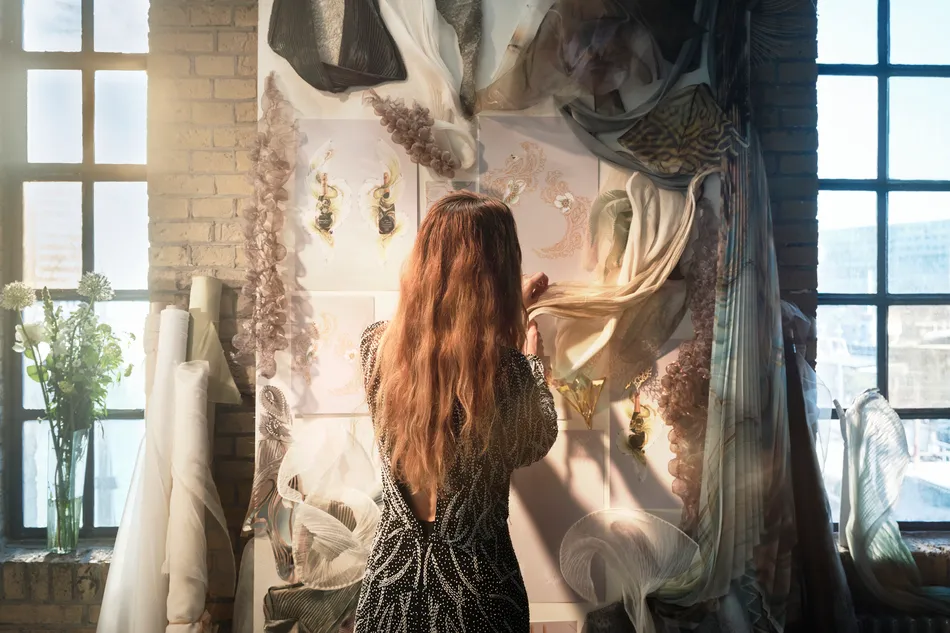
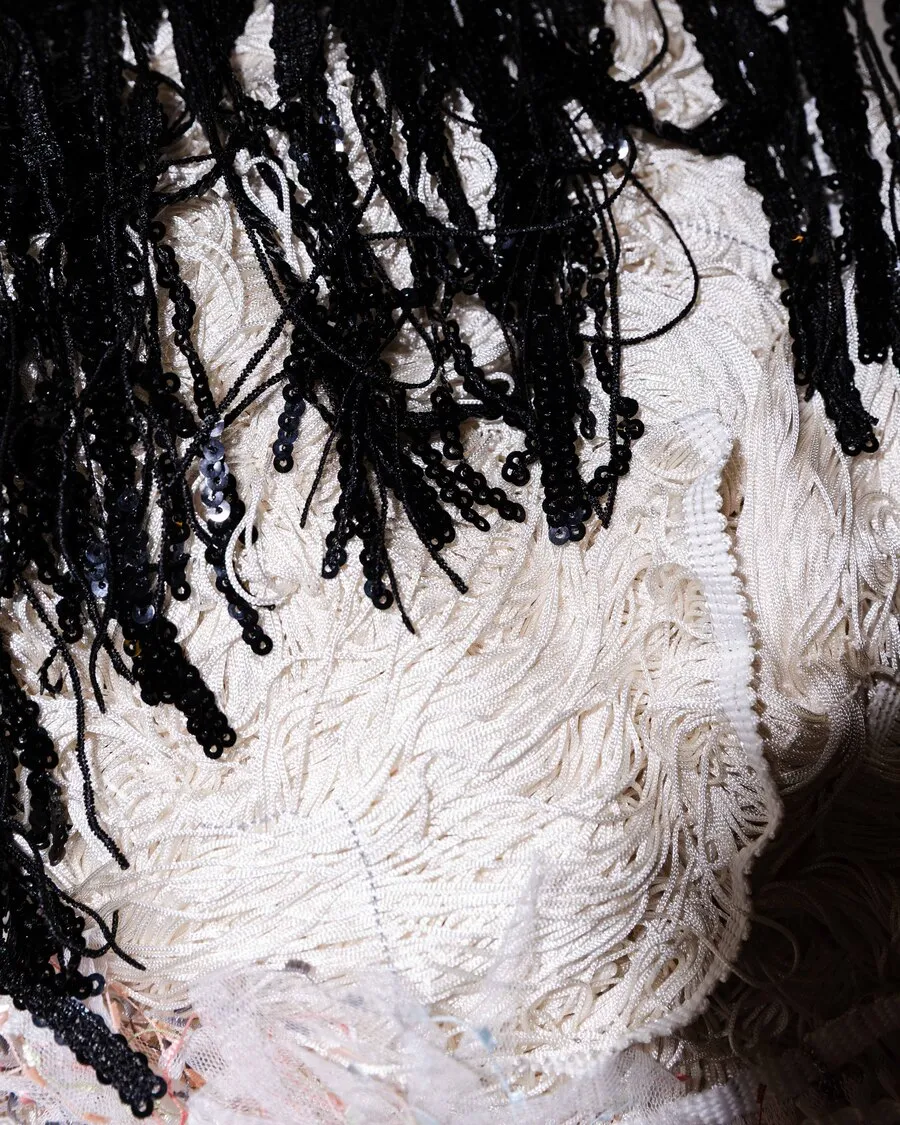
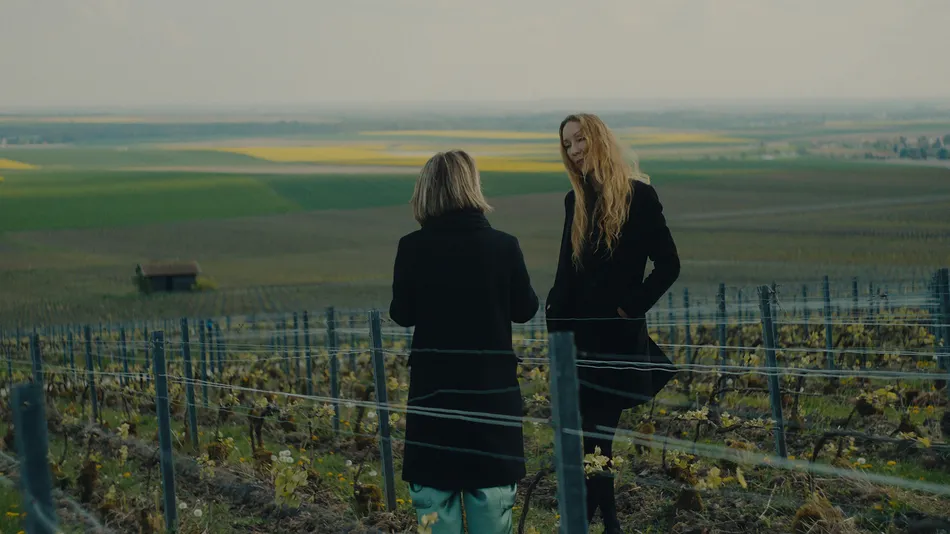
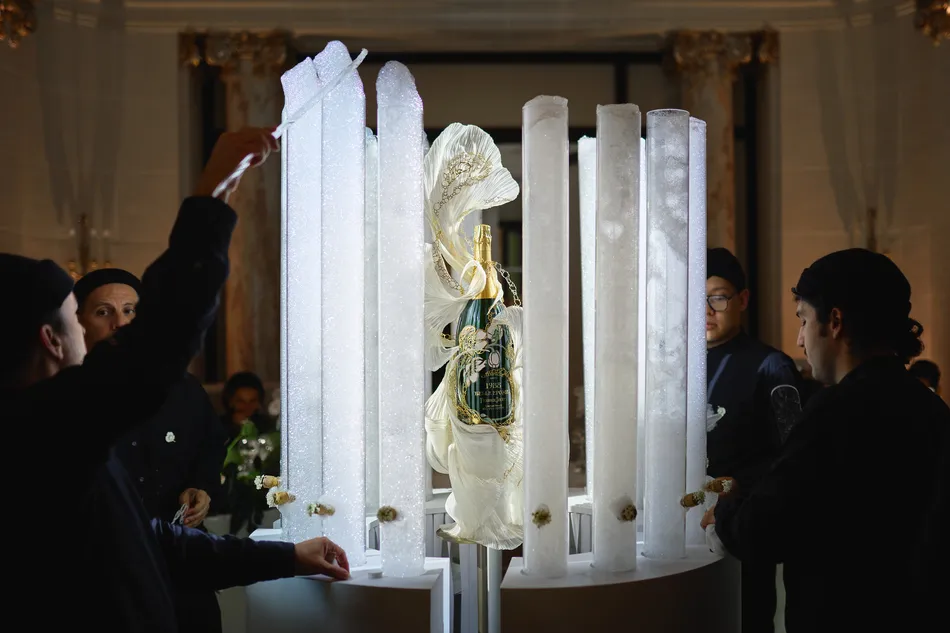
To work on the collection, Iris van Herpen travelled to Ambonnay and Cramant, to the brand’s vineyards, renowned for the Chardonnay that lends the bubbles their distinctive floral notes. Through cymatics (the study of how sound waves affect matter), she recorded the vibrations generated by the multitude of microorganisms in the subsoil. She then translated them into shapes and visual patterns, forging an artistic language that conveys the genius loci of the land. From this fieldwork – quite literally – and from her exchanges with Séverine Frerson at the Épernay headquarters, Symphonic Bloom was born. A tactile work with a sculptural imprint, evoking the way the aromas of champagne layer and develop over time. In silk and reclaimed 22-carat gold, it seems to blossom from the bottle – a rare 1988 Belle Époque jeroboam – and spread into the air. Its upward movement recalls that of the dancer Loïe Fuller in the bronze lamp fashioned by Raoul Larche in the early twentieth century: a piece from Perrier-Jouët’s collection of Art Nouveau works, the largest in all of Europe.
Symphonic Bloom, Symphonic Life and a dedicated cuvée make up Iris van Herpen’s collection for Perrier-Jouët
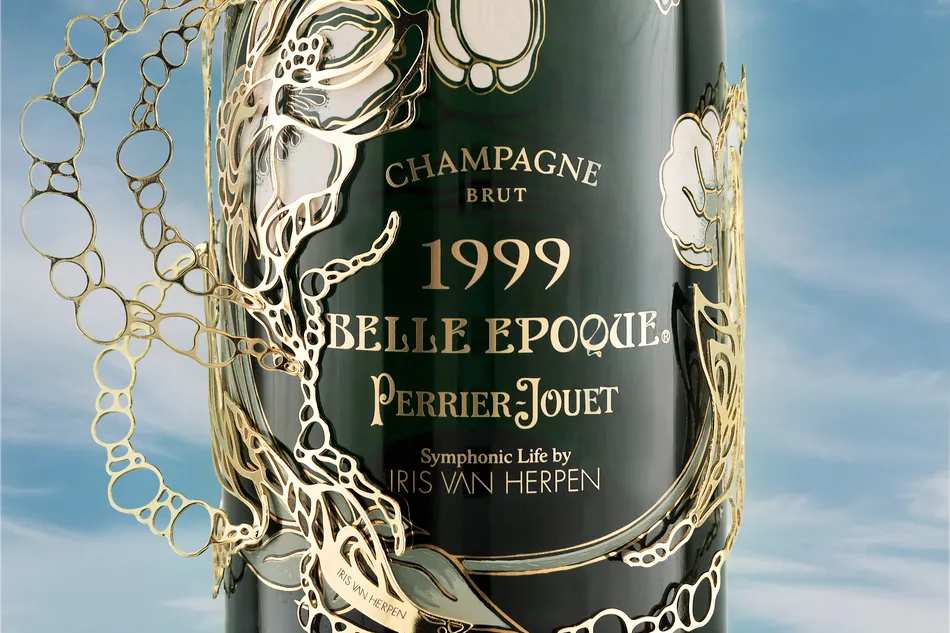
Starting from Symphonic Bloom, van Herpen developed Symphonic Life, a series limited to ten numbered pieces. Sinuous creations that coil around as many Belle Époque magnums. Also in recycled gold, they take shape around the bottles like an extension of the anemones engraved on their glass. They hold champagne from the 1999 vintage, particularly prized for having aged for over a quarter of a century in the brand’s cellars. This ageing lends the whole notes of white flowers and almond, mingled with full-bodied hints of incense, tobacco, apricot and candied lemon.
Taking the dialogue to a further, broader level comes the dedicated cuvée. The starting point here is the idea of how natural textures influence the senses. Van Herpen worked, in her own inimitable way, on both the bottle and the case that holds it. Frerson reinterpreted the 2018 Belle Époque, adding a special liqueur de dosage, a bespoke blend developed with the designer herself. The resulting cuvée releases accents of white flowers, cooked pear and grapefruit, heightened by a touch of white pepper and a velvety finish.
In Frerson’s view, “The floral signature of Perrier-Jouët is born from a deep connection with nature and a continual search for elegance and nuance. Through our dialogue, we explored texture as a shared language, from the tactile qualities of her work to the layered sensations that define an exceptional champagne.”
Courtesy of Perrier-Jouët.
From Japan to the United States, the journey of the Perrier-Jouët x Iris van Herpen collection
The Perrier-Jouët x Iris van Herpen creations were unveiled at the Tokyo Gendai art fair in September, then exhibited at The Peninsula Paris. Framing the presentation at the Parisian hotel was The Banquet of Nature, a format conceived by the house in 2019 as a synaesthesia of flavours, images and diverse suggestions, staged this year with the couturier’s input. Once again drawing inspiration from the “hidden” patterns in the vineyards, she devised two sensory experiences centred on foam and an edible dress. The presence at the Peninsula extended to its in-house Kléber bar, which from 21 to 25 October served a selection of amuse-bouches by David Bizet, a chef with two Michelin stars to his name, paired with glasses of Belle Époque 2018. The joint journey of van Herpen and the champagne house will continue in December at Design Miami. On this occasion, the programme includes an encore of the Banquet of Nature and a gastronomic experience curated by multi-starred chef Pierre Gagnaire. A Perrier-Jouët ambassador, he heads his eponymous restaurant in Paris, which has outposts scattered across England, the Far East and the United Arab Emirates.
Iris van Herpen: designing clothes is a science
Born in 1984 in Wamel, the Netherlands, Iris van Herpen launched her haute couture label in 2007. In 2010 came a pivotal moment in the brand’s rise: the appearance, in the spring/summer 2011 collection Crystallization, of a 3D-printed dress, now on view at the Musée des Arts Décoratifs. The following year, the Groninger Museum would devote her first retrospective. Over the years, her creations have entered institutions of the calibre of MAD and the Palais de Tokyo in Paris, New York’s Metropolitan Museum of Art and London’s Victoria and Albert Museum. Since 2011 the designer has been a member of the Fédération de la Haute Couture, a regular presence on the haute couture calendar of the Ville Lumière. With a background in dance, she conceives clothing as a form of expression in its own right, the outcome of an interdisciplinary blend of art, tailoring, architecture and science. Water, air and earth – three of the four fundamental elements of ancient cosmogonies – have nourished her research from the very beginning, aimed at revealing the often hidden beauty of ecosystems by translating organic forces and volumes into garments.
Her clients include personalities of the stature of Cate Blanchett, Lady Gaga, Björk, Scarlett Johansson, Natalie Portman and Rihanna, who have carried the designer’s visionary flair onto international red carpets.
Central to her clothing is an attention to movement, a legacy of classical ballet. She has stated: “Dance taught me so much about my body, the transformation of movement, the ‘evolution’ of shape, and how to manipulate both shape and movement.”
On her scientific approach, she said: “I look at the forces behind the forms in nature, these patterns and natural cycles are my guide to explore new forms. I continue to ask, can emotions be materialised? I believe it’s possible to merge, stir and sculpt our senses through a sensitive balance of textures, shapes and colors.”
Perrier-Jouët’s artistic signature
Perrier-Jouët was founded in 1811 by husband and wife Pierre-Nicolas Perrier and Rose-Adélaïde Jouët, determined to make Chardonnay – then little used – the centrepiece of their winemaking. To this day, the grape covers 56% of the estate, in the heart of Champagne. In 1842 came the release of Cuvée K, in effect the world’s first brut. The bond between the brand and art – Art Nouveau above all – is deep and well documented. An elective affinity, since the “new” artists of the turn of the twentieth century reinterpreted nature to bring beauty into everyday life; the Perrier and Jouët couple’s enterprise did the same, on another plane. Ideally sealing this harmony of values, in 1902, was Émile Gallé, who created the stylised anemone motif that still adorns the bottles today.
The Maison Belle Époque in Épernay, a UNESCO World Heritage site, houses furniture and works by Art Nouveau luminaries such as Henri de Toulouse-Lautrec, Louis Majorelle, Hector Guimard, René Lalique and Alfons Mucha. In more recent years, the brand has associated its name with major figures on the global scene, from Daniel Arsham to Marcin Rusak, by way of Ritsue Mishima, Vik Muniz and Fernando Laposse.
Marco Marini