Mushrooms framed by steel, concrete, and digital code: Zheng Mahler’s Clouds
Built from fungi, fog, datasets, and machine learning, Zheng Mahler’s Mushroom Clouds asks what happens when an exhibition becomes a living system
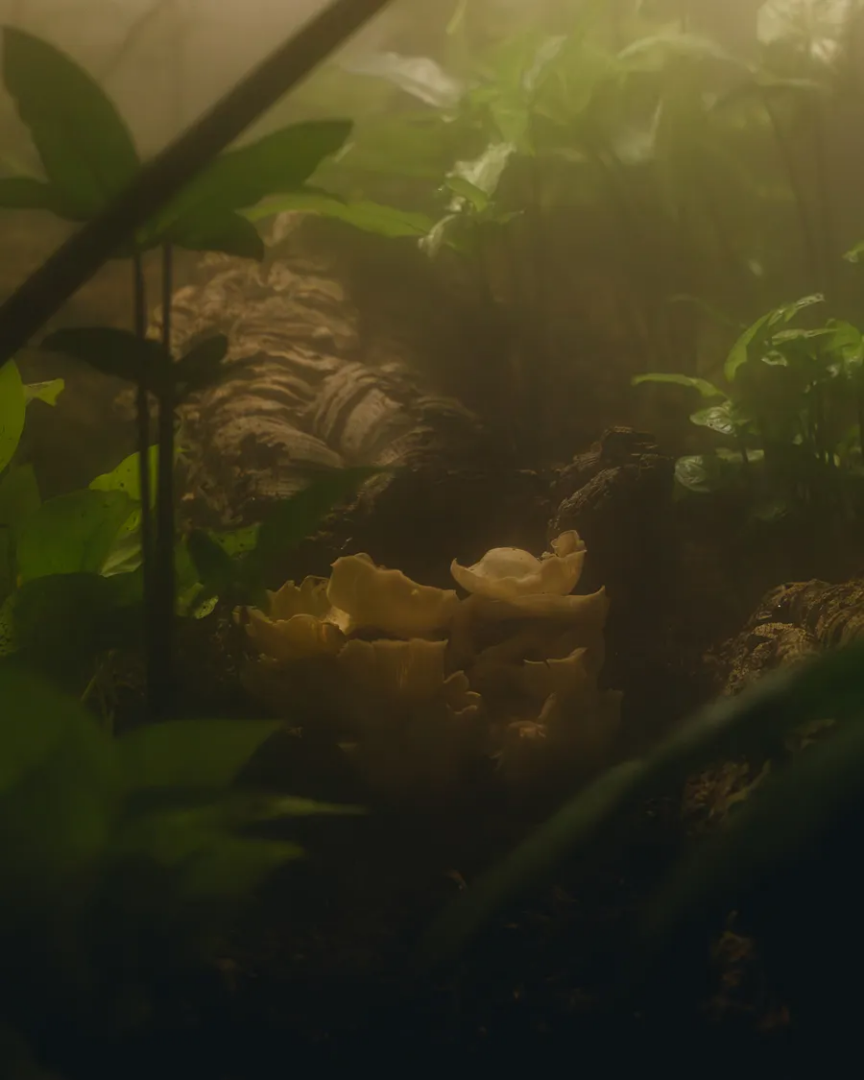
Mushroom Clouds, Zheng Mahler’s second solo exhibition at PHD Group, begins where most exhibitions end — with maintenance. Humidity must be monitored. Fog systems must run. Mushrooms appear, decay, and return to the system. Insects move in uninvited. Conditions shift. Nothing remains fixed for long.
The exhibition follows a familiar contemporary ambition of moving beyond human-centered perspectives. Yet rather than treating this as a theoretical exercise, Zheng Mahler, formed by artist Royce Ng and anthrozoologist Daisy Bisenieks, approaches it as a practical problem. What does it mean to work with a living system without reducing it to an image, a dataset, or an object on display?
The answer emerged through years of observing fungi. What began as fieldwork gradually expanded into an archive, a custom AI dataset, and eventually a living vivarium where biological and technological systems coexist. Throughout the process, the artists moved further away from representation and closer to cultivation. The work is not simply shown. It’s sustained.
Looking before building: Where the Mushroom Clouds project began
The project didn’t begin in the gallery. It began on Lantau Island. After moving there in 2013, Zheng Mahler spent years observing the seasonal arrival of fungi, gradually building a practical knowledge of the island’s mycological life. But what they found was a gap between observation and documentation. Despite Lantau being Hong Kong’s largest island and one of its richest ecological environments, formal information on its fungal life remained surprisingly limited.
An unexpected encounter pushed the project further. An article about AI-generated mushroom-foraging books raised questions about the relationship between technological systems and biological ones, and about what happens when machines attempt to interpret forms of life they barely understand.
«Observing fungi requires attention to their relation with different substrates and neighboring plants or trees, to understanding their mycelial worlds. It requires sensing the elements of their immediate environments — the amount of light, shade, humidity, temperature, and substrate chemistry where each type of fungi is flourishing. Learning about mushroom biology helps you understand how they cultivate symbiotically with plants in a closed environment like a vivarium. Mycelium, for example, prefers carbon-rich, dark environments to colonize substrates but needs degrees of light and oxygen to fruit for mushrooms to emerge.»
The deeper the research became, the more fungi resisted familiar categories. Their resilience proved almost excessive. Fungi can feed on soil, wood, rock, hair, books, and even radiation. Their ability to adapt has even led to growing research into mycoremediation, where fungal networks are used to decontaminate polluted environments and break down waste.
«Photography wasn’t a common practice for us before, but it became a necessity during research and fieldwork. Identifying fungi diversity and using ‘focus stacking’ techniques helped us create a rich database; it gave us the opportunity to consider the diversity of existing AI datasets’ representation of fungal life.»
Before the model could learn, the dataset had to be built by hand
In a project concerned with both fungi and artificial intelligence, research extended far beyond observation. The real challenge was translation: converting living organisms into machine-readable information without flattening their complexity in the process. Unlike the large-scale models that power contemporary AI systems, often trained on vast quantities of internet data, Zheng Mahler built their dataset from the ground up. Every image had to be found, documented, processed, and labeled before it could enter the system.
«To make our dataset of fungi that exist on Lantau Island, we had to go into the forests, often during the humid, mosquito-infested rainy seasons. We would walk around with eyes to the ground or snake up tree branches for hours, looking for fungi growing from the soil, tree roots, branches or rotten logs. We’d lie down on the ground at eye level with the fungi and take twenty to thirty photos, changing the focal length on the lens infinitesimally for each photo. We then took those photos and processed them on the computer to make something which could be used in the data set. Then we had to label each image with the prompt text so the model could locate it within the millions of parameters of the foundation model (Stable Diffusion XL) we were training to.»
Even a carefully built dataset could not escape inherited bias
The custom dataset didn’t produce a clean slate. Zheng Mahler worked with a Low-Rank Adaptation (LoRA), a method that allows an existing AI model to be retrained on a smaller, specialized dataset. But the model was never entirely their own. Beneath the fungal archive they had painstakingly built remained the assumptions of a much larger system, ready to surface at unexpected moments.
«Many of the biases from the original training still remained in our customization. If we wanted to generate something relatively straightforward, such as a water buffalo, the model would often default to a cow. Because water buffalo were not sufficiently represented in the original dataset, the model simply moved toward its nearest visual neighbor. We could have retrained it to include water buffalo, but we decided to leave those images out of the final animations because of time limitations.
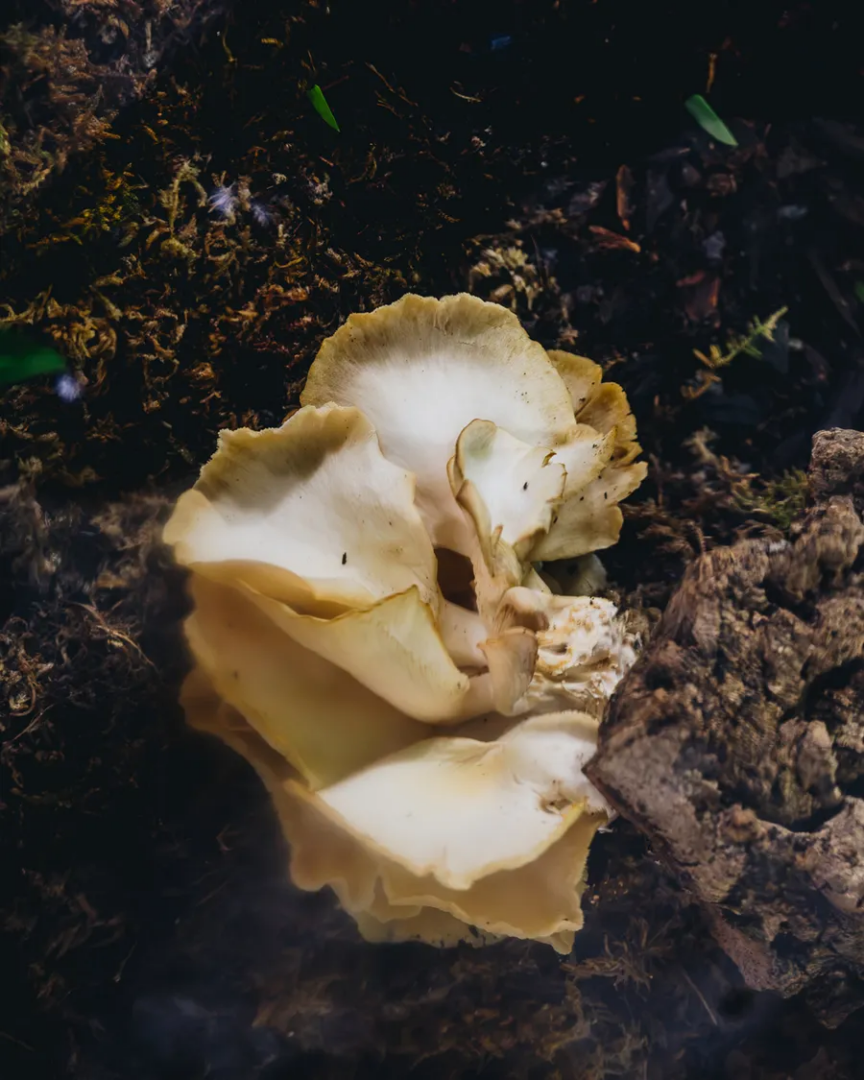
The model would also hallucinate based on the prompt imagery we provided. We created animations for Auricularia aurentia, or orange peel fungus, which resembles yellow petals or orange peels scattered across the forest floor. The model repeatedly interpreted the fungus as actual orange slices and began morphing it into them. It was frustrating, but also revealing. There was a kind of surrealist automaticism at work, where the model kept projecting its own interpretations onto the source material. Its mistakes exposed a strange internal logic, an unconscious continuously attempting to make sense of what it was seeing.»
Psychedelic is the closest description of the animations the AI produced. The images are not stable; they constantly morph as figures appear and disappear. The colors shift too, from figurative to abstract. Not deliberate, but it reflects the psychedelic properties of psilocybin-containing mushrooms.
«The fact that an AI model produced images that replicated the visual phenomenology of the human mind is telling. Perhaps, after all, there’s a similarity between the construction and function of AI and the human brain.»
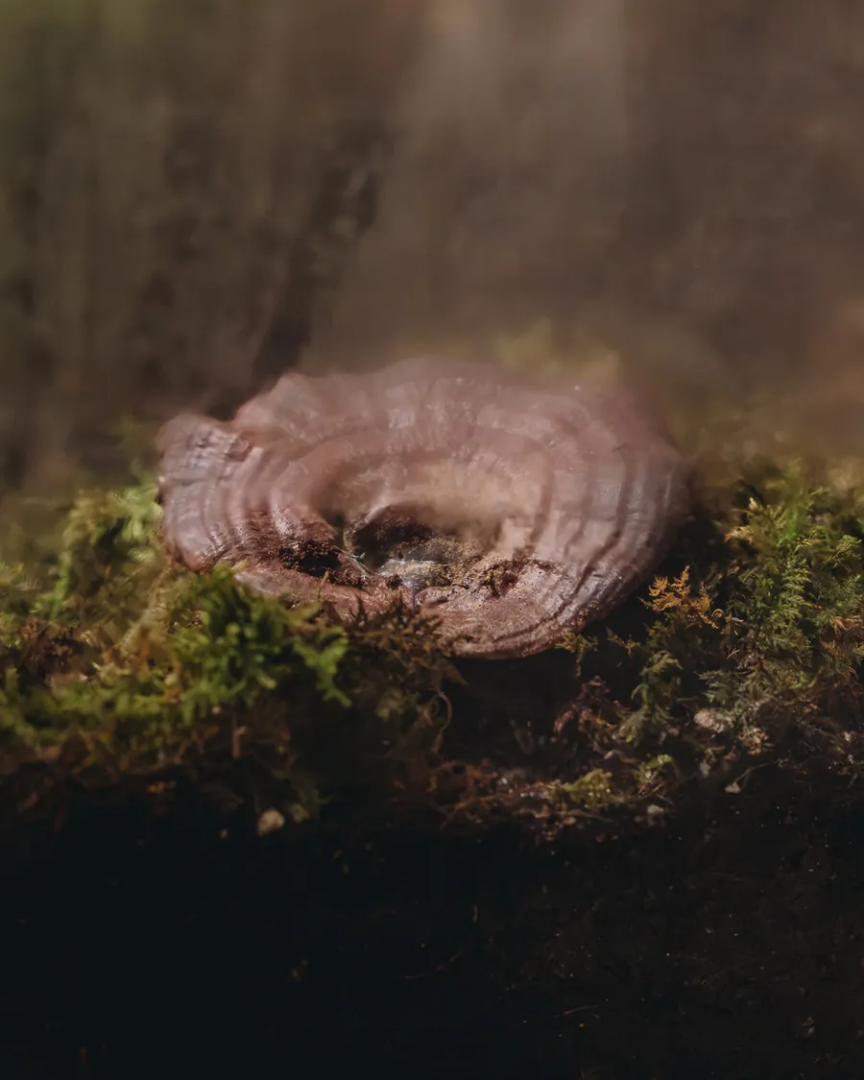
Zheng Mahler on turning their research into a living environment
Observation produced an archive. The archive became a dataset. The dataset became a model. But none of these could fully communicate the thing they were trying to study. The next step was creating a living environment. Rather than describing the relationship between fungi and AI, the goal was constructing the conditions in which both systems could coexist and respond to one another in real time. The approach has been consistent with their past works, which have often focused on both production and experience, rather than mere representation. To create conditions for raw, sensory encounters in the exhibition space.
«We wanted not only to research and describe the relationship between fungal life and AI, but to create that relationship inside the gallery itself. We’ve seen many ecologically minded works place living matter in exhibition spaces, especially plants that often die shortly after the opening. This is justified as a comment on the entropy of living systems. We wanted to approach this differently. If living organisms are brought into the gallery, their living conditions should also be considered and supported. The challenge became how to host these life forms while revealing both the fragility and complexity of the systems they inhabit. Building the technological infrastructure required to do this revealed the similarities between biological and digital networks, but not only. It showed the ways in which they continuously respond to one another.»
Creating the conditions for growth means making room for unpredictability
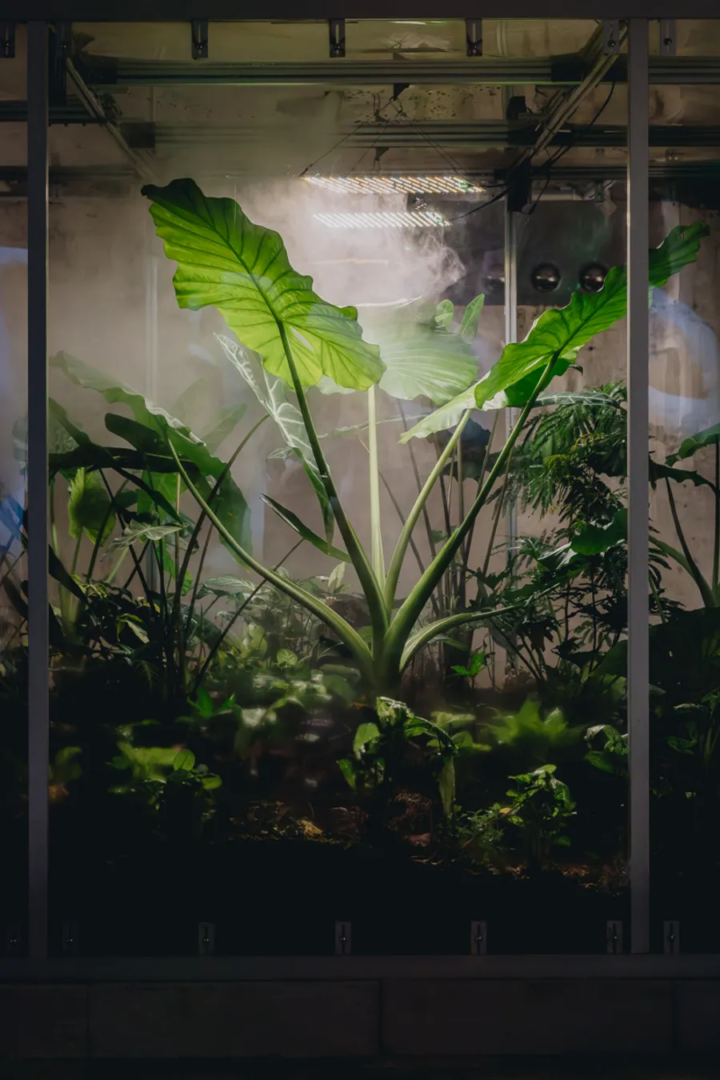
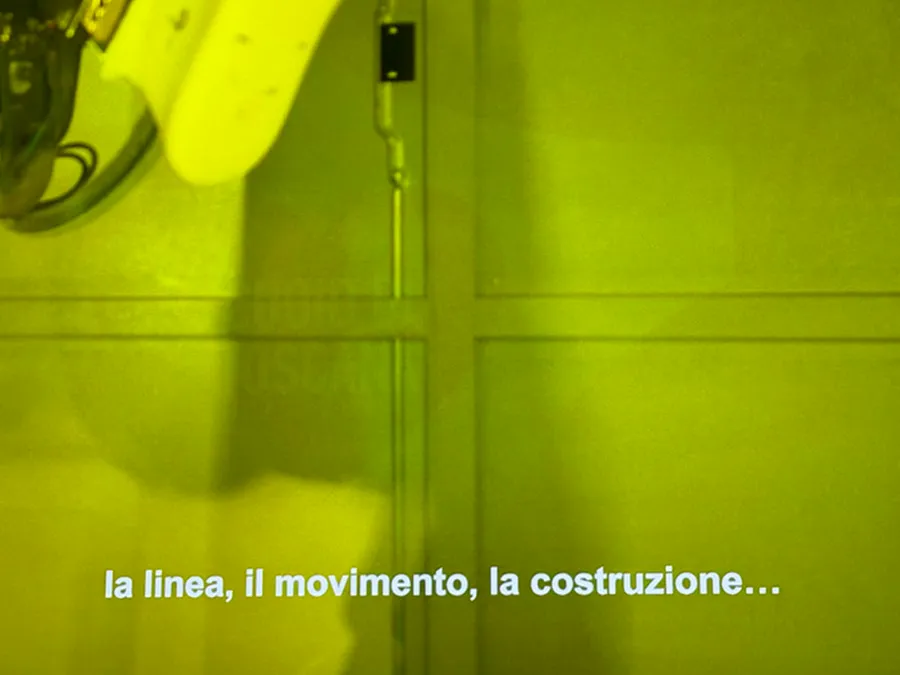
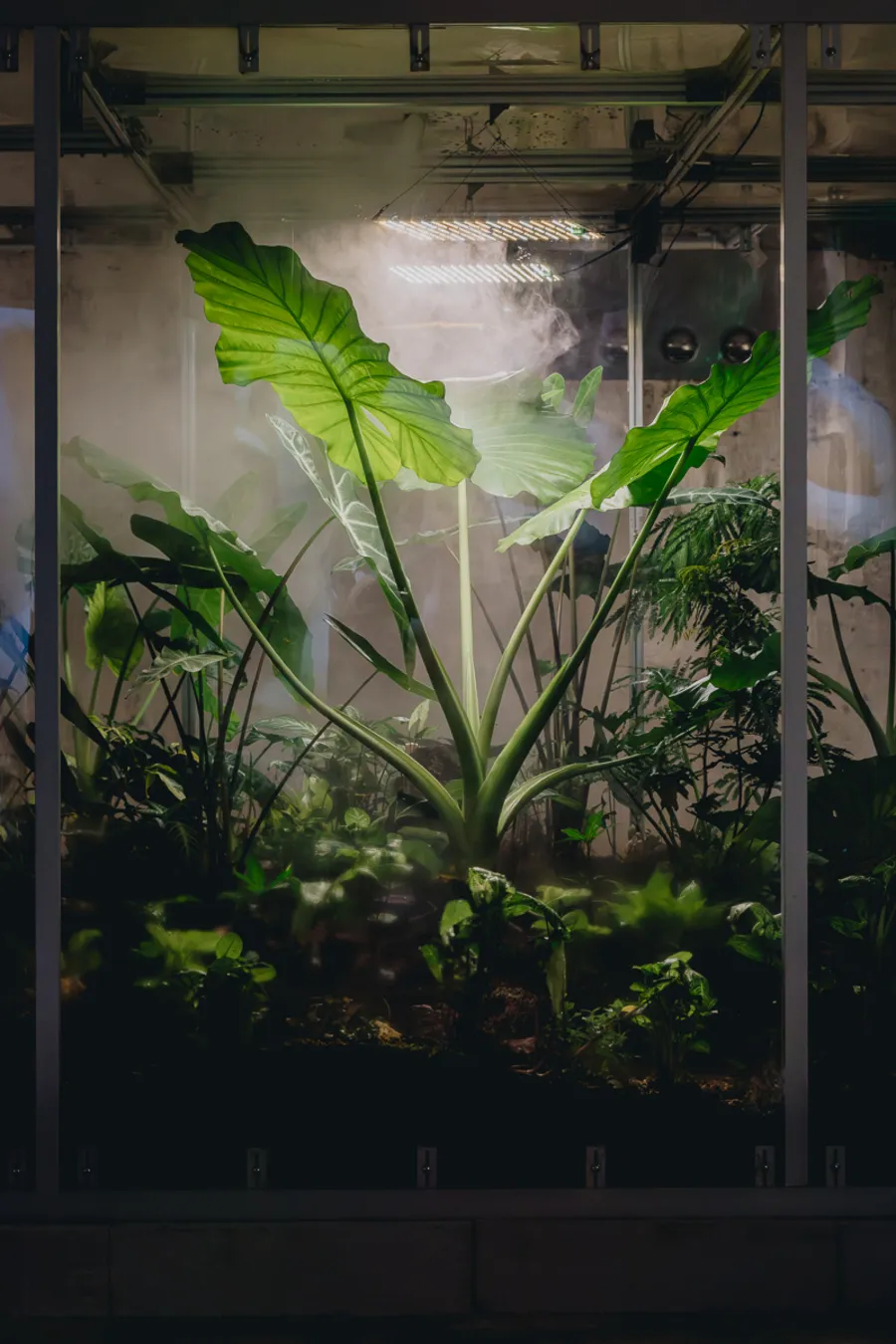
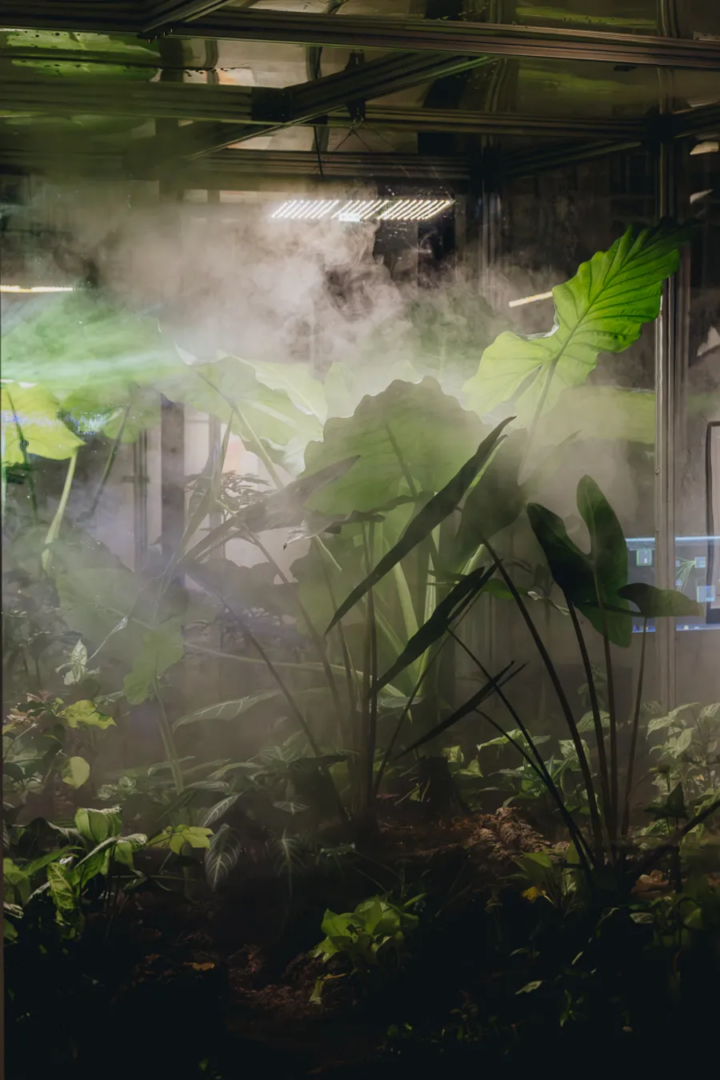
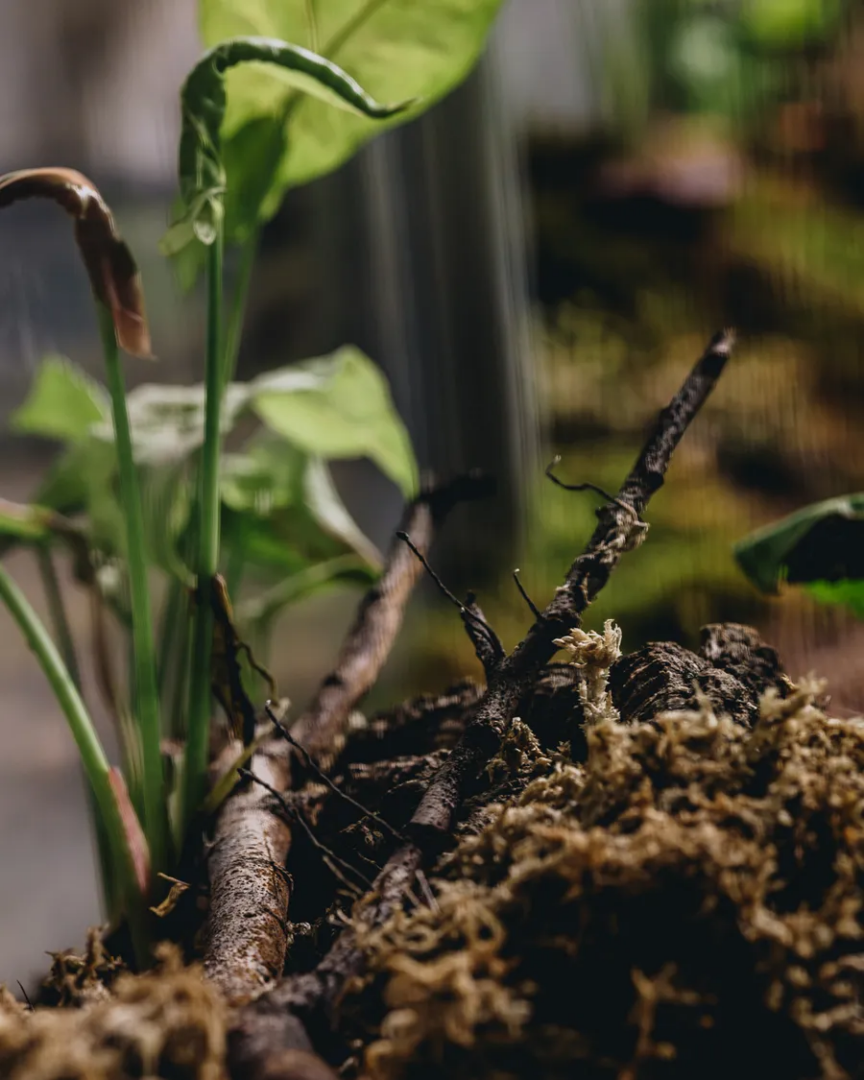
Nothing inside the vivarium exists purely for display. Every component performs at least two functions at once. Fog maintains the humidity required for fungi and plants to survive, while simultaneously acting as a projection surface for AI-generated mushrooms. Sensors monitor temperature and moisture levels, but also feed environmental data back into the model. This then influences the fungal forms it generates. Rather than separating biology, technology, and aesthetics, Zheng Mahler folds them into the same system. The result is a self-sustaining feedback loop in which fungi, data, light, humidity, and machine-generated imagery continuously respond to one another.
«The potential success of a vivarium at this scale was unpredictable. We were fortunate that the fungi and plants responded positively to the conditions we created, and that the volumetric fog display worked from the beginning. But as time passed, external factors began shaping the system in ways we couldn’t anticipate.
One of the most unexpected developments was the arrival of other life forms. Snails, slugs, ants, flies, mosquitoes, spiders, and even a grasshopper gradually appeared inside the vivarium. We have no idea where most of them came from. They weren’t there in the beginning. Now the space is thriving with its own ecosystem, while dead fungi and leaf matter are recycled by the slugs and snails, creating a natural composting system.
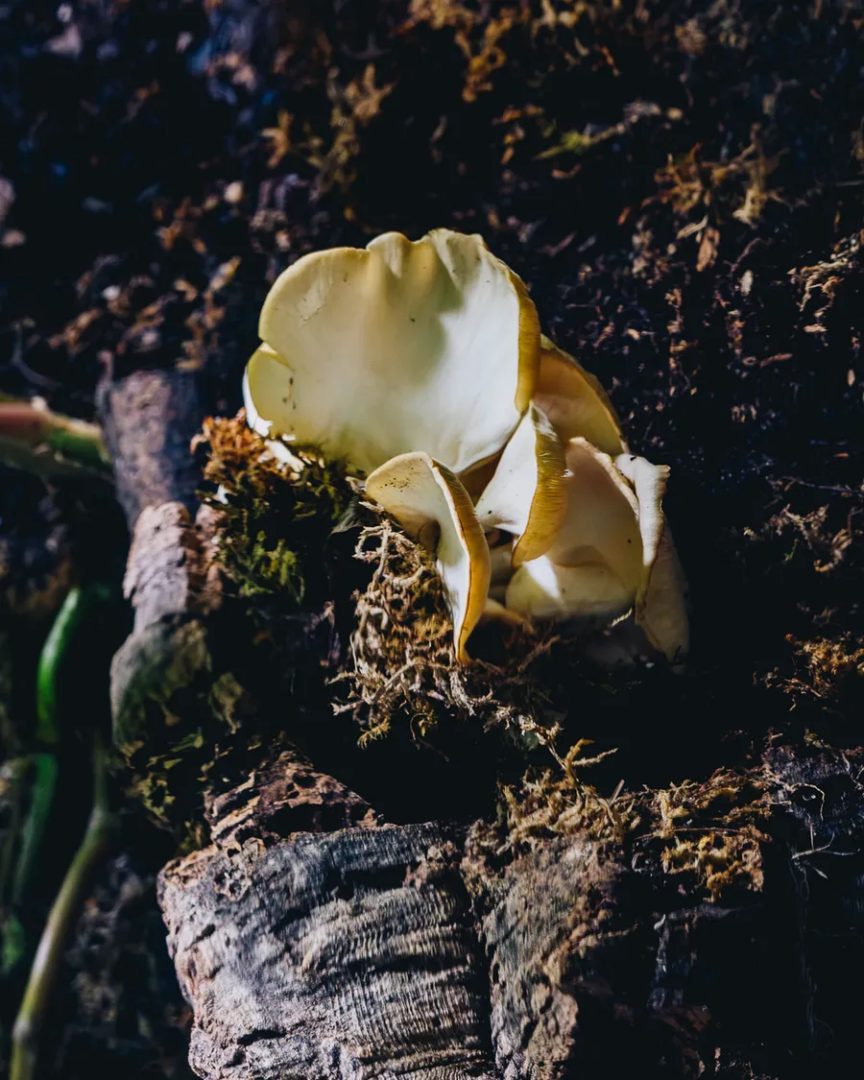
New fungal species have also emerged that we never introduced ourselves, including Pluteus leoninus, or lion shield mushroom, which we had previously documented on Lantau. Somehow the spores found their way in, waited for the right conditions, and eventually fruited on their own.»
The design of the vivarium used many of the materials which were already in the gallery, PHD Group owned by Ysabelle Cheung. Some of them were sourced locally in the neighborhood of Wan Chai, including concrete bricks and aluminum extrusion. The whole installation was adapted to the space itself, building on from the mirrored double doorway of the gallery which performed as the main entrance to the vivarium, with the vivarium structurally emerging like a mushroom from the wall.
Cultivation mattered more than control
The project repeatedly returns to the same question: what happens when the role of the artist shifts from producing outcomes to maintaining conditions? Throughout Mushroom Clouds, cultivation appears as both a biological and technological process. Fungi require care. Datasets require care. Even the exhibition itself depends on continuous maintenance. Control matters less than creating the conditions under which different systems can grow.
«Working with living entities like fungi requires a responsibility toward their life worlds. Images, datasets, research can easily flatten that complexity, so it became important for us to preserve their dynamism. The vivarium allows fungi to follow their own rhythms of growth and decay, while visitors encounter them at different stages of their cycles, or sometimes not at all. This reduces the expectation of spectacle and creates room for chance encounters.
The ongoing care of the vivarium, and considerations for what happens to these organisms after the exhibition ends, became essential parts of the work. Around ninety percent of fungi are still unknown to science, so the project is also a reminder that many forms of fungal life remain beyond human knowledge and control.»
Nature no longer appears alone; it arrives framed by steel, concrete, and digital code
Just when the vivarium begins to resemble a self-sustaining ecosystem, the technological infrastructure reasserts itself. LEDs flicker. Exhaust fans hum. Computers process environmental data. The exhibition never presents nature as separate from technology, but as something entangled with it.
«Perhaps the installation has something inhuman, even apocalyptic, about it: a living ecological system framed within a brutal technological infrastructure of steel, concrete, LED lights, and computers. That tension is important. This is not a typical celebration of nature that rejects technology and AI. It’s an attempt to expose the nature-culture division at the heart of technological thinking.
As artists, we are interested in breaking down that distinction and treating it for what it is: a constructed one. Technology is no less a product of nature than nature has become a tool of civilization. The two are fundamentally intertwined. The more urgent question is not whether technology belongs in nature, but whether we can create technological systems that serve something beyond human interests.»
What happens when we stop treating humans as the measure of all intelligence?
«One of the central questions that emerged from this project was not whether fungi and AI are similar, but how the metaphors we use shape the technologies we build. If we continue speaking about AI through human metaphors, through ideas of consciousness, intelligence, or alignment with human values, then all of the anthropocentrism embedded in those concepts is carried into the system itself.»
What this exhibition proposes instead is fungi as an alternative metaphor. Both fungal networks and AI systems require cultivation. Both depend on the quality of their substrates. Both produce outcomes that emerge from relationships rather than isolated acts of creation. Thinking through fungi opens up a different way of imagining what AI could become.
«That remains the biggest unknown for us. We don’t know how AI will evolve. Perhaps the role of artists is not to predict that future, but to offer alternative models through which it can be imagined.»
Susanna Galstyan