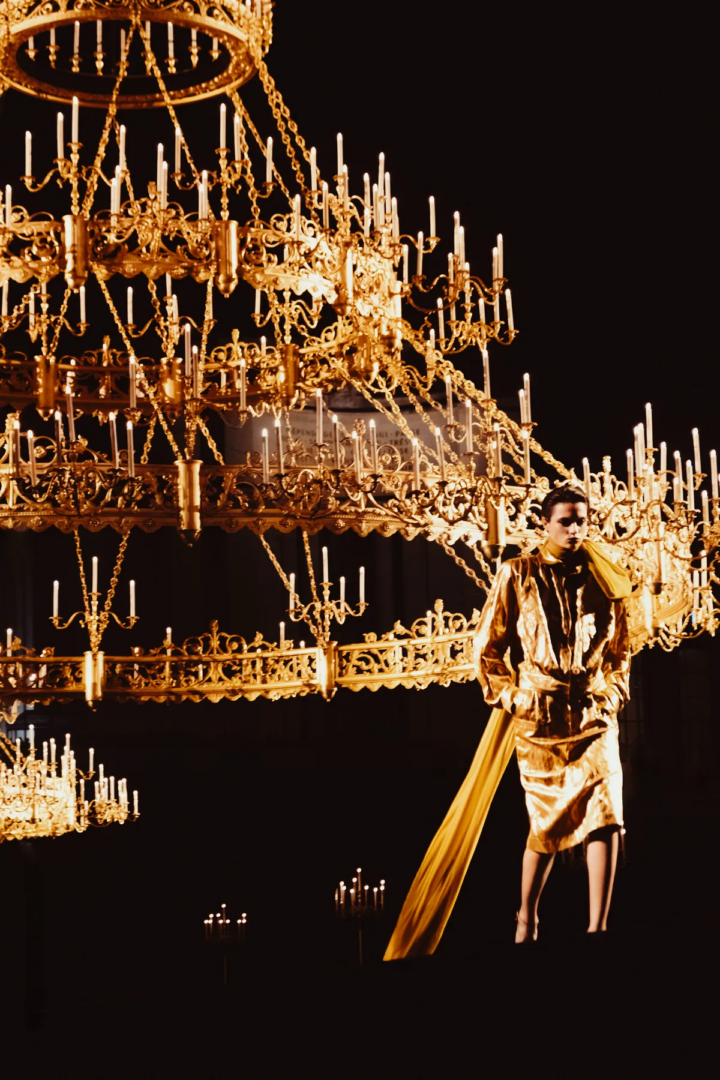
Saint Laurent SS27: gold leaf on latex, forty-nine gilded looks
Gold leaf on latex, black velvet for a finale, and a good-luck charm for the next generation: Anthony Vaccarello’s tenth year at Saint Laurent
At the end of a show drawn from Yves Saint Laurent’s archive, Anthony Vaccarello handed a good-luck charm to the next generation: his five-year-old son, Luca.
It is his tenth year at the house. Vaccarello has built a vocabulary of sheer fabrics, structured shoulders, tuxedos and metallics.
The gold comes from the archive. At 5 avenue Marceau, a short walk east, Yves Saint Laurent ran his couture house from 1974 to 2002; the building is now his museum. In his collections gold ran through brocade, lamé, lace and sequined leather, and it punctuated black on buttons, belts and chains. Vaccarello took it off the evening gown and put it on rubber, on the trench coat and on the saharienne.
The good-luck charm: what Anthony Vaccarello handed to his son Luca
Charlotte Gainsbourg had just sung on the runway; Vaccarello embraced her, the audience stood, and the two walked hand in hand along the line of models. He then left the runway, took the charm from his pocket, gave it to Luca and kissed him.
Luca is the son of Vaccarello and his husband, Arnaud Michaux, a designer who works with him in the Saint Laurent studio.
Good-luck charms have a history at the house. For his first collection, in 1962, Yves Saint Laurent had the jeweller Roger Scemama make an asymmetrical heart in red stones and pearls. He kept it as his talisman, and season after season it went down the runway on a model of his choosing, until his final show in 2002. Vaccarello has used it too, as a necklace worn down the back to close one of his own shows.
Gold leaf on latex: metal laid over the cloth, not woven into it
Most metallic cloth keeps its metal in the yarn. Lamé weaves flat metal strips into the weft; lurex is cut from aluminium-coated film. The metal is part of the structure, and it bends when the cloth bends.
Gold leaf works the other way. Goldbeaters hammer the metal to about one ten-thousandth of a millimetre, a thickness at which it has no strength of its own. It needs an adhesive, called size, and a surface to sit on: traditionally wood, plaster, parchment or leather, all of them still.
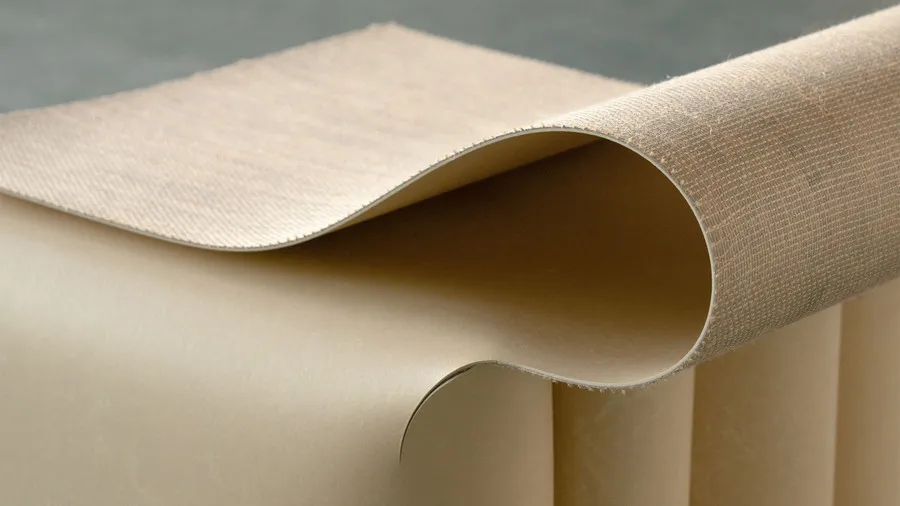
Latex moves. It is a sheet of natural rubber that extends with the body and returns. A leaf laid on it holds while the rubber is still, and splits along the lines of movement under tension. On the runway, gilded latex reads as a hard shell over a soft membrane, and the cracks are part of the finish.
Gilt leather and surihaku: the precedents for gold on cloth
The technique has precedents. In Japan, surihaku pressed gold leaf onto silk through a paste-coated stencil, used on kosode and Noh costumes in the Momoyama period, with the silk keeping its drape underneath. In Europe, gilt leather covered walls and chairs from the sixteenth to the eighteenth century: makers in Spain and the Low Countries laid silver leaf on tanned hide, varnished it yellow to pass for gold, then embossed it. Both treat the metal as a skin over a support that stays still. Latex moves, and it sits directly on the body.
Guipure, brocade, organza: four ways of handling light
The gold sequence changed method from look to look while the silhouettes repeated.
Guipure is lace with the net removed: the motifs connect through small bars instead of a mesh, and today most of it is embroidered onto a base that is then dissolved. In gold, on sheer dresses, it leaves skin visible between the motifs. Where latex carries gold on a continuous skin, guipure carries it along a network of lines.
Brocade and jacquard bring relief from the weave itself, with an extra weft floating over the ground to raise the motif. Gilded, the raised faces catch the light and the recesses stay dark. The depth is built into the cloth.
Organza, chiffon and silk mousseline, the last in amber and cognac, ran between the gilded looks. They let light through instead of sending it back. A chiffon look moves with the air around it; a gold-leafed latex look moves with the body alone.
The trench, the saharienne and Le Smoking: Yves Saint Laurent’s archive
The choice of garments to gild follows the house’s own history. Saint Laurent showed his first trench coat in 1962, the year he opened his house. He kept the raglan sleeves, the double row of buttons and the belt of the British officer’s coat, and shortened it to follow the body. The saharienne arrived in 1968 from the safari bush jacket, laced at the front over bare skin in Franco Rubartelli’s photographs of Veruschka. Le Smoking, the tuxedo for women, dates from 1966, the same period in which he began working with transparency.
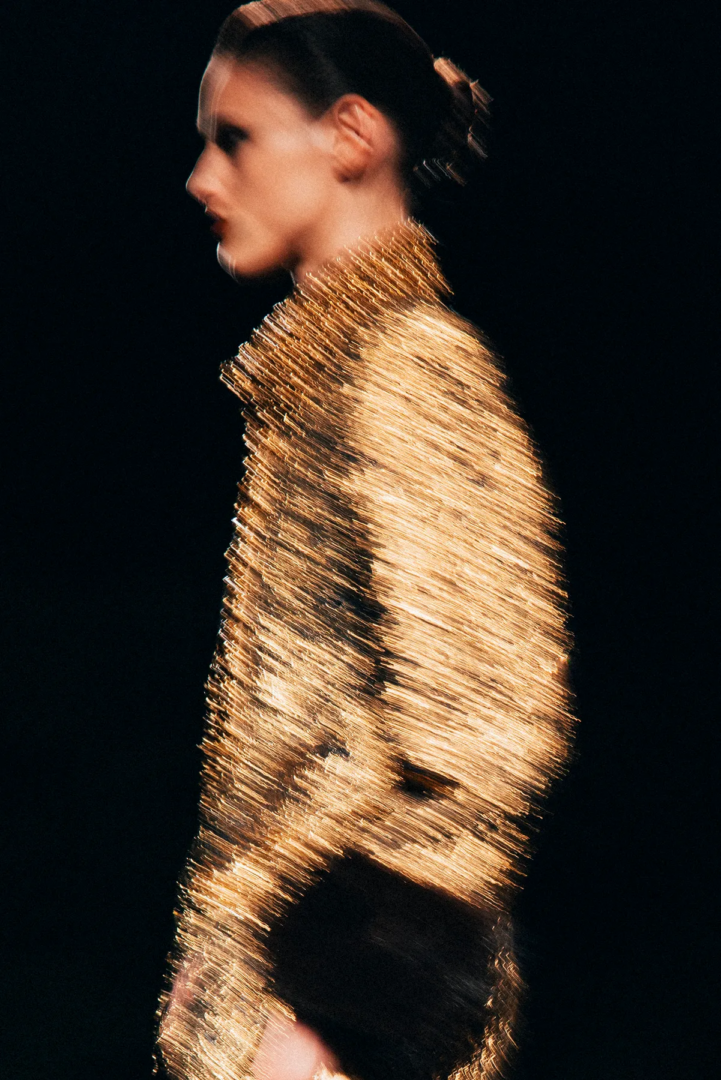
All three return here. The trench keeps its epaulettes, belt and storm flap, and changes job: from keeping rain out to sending light back. The saharienne is cinched at the waist and extended with trailing skirts. Cotton drill is built to absorb dust and light; gilded, it returns it.
In the founder’s work, heavy gold belonged to evening and to couture. For spring/summer 1988 the house showed a jacket in homage to Van Gogh’s sunflowers, embroidered by Maison Lesage on yellow organza with sequins, glass beads and pearls: an estimated six hundred hours by hand, four known examples, one sold at auction in 2019 for 382,000 euros. Here trench coats, sahariennes, wrap skirts and pencil skirts take the finishes of the salon.
Saint Laurent SS27 accessories: filigree earrings, chain heels, jewelled buttons
Laetitia Crahay designed filigree earrings, openwork built from fine wire twisted, bent into scrolls and soldered to a frame. The structure answers the gold guipure: one is thread coated in gold, the other gold drawn into thread. Loulou de La Falaise designed jewellery for the house from 1972, at the same large scale.
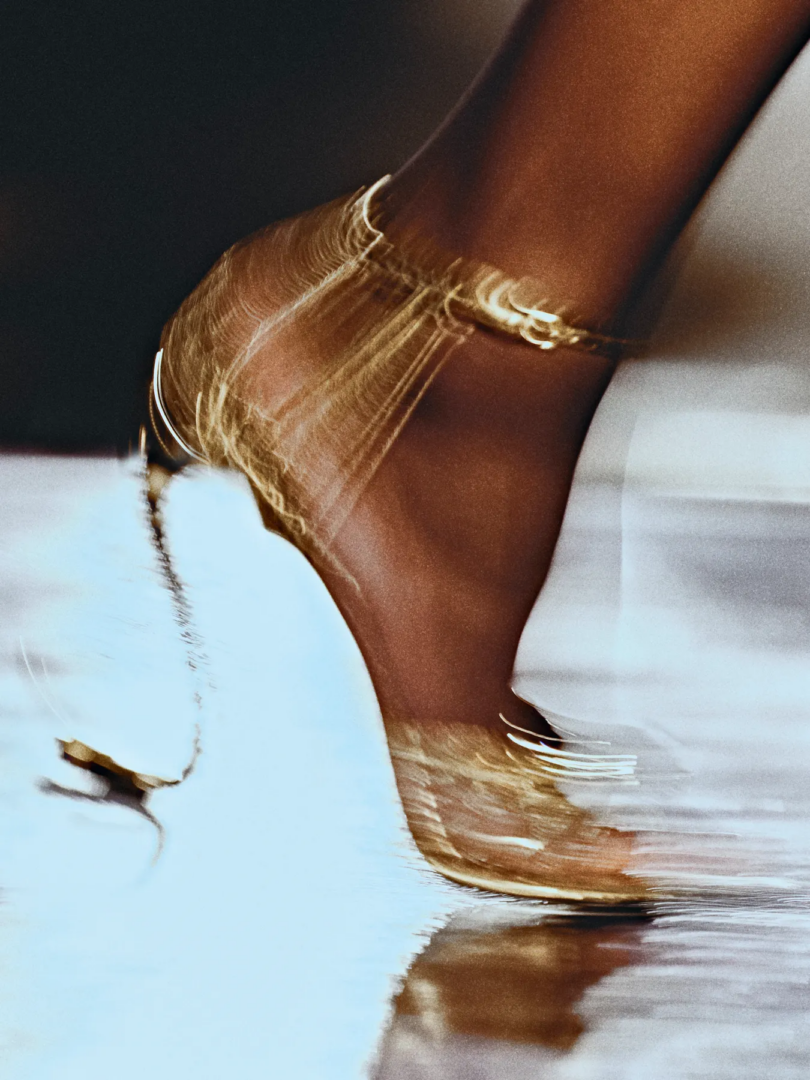
Corrado De Biase designed the shoes, some built from gilded metal chain on heels shaped as twisting snakes. Models wore jewelled turbans and scarves in red, black and ochre, and the tailoring carried jewelled buttons and sash belts.
Where the gold started: the June menswear show
The gold started in June. At the menswear show, at the Bourse de Commerce, forty looks ran in blacks, beiges and browns, and gold appeared at the end, on trench coats and ribbed knits. One trench was cut in gold-leaf faille, a ribbed silk. Three months later the same finish covered forty-nine women’s looks.
Look fifty: the black velvet finale and Charlotte Gainsbourg
The sequence breaks at look fifty, a black velvet suit with jewelled buttons. Nine black looks follow: double-breasted velvet tunics over skirts slit to the thigh, then gowns with billowing sleeves, trains and black tulle. Velvet is a pile fabric, and its cut fibres trap light between them. It absorbs most of what reaches it, while gold leaf returns most of it.
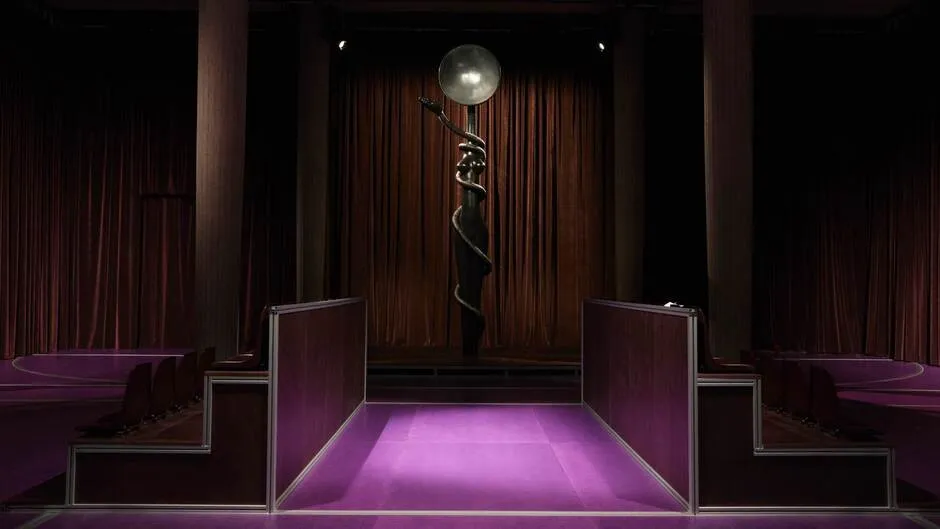
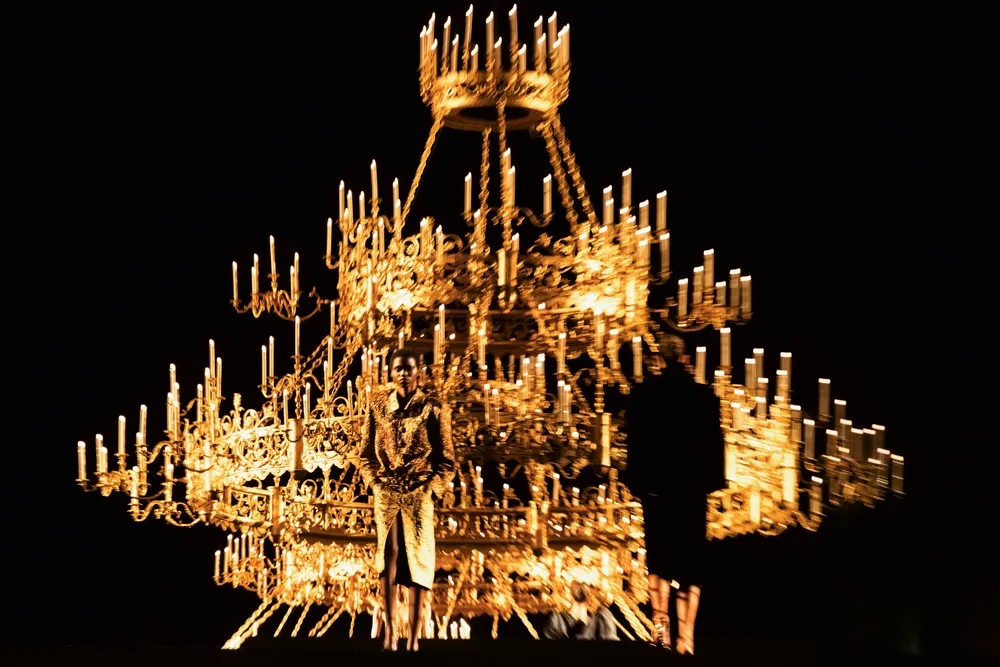
Then came an unannounced performance. Charlotte Gainsbourg sang in black suiting, the chorus naming the founder. Guests had arrived to Miles Davis’s score for Ascenseur pour l’échafaud, recorded in Paris in 1957, under chandeliers modelled on the ballroom of the Hôtel InterContinental, where Saint Laurent began showing couture in 1976.
Melis Ozek