Dior SS27: from wénwán walnuts to the work on material
Jonathan Anderson starts from two walnuts to work on asymmetry: double-breasted blazers in chiffon, irregular pleating, petals cut by hand one at a time, and the 1952 La Cigale dress remade in tulle
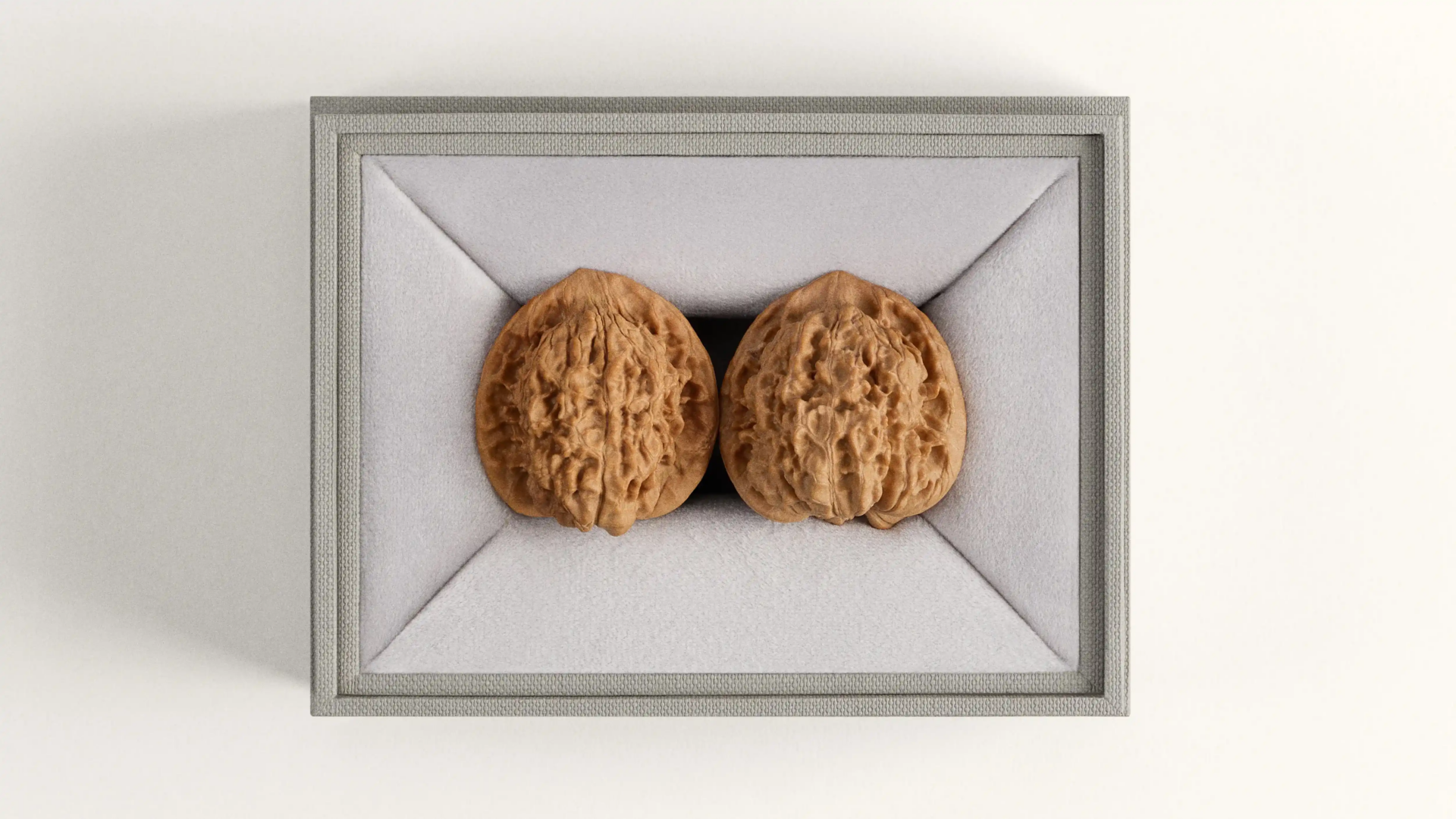
Two walnuts to turn slowly in the palm of the hand. That is the starting point of the Dior spring-summer 2027 collection, which Jonathan Anderson presented in Paris on 29 September. They are wénwán walnuts: the Chinese tradition calls for handling them over long periods, until contact and time polish the surface into a bright patina. Each walnut changes according to the use it gets.
Wénwán walnuts are used in pairs, chosen for their resemblance. Finding two identical ones is impossible: shape, size and irregularities make every example different. That unreachable symmetry is what interests Mr. Anderson, and he carries it into the construction of the clothes. The material changes through a process made of time, knowledge and repetition, and its natural features stay visible.
The reference to nature belongs to the history of Dior. Christian Dior built part of his language on the observation of flowers, translating their forms into textile structures. The Corolle line of 1947, the one associated with the New Look, introduced full skirts, fitted bodices and a narrow waist: a silhouette that recalled a flower.
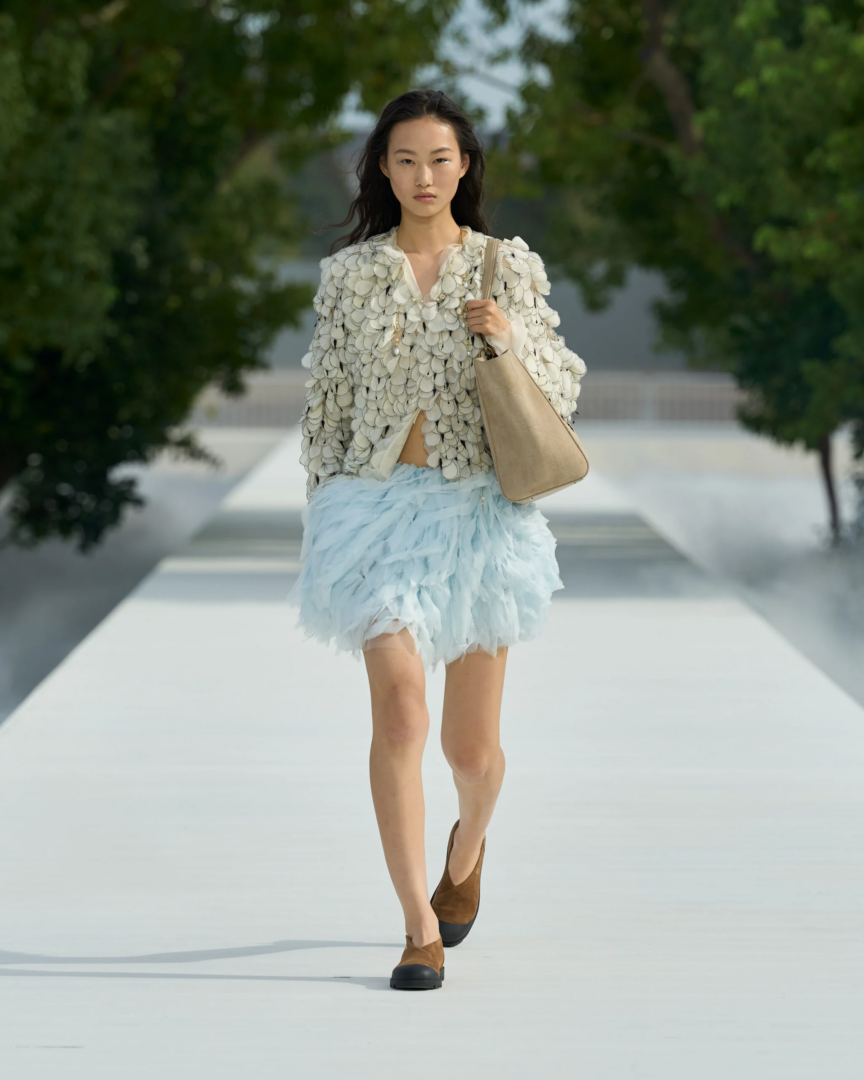
Mr. Anderson returns to that inheritance and leaves its structures aside. Nature serves him as a way to study how materials behave, the relation between symmetry and asymmetry, the movement of a garment. The lines of the tailoring soften: skirts open into irregular pleats, floral surfaces gain depth, layers play on different degrees of transparency.
Chiffon, organza and Chantilly lace: the fabrics of Dior spring-summer 2027
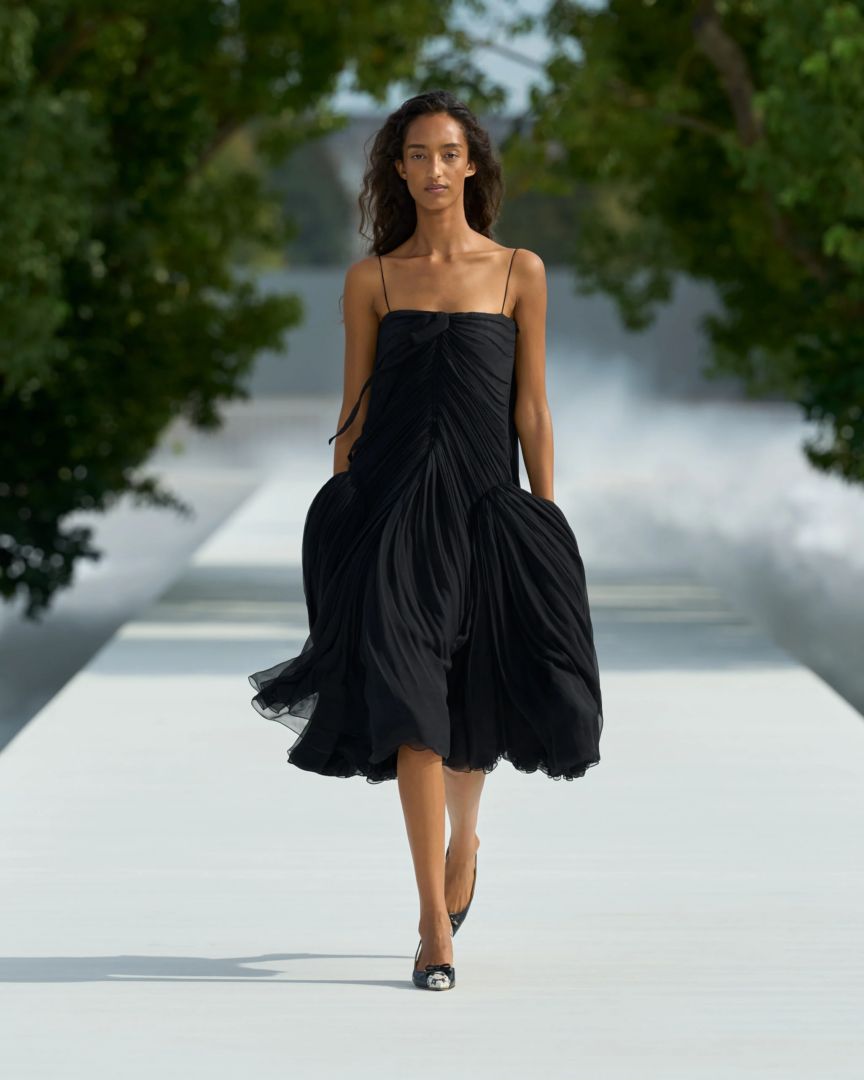
Lightness is the field of experiment this season. Mr. Anderson works on construction to change the relation between fabric and structure: to obtain defined volumes with materials that follow the body, instead of imposing a shape on it.
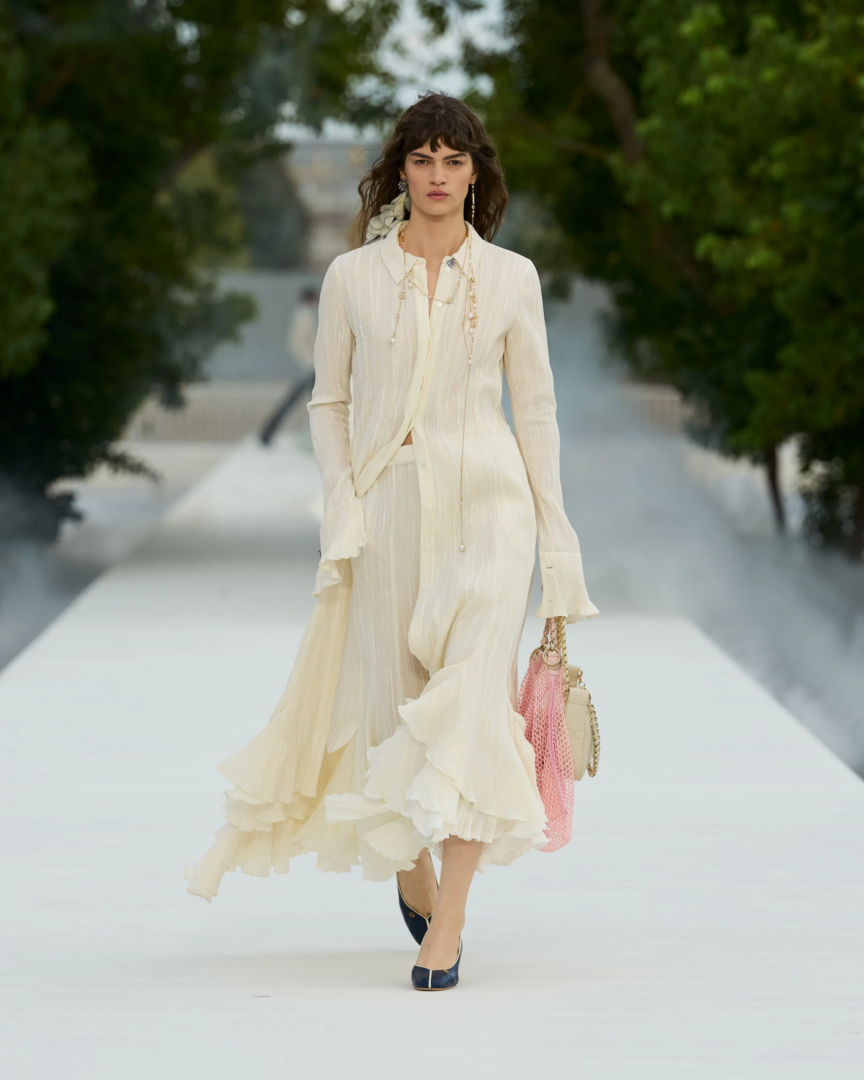
The research covers chiffon, silk mousseline, organza, tulle and Chantilly lace, together with duchesse satin and printed and pleated jacquard. Transparent fabrics and firmer materials alternate, with different techniques used to control the silhouette. The wardrobe keeps its references to Dior tailoring and changes their weight, their hand and their behaviour.
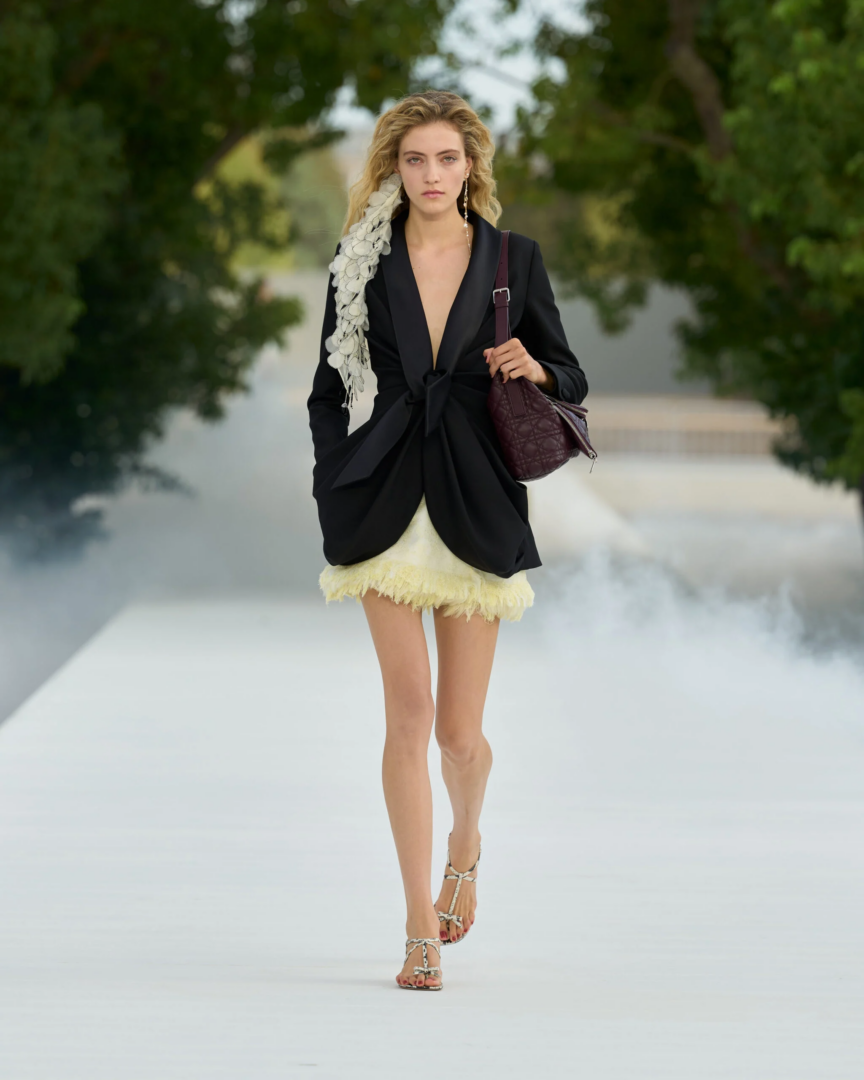
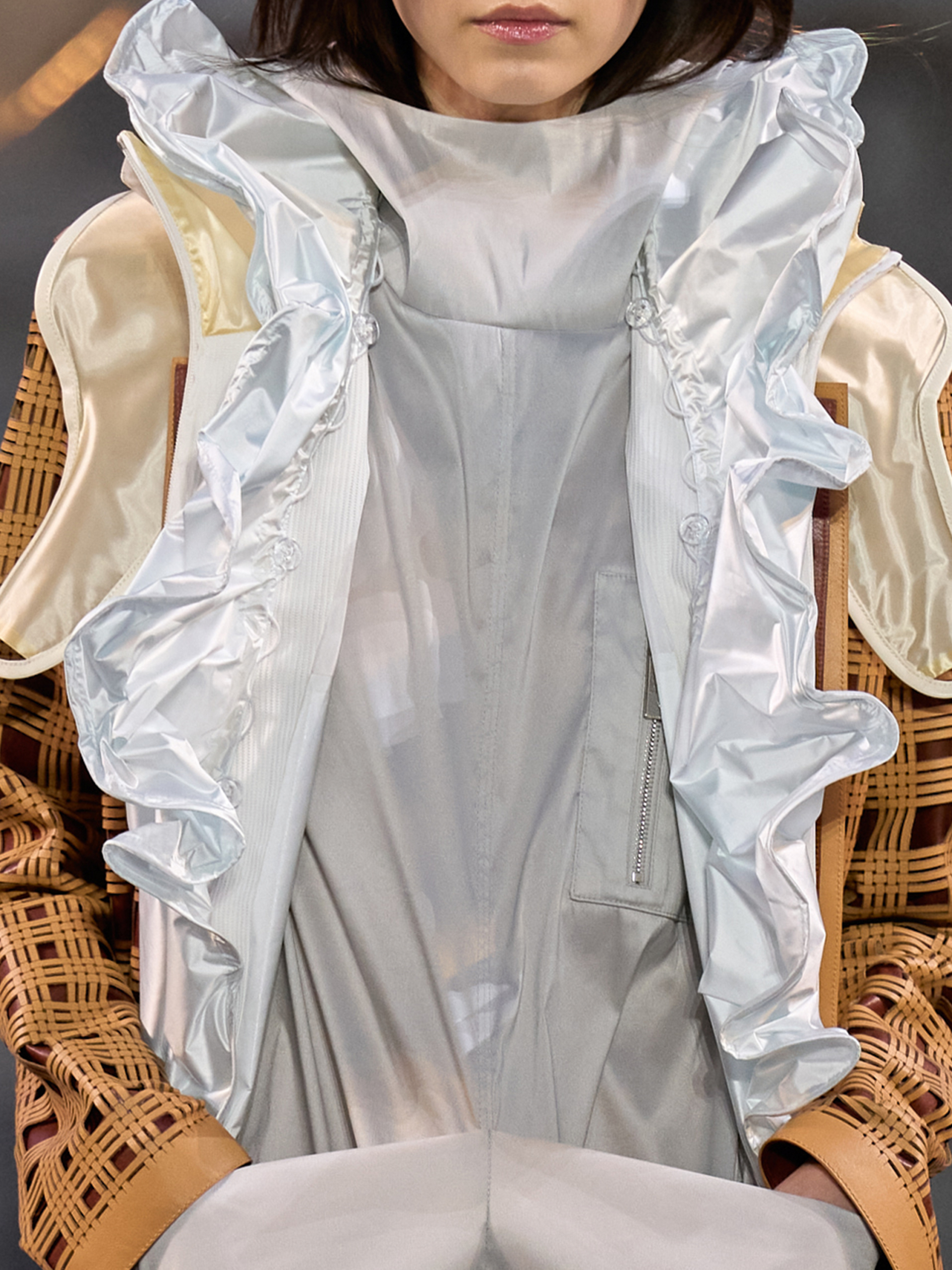
The lightening starts with the jackets. Double-breasted blazers, usually built with rigour, arrive in semi-sheer chiffon as well: lapels, fastenings and proportions stay recognisable, while the fabric changes how the garment reads. Some jackets go with striped shirts and trousers that are just as light; others with short layered skirts.
Tailoring meets the flou, the making of soft and fluid clothes. Transparent fabric puts on view what is normally hidden, and asks for attention to seams, overlaps and finishes. Lightness on show complicates the work, in order to hold proportion and volume.
In the skirts, pleating gives the surface a repeated structure and movement. In some models the pleats are asymmetric and the layers open as the wearer walks; in others, inserts of Chantilly lace enter the main fabric, alternating opaque and transparent surfaces.
Duchesse satin works as a counterpoint to the thinner fabrics: it holds firmer constructions and keeps the link with the architectural tradition of Dior. In the printed and pleated jacquard, the three-dimensional transformation of the surface is added to the design woven into it.
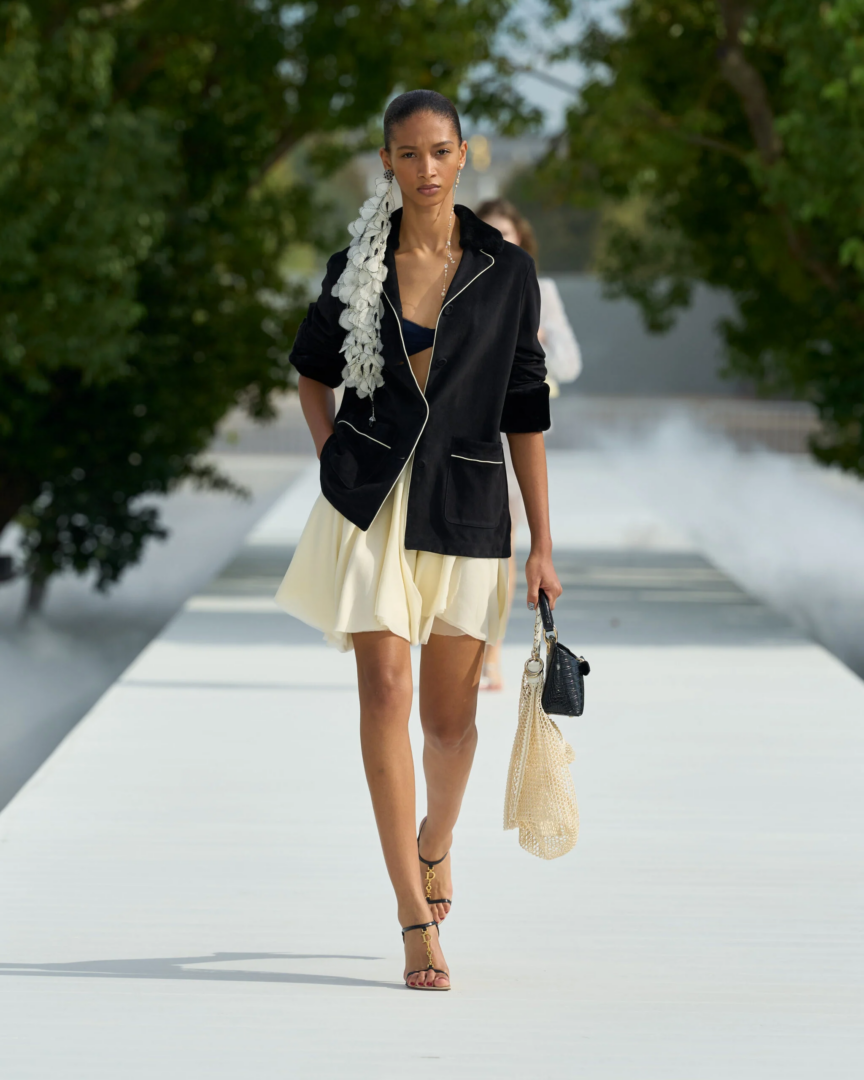
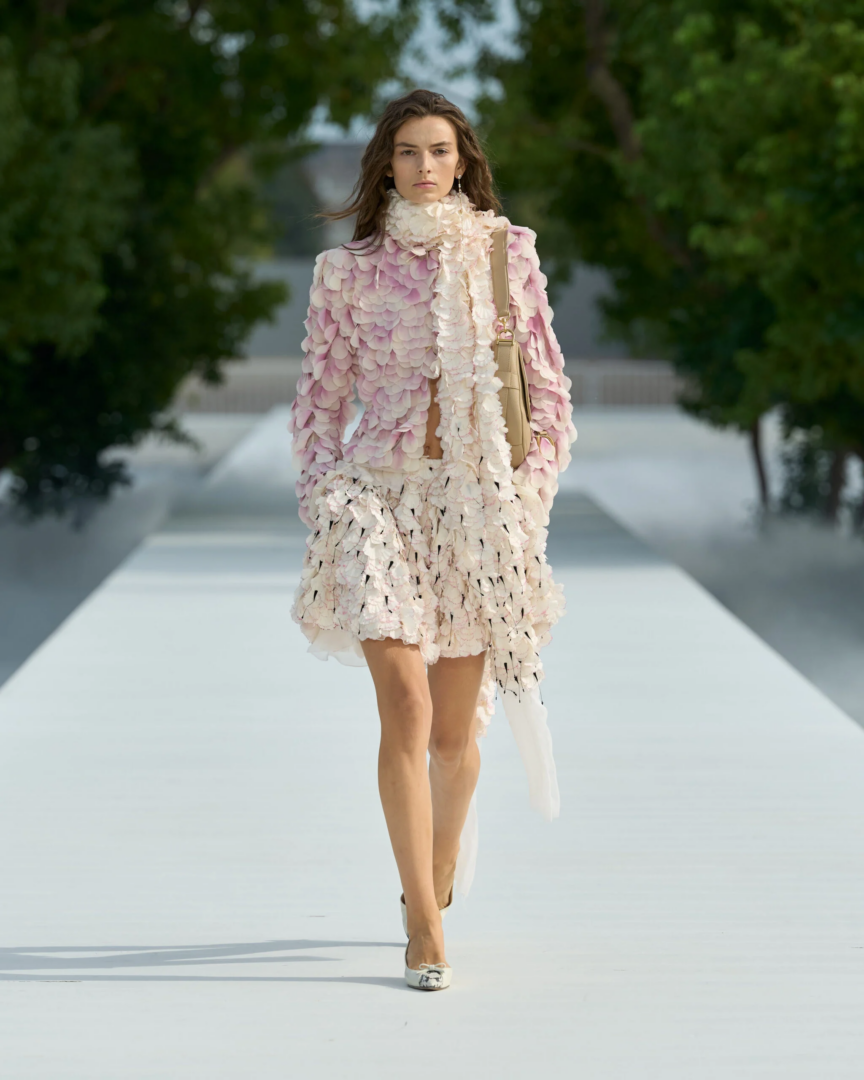
The relation with nature also passes through the floral appliqués. Jackets and miniskirts are covered in petals cut by hand one at a time: a three-dimensional surface that changes with movement. The petals become elements of construction.
The 1952 La Cigale dress and the Bar jacket: the Dior archives according to Anderson
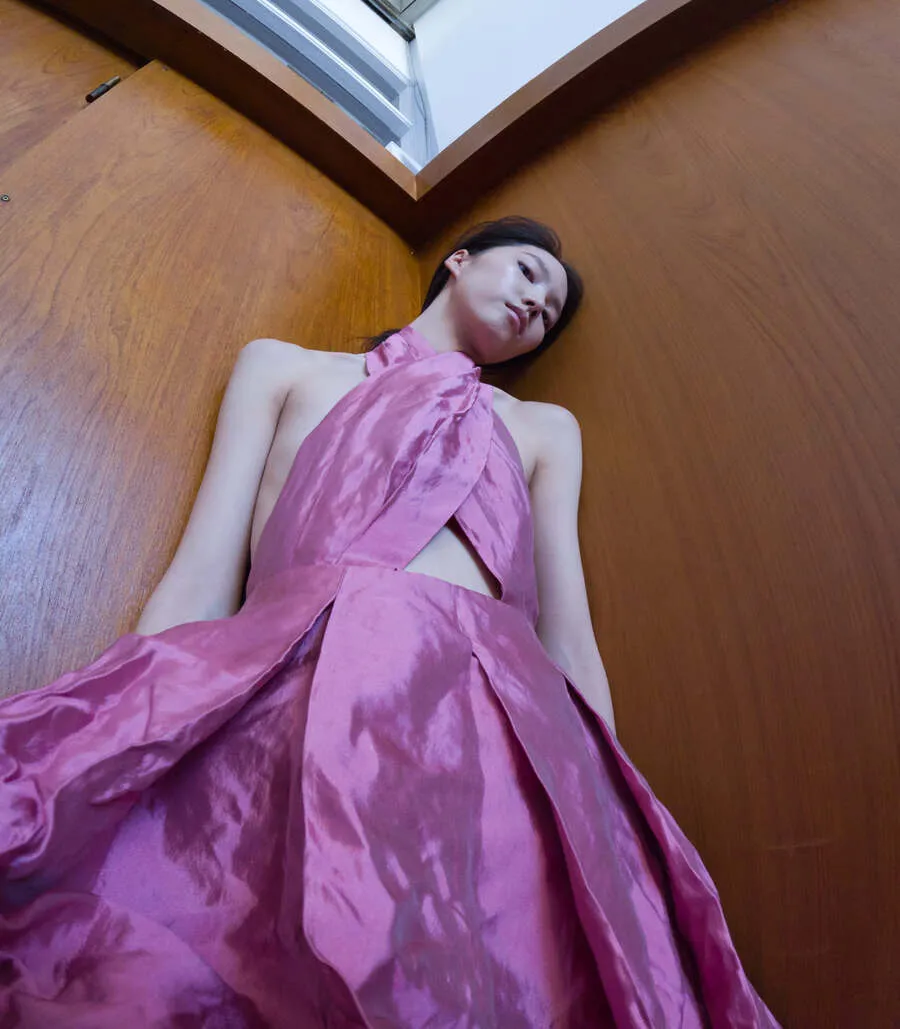
Among the references is La Cigale, a dress Christian Dior designed for autumn-winter 1952, the Profilée line: a fitted bodice and a skirt that expands at the sides, in a geometric silhouette.
An example at the Kyoto Costume Institute documents the technique. It is in grey moiré silk ottoman, with a stiff underskirt in double tulle to hold the volume: the lateral expansion depends on the internal structure, which keeps the three-dimensional shape whatever position the body takes.
Mr. Anderson transfers those proportions to a pink cocktail dress, strapless, in pleated tulle. The reference stays legible in the expansion at the hips, and the fabric changes: the volume, previously obtained with a firm material, passes to a lighter surface made of folds.
A similar transformation reaches the Bar jacket, presented by Christian Dior in 1947 as one of the elements of the New Look: narrow waist, defined shoulders, a peplum, a structure built to change the proportions of the body. Mr. Anderson softens its construction and brings everyday clothing into it: one version joins the Bar jacket to the rural barn jacket, with a corduroy collar. On one side the tailored structure that builds a silhouette, on the other a garment made for practical use.
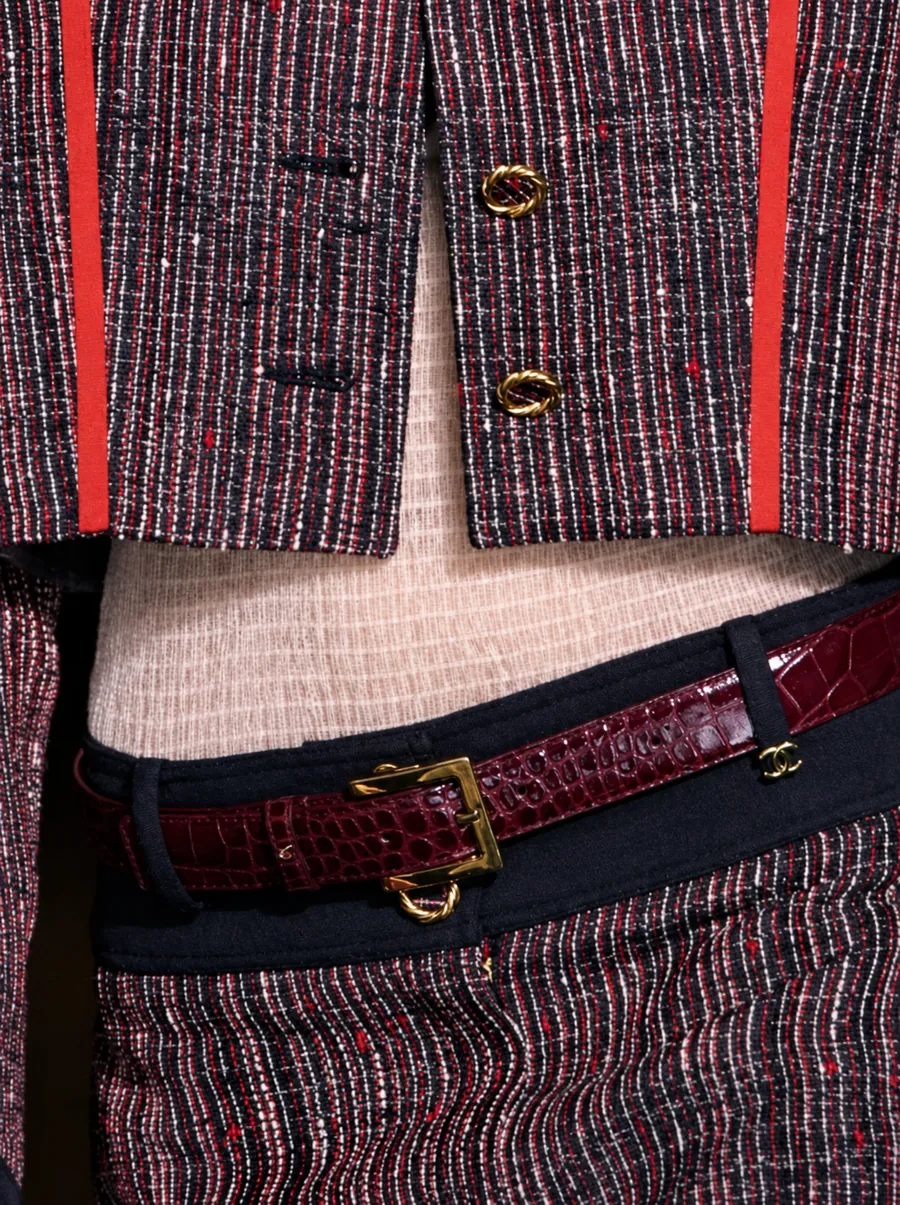
Houndstooth changes treatment too. The pattern, tied to the Dior tradition, appears on light fabrics, transparent chiffon included: it stays recognisable and loses the substance of heavy cloth, while the transparency allows it to be layered over other motifs.
The Dior SS27 silhouettes: 65 looks, short skirts and metallic trousers
The collection runs to 65 looks and works on the contrast between formal and informal. Mr. Anderson takes up voluminous short skirts, soft jackets and transparent layers, and combines them with metallic trousers, double-breasted outerwear and shirts left open or buttoned out of line.
The styling pulls shirts out of skirts and puts bras under jackets, with evening details set against tailored construction. The silhouette comes from the alternation of volumes, lengths and surfaces, and changes with the position of the body: standing still it reads as structure, while the openings and the swing of the fabric alter its profile.
Some pieces hold continuity with the men’s collection. The metallic python-effect trousers, in silver, bronze and green, go with soft jackets and more traditional outerwear; the reflective surface breaks away from the opaque and transparent fabrics in the rest of the wardrobe.
The palette holds white, black and greys, with pastels and metallic accents. Pink, pale blue and green sit alongside floral prints with a watercolour effect. Stripes, checks and houndstooth are set next to one another to break the uniformity.
Murano glass buttons, the Saddle Bag and Dior Bow sandals: accessories and details
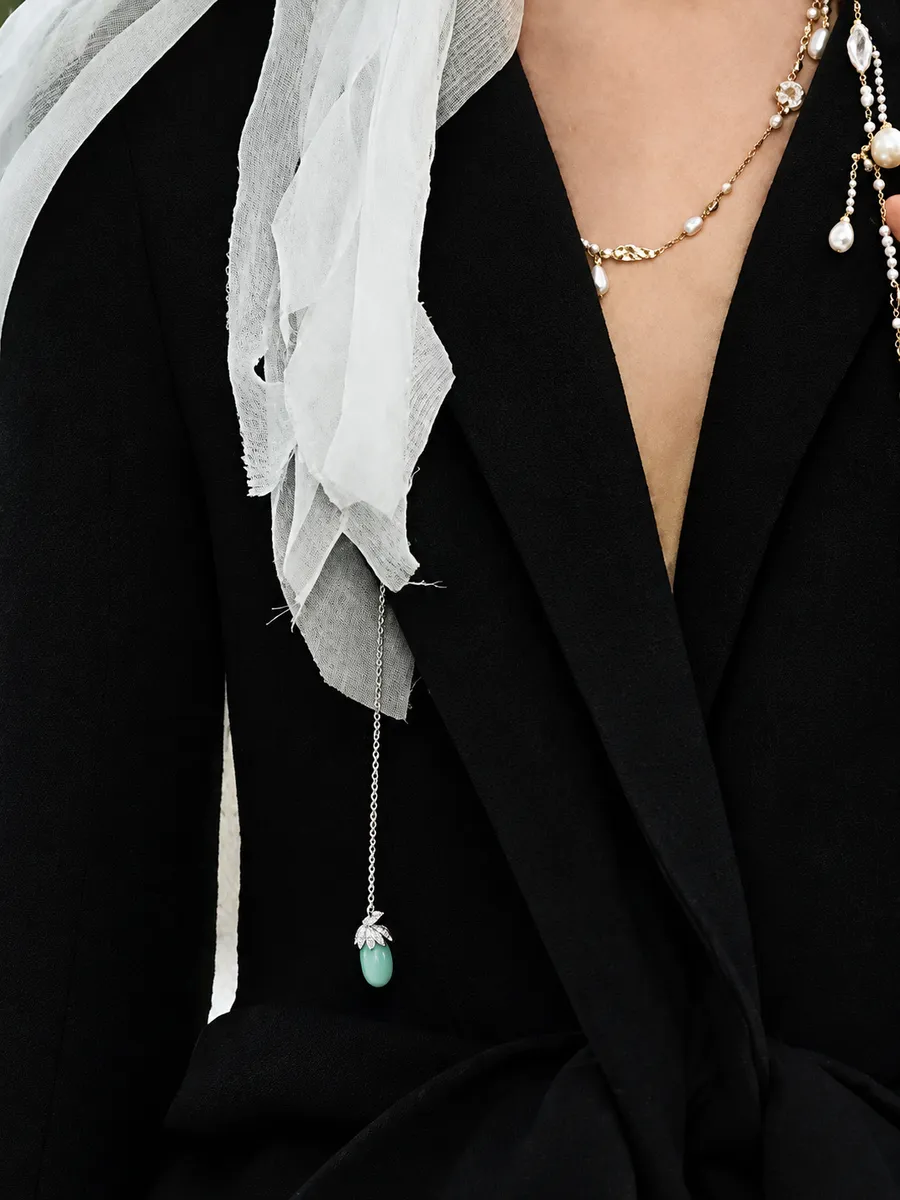
Some jackets have buttons in Murano glass; other coats hide faux-fur inserts under the lapels, visible when the collar goes up. Different materials in precise places on a garment, with changes of sheen and substance.
The wénwán walnuts return in the accessories: a silver minaudière reproduces their irregular shape. Beside it, a new bag with a motorcycle reference and zipped pockets, and the return of the Saddle Bag, the accessory of the John Galliano years. Mesh bags complete the range, with fringed silk scarves and petal appliqués in sheer georgette.
The shoes include a new version of the Dior Bow sandal, square-toed shoes with floral prints and a Dior Cigale model with a sole shaped like petals. Some sandals take up the zipped models of the Galliano period.
The Dior show at the Tuileries: camphor trees and the Bassin Octogonal
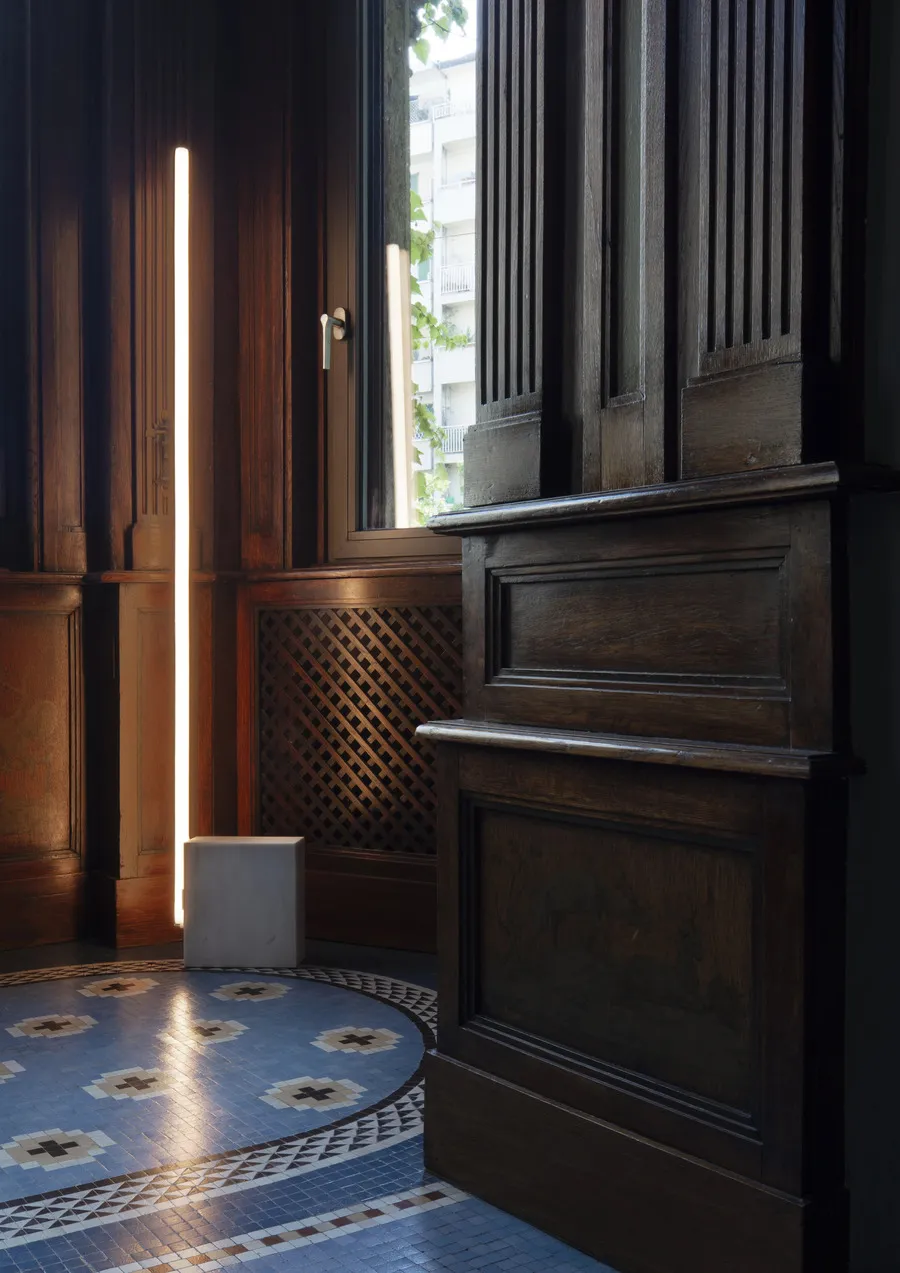
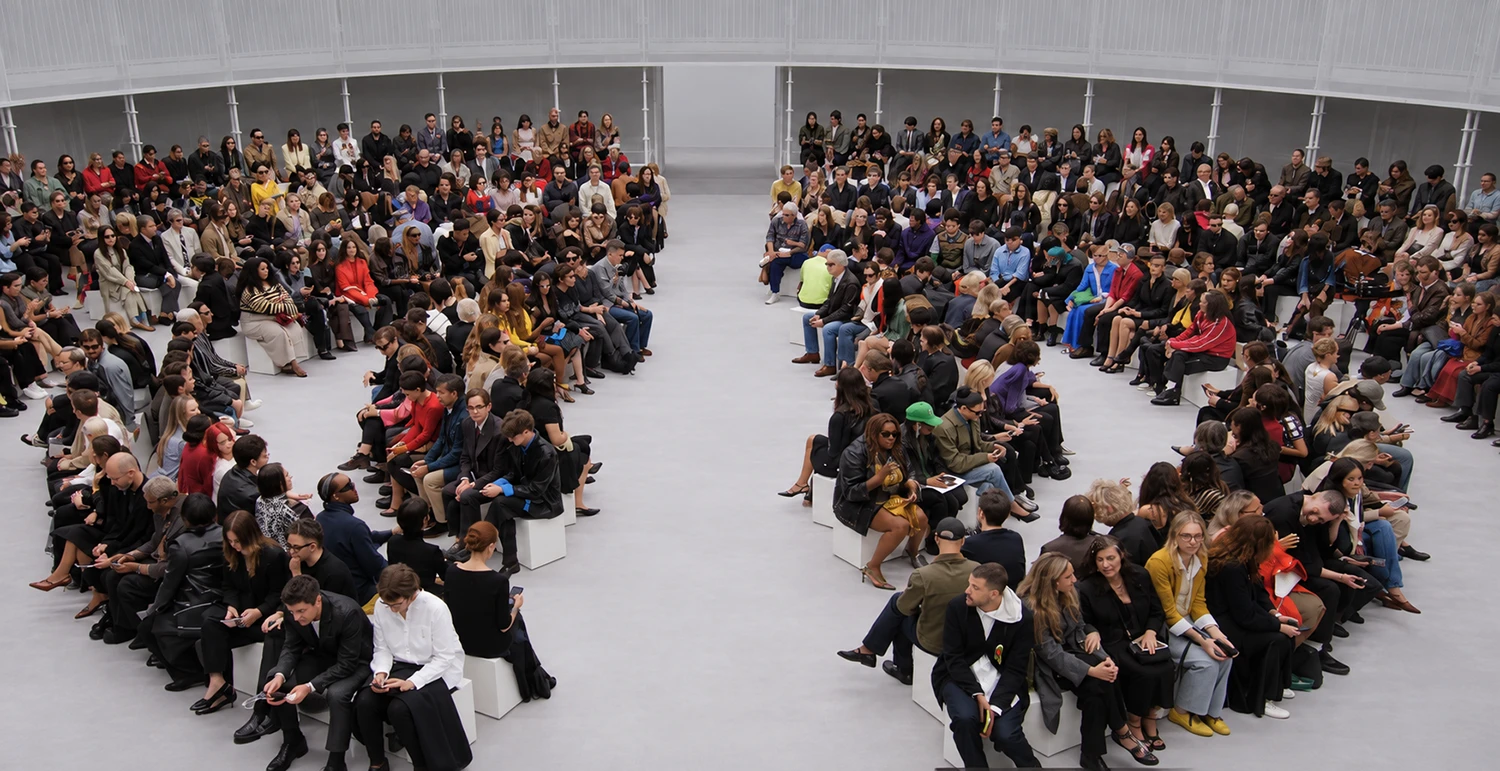
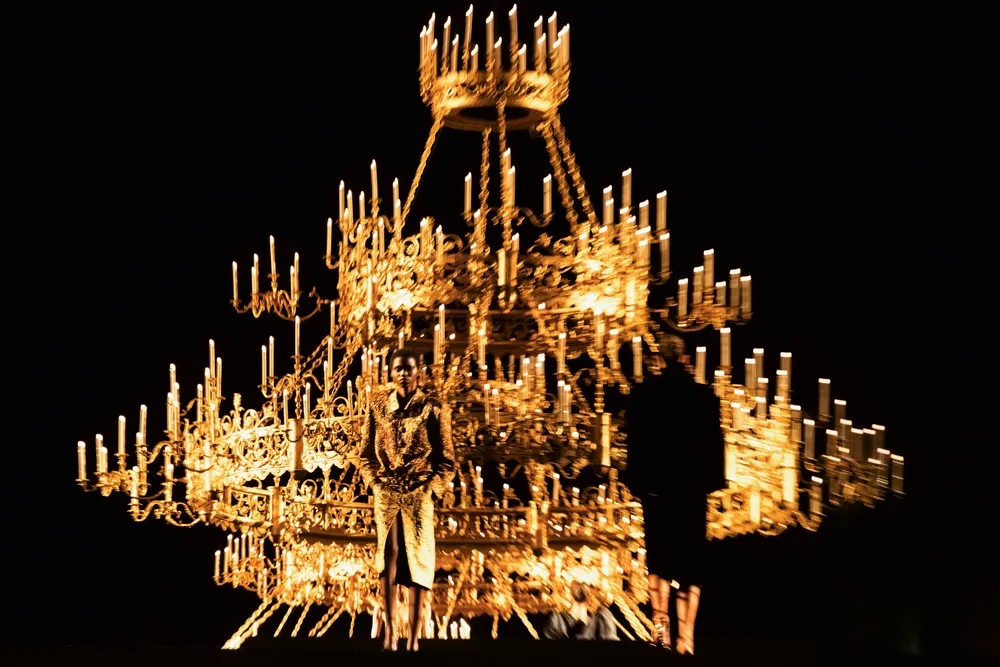
The show took place in the Jardin des Tuileries, around the Bassin Octogonal, with a runway crossing the water. Camphor trees emerged from artificial mist, among natural elements and temporary structures. The location gives continuity to the autumn-winter 2026-2027 collection, also held at the Tuileries. After the show the trees will be replanted in the gardens.
The seating comes from a historical reference as well: Mr. Anderson chose armchairs based on an eighteenth-century English model from the reign of George III, taken from his own collection.
The show is dedicated to the memory of Mathilde Favier, for years head of public relations at Dior Couture, who died in August 2026.
The Dior SS27 beauty look by Peter Philips and Guido Palau
The beauty look is by Peter Philips, creative and image director of Dior Makeup, with the hairstylist Guido Palau. Mr. Philips offers two versions of the silver eye: the first with thin elements in Mylar, the second with glitter applied at the side to build a line of light. The rest of the face stays natural, with a light base and glossy lips, for the contrast between metal and skin.
Mr. Palau works hair with an irregular texture, soft waves with a sea-water effect. Ama Quashie signs a manicure in reds and burgundies, which brings asymmetry into the combinations of colour.
Matteo Mammoli